How AI is Creating Product Videos for Small Brands Automatically in 2026
SnapReel
April 24, 2026 · 11 min read
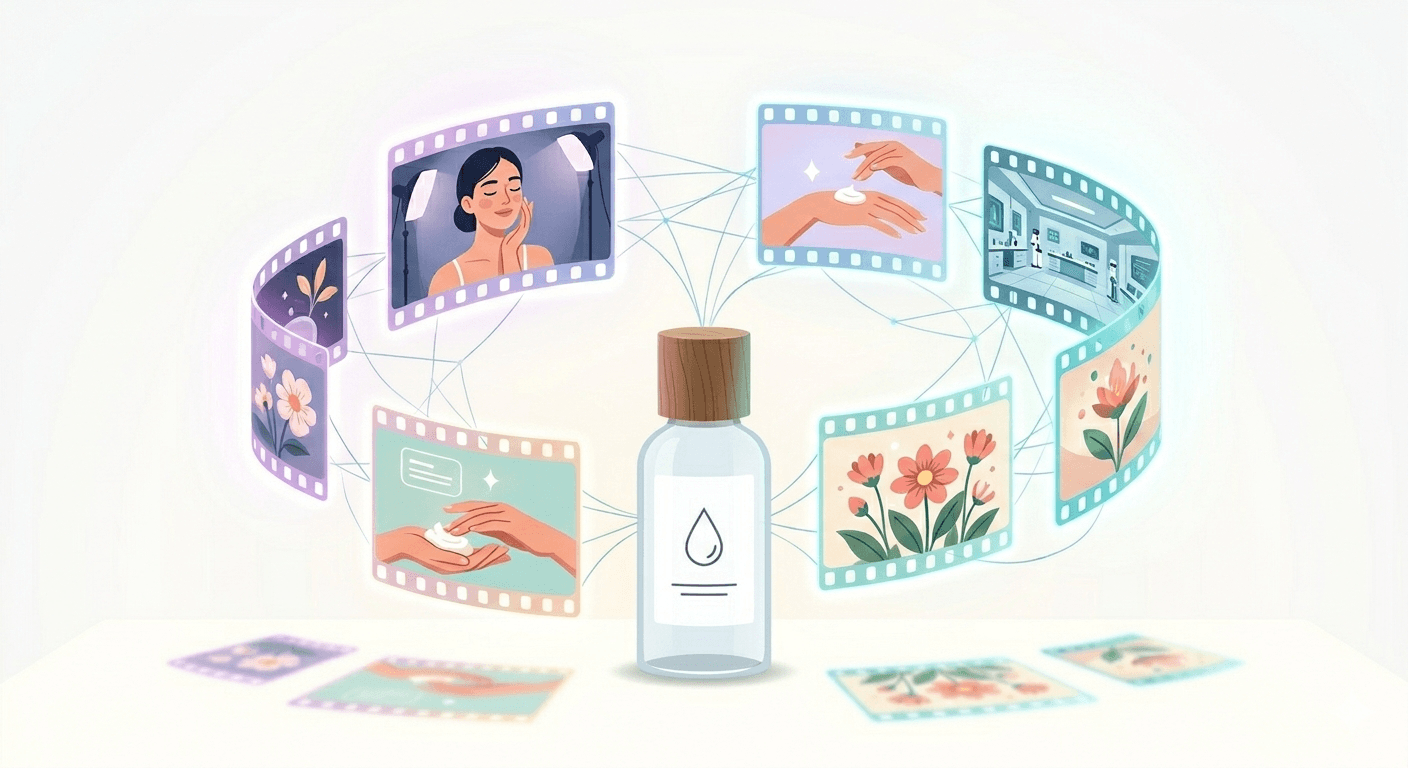
Table of Contents
- 1.
- 2.
- 3.
- 4.
- 5.
- 6.
- 7.
- 8.
A year ago, getting a professional product video made meant hiring a videographer, renting a studio, paying an editor, waiting two weeks, and spending anywhere from $1,000 to $10,000 for a single 60-second clip. For large brands with marketing budgets, that was a normal line item. For small brands, it was either unaffordable or a massive gamble.
That calculation has completely changed in 2026. AI product video generators can now produce cinematic, brand-consistent product videos automatically — from your product images and brand data — in minutes, with no camera, no crew, no editing software, and no production budget. The technology has moved from experimental to production-ready, and small brands are the biggest beneficiaries.
This article breaks down how AI video generation works, what the technology actually produces today, which tools are doing it best, and how one platform has taken it a step further by integrating fully automated product video into a complete social media management system.
The Old Way of Making Product Videos Was Broken for Small Brands
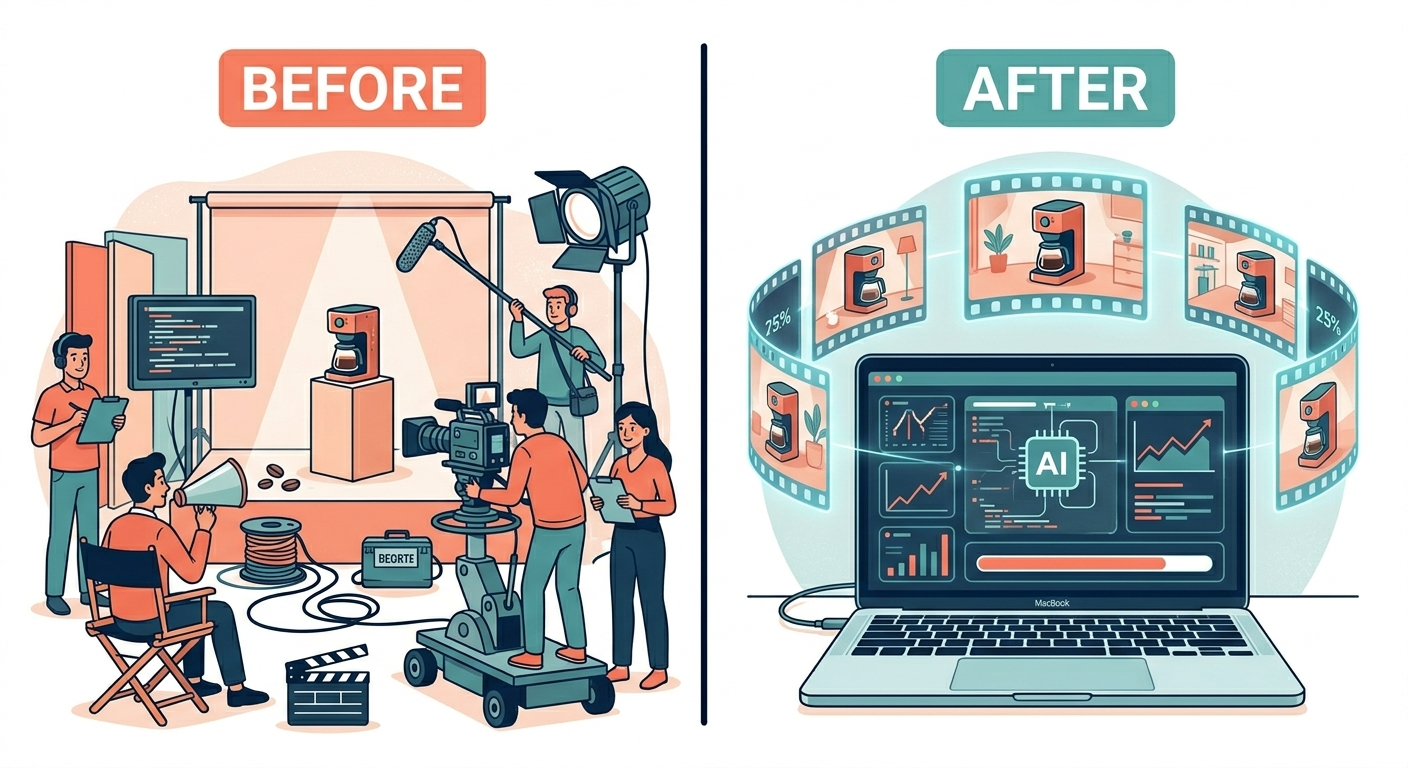
The traditional product video production process was built for companies with marketing departments and production budgets. You briefed a creative agency or freelance videographer, they scheduled a shoot, set up lighting, filmed multiple takes, sent footage to an editor, went through rounds of revisions, and delivered a final file weeks later. The cost for a single professional product video regularly exceeded $5,000 for anything worth using.
For small brands — solo founders, two-person teams, Shopify stores, local businesses — this process was effectively out of reach. The alternative was using smartphone footage, which looked unprofessional, or free templates that made every brand look identical. Neither option built the kind of brand credibility that converts browsers into buyers.
The result was a massive content gap. Large brands dominated social media with polished video content. Small brands posted static images and text, got lower engagement, and spent more on paid ads to compensate for organic underperformance. Video was the most effective content format on every platform — and small brands simply could not compete.
AI product video generation closes that gap completely.
What AI Product Video Generation Actually Produces in 2026
It is worth being specific about what modern AI video generation produces — because the technology has advanced significantly beyond what most people picture when they hear "AI video."
In 2026, AI video generators have reached a level of temporal consistency that was previously impossible — characters and environments no longer glitch or change shape between frames. pasivemarketer This means that product videos maintain visual coherence across every shot, which was the main limitation that made early AI video look obviously artificial.
What a properly configured AI video pipeline produces today: a scripted multi-scene video with professional shot composition, consistent product representation across all frames, voiceover narration, background music, cinematic transitions, and platform-optimized formatting for vertical (TikTok/Reels), square (Instagram feed), and horizontal (YouTube) aspect ratios. All from product images and a text brief.
The 2026 AI video market has fragmented into clear categories — avatar tools for explainers and presentations, creative generation tools for ad concepts and visual promos, and repurposing tools for turning existing content into clips. Predis For small brands that want original product marketing videos generated automatically, the creative generation category is the most relevant — and the most rapidly advancing.
How AI Generates a Product Video Step by Step
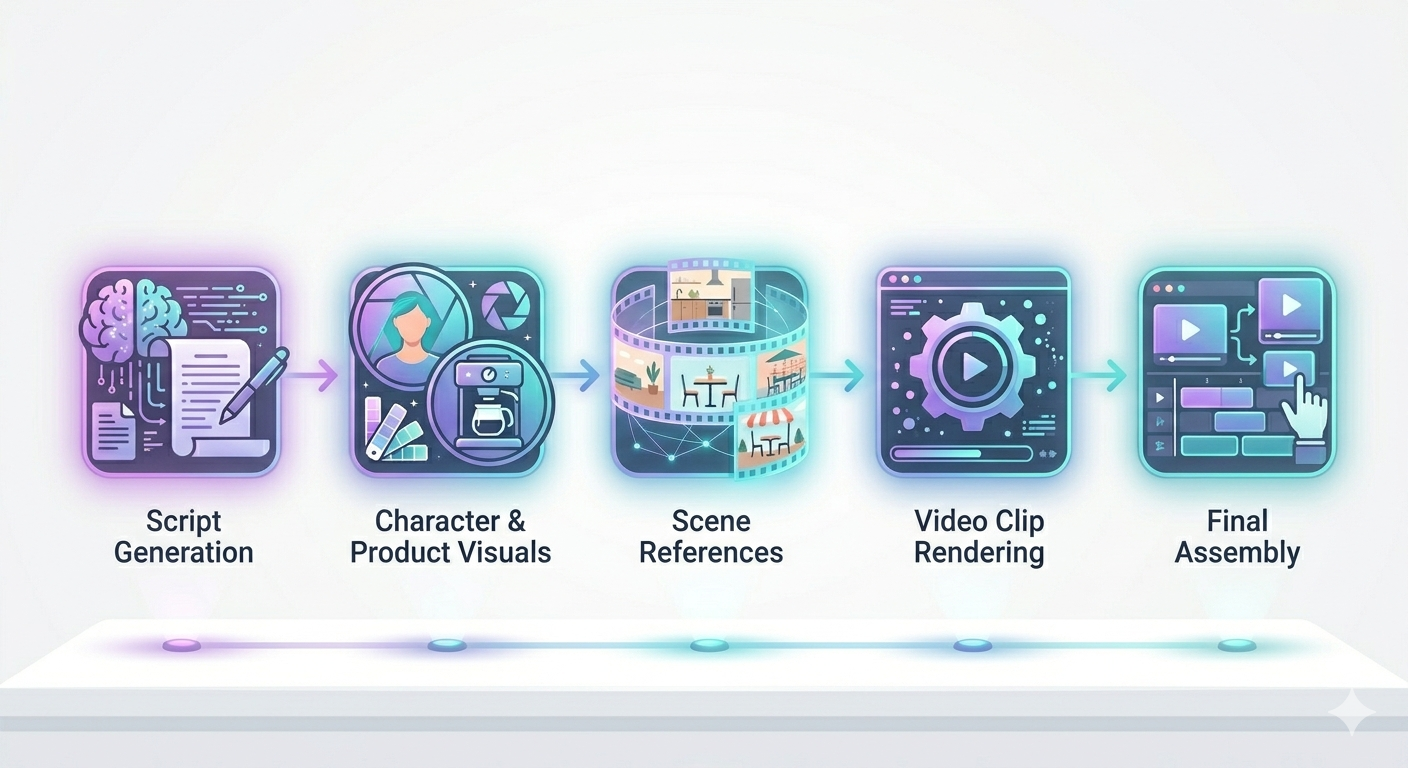
Understanding the process helps you evaluate which tools are genuinely capable and which ones are just marketing automation with a video template bolted on. A real AI product video pipeline has five distinct stages.
Stage 1 — Script Generation
The AI starts by writing the video script based on your product data, brand tone, and content goal. A strong script engine — like Gemini's top reasoning model — does not just write generic promotional copy. It structures the script cinematically: opening hook, product reveal, benefit showcase, social proof moment, and call to action. Each scene has a shot direction built in — close-up on product texture, wide shot showing usage context, cut to brand logo with tagline. The script is the blueprint for every frame that follows.
Stage 2 — Character and Product Visual Generation
Once the script exists, the AI generates the visual ingredients. This includes the product itself rendered in the correct context — on a clean surface, in a lifestyle setting, in use — plus any character or person required for the scene. Models like Nano Banana Pro specialize in generating consistent product and character visuals that maintain identity across multiple shots, which is essential for brand-consistent video.
Stage 3 — Scene Reference Generation
Before video clips are rendered, the AI generates scene reference images — detailed visual frames showing exactly what each shot will look like in terms of composition, lighting, environment, and mood. Tools like Google Imagen Pro produce photorealistic scene references that serve as the visual direction for the video generation stage. This step ensures visual consistency across the entire video.
Stage 4 — Video Clip Rendering
With scene references and character visuals ready, the AI renders actual video clips for each scene. Kling 3.0 is currently the most stable, controllable, and production-ready cinematic AI video generator available Shopify, producing clips with smooth motion, accurate product representation, and cinematic quality. Seedance 2.0 offers similar capabilities optimized specifically for brand and product content at scale.
Stage 5 — Final Assembly
The individual clips are assembled into a complete video by a rendering engine like FFmpeg, which adds transitions between scenes, syncs the voiceover audio generated by ElevenLabs, adds background music, burns in subtitles, and applies color grading for a polished final output. The result is a complete, ready-to-publish product video — indistinguishable in production quality from videos made by a professional team.
AI Product Video Tools Available in 2026
Several tools now offer some version of AI product video generation. Here is an honest look at what each category delivers.
Template-Based Tools (InVideo, Lumen5, Steve.ai)
These tools generate videos by placing your content — product images, captions, logos — into pre-designed video templates. The output is fast and affordable, starting from $19 to $29 per month. The limitation is obvious: every video looks like it came from the same template library. Brand differentiation is minimal, visual quality is capped by template design, and the AI is not generating original visuals — it is arranging your assets inside a pre-built structure.
For brands that need high volume at low cost and are not concerned with cinematic quality,
template tools deliver reasonable value. For brands trying to build a distinctive visual identity, templates produce generic output that blends into the feed rather than standing out.
Avatar and Presenter Tools (Synthesia, HeyGen)
Synthesia is built specifically for business video at scale — turning scripts, documents, or slides into presenter-led videos without filming. Shopify HeyGen excels at multilingual video with accurate lip-sync across 50+ languages. Both are excellent for explainer videos, training content, and brand introductions.
The limitation for product marketing is that avatar-led videos feel more like presentations than brand content. They work well for service businesses and B2B brands but are less effective for product-forward brands that need visual storytelling around the product itself rather than a talking presenter.
Creative Generation Tools (Runway, Kling, Seedance)
This is the category producing genuinely cinematic AI video in 2026. These tools generate original video footage from prompts, images, and scene references — not templates. The output quality is dramatically higher than template tools, and the visual identity of each brand can be preserved across videos through consistent asset and prompt inputs.
The challenge with standalone creative generation tools is that they require significant technical knowledge to use effectively. Getting consistent, brand-accurate results from Runway or Kling requires prompt engineering expertise, multiple iteration rounds, and manual assembly of clips into a final video — which reintroduces the production workload that small brands are trying to eliminate.
SnapReelAI — Cinematic AI Product Video, Fully Automated
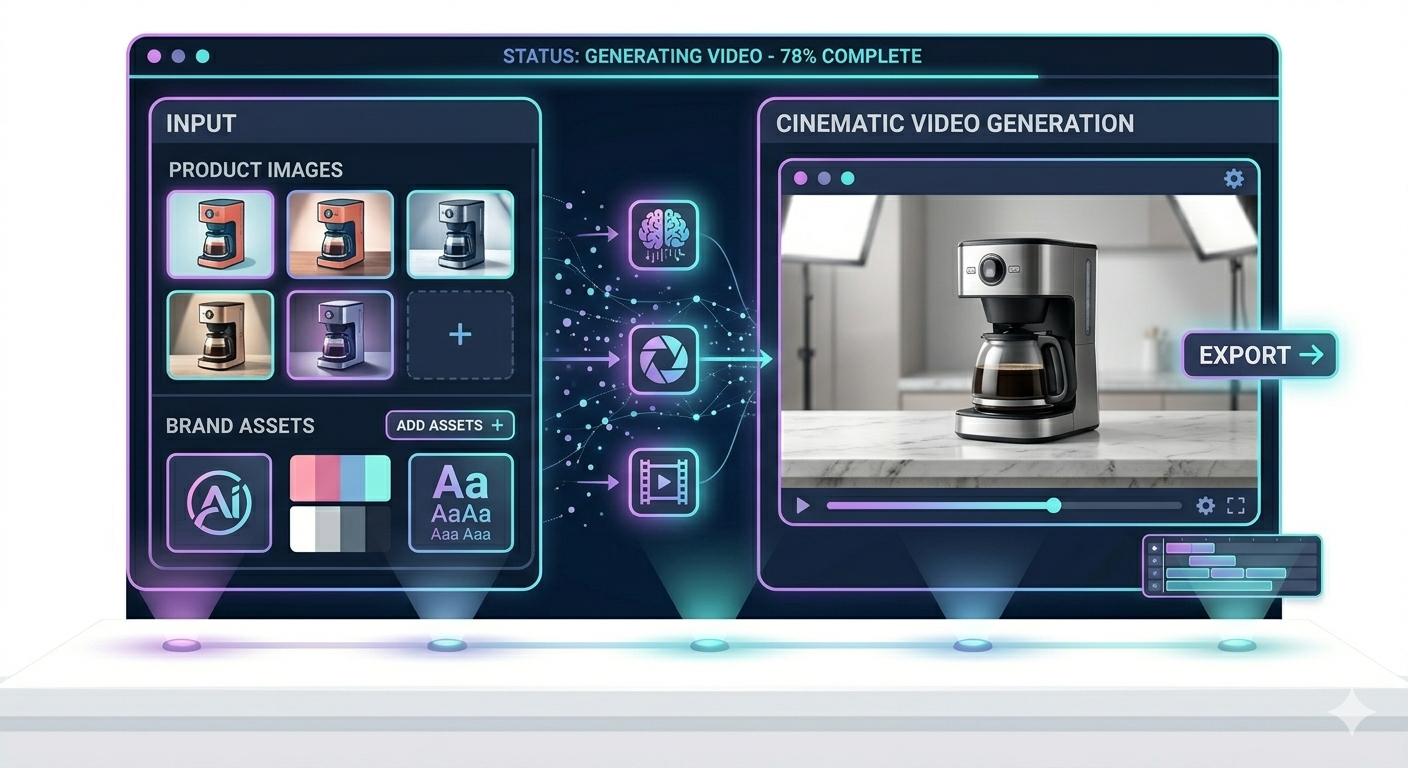
The gap in the market is a tool that combines cinematic AI video generation quality with complete automation — so small brands get professional product videos without learning prompt engineering, without manually assembling clips, and without any production involvement at all.
SnapReelAI is built to close that gap. It uses the same generation models — Gemini for scripting, Nano Banana Pro for product and character visuals, Google Imagen Pro for scene references, Seedance 2.0 for video clips, and FFmpeg for final assembly with ElevenLabs audio — but wraps the entire pipeline in a fully autonomous system that runs automatically on a schedule.
A small brand onboards once: logo, product images, brand colors, reference visuals, content guidelines. From that point, SnapReelAI generates product videos automatically as part of a weekly content schedule — deciding when a product video is appropriate, writing the script, generating all visuals, rendering the full video, and publishing it directly to TikTok, Instagram, Facebook, YouTube, LinkedIn, Reddit, and X at the scheduled time.
The brand never touches the production pipeline. There is no draft to review, no clip to approve, no file to upload. A new cinematic product video appears on every connected platform, automatically, as often as the AI determines is right for the content strategy. For small brands selling physical products, this means daily professional video content with zero production cost beyond the subscription.
For UGC-style product reviews, SnapReelAI also supports AI face-swap through Kling motion — enabling brands to generate review videos where a person is replaced with a celebrity or chosen persona, adding social proof content to the mix without filming anything.
See your product in professionally branded Reels generated automatically — every single day.
Create AI-powered videos and auto-post to all your platforms.
What Types of Product Videos Does AI Generate Best?
AI product video generation in 2026 excels at specific content types that align perfectly with what small brands need most for social media.
Product showcase videos — Clean, cinematic shots of the product from multiple angles with voiceover highlighting key features and benefits. These perform well on Instagram Reels, TikTok, and YouTube Shorts and are the most straightforward application of AI video generation.
Lifestyle context videos — The product shown in real-world use scenarios — a skincare product in a morning routine, a coffee brand in a cozy kitchen setting, a fitness supplement before a workout. AI generates these scenes from product images without any filming required.
UGC-style review videos — Person-to-camera style content where an AI-generated or face-swapped presenter reviews the product conversationally. This format has the highest engagement rate on TikTok and Instagram and is increasingly being generated fully by AI using models like Kling motion for the face-swap layer.
Brand story videos — Short narrative videos that communicate the brand's origin, mission, or values through a combination of product visuals, lifestyle scenes, and on-screen text. These build brand depth beyond product promotion and work well on LinkedIn and Facebook.
Frequently Asked Questions
Can AI really generate professional product videos without any filming? Yes — in 2026, the best AI video generation tools produce cinematic product footage from product images and text prompts alone. No camera, no studio, and no editing are required. The output quality from models like Seedance 2.0 and Kling 3.0 is production-ready for social media.
How much does AI product video generation cost? Standalone AI video tools range from $19 to $99 per month depending on output volume and quality. Fully autonomous platforms like SnapReelAI include video generation as part of a complete social media management system, making the per-video cost significantly lower when factored across daily automated publishing.
Will AI-generated product videos look generic or templated? Template-based tools produce generic output. True AI generation tools — which create original footage from your specific product assets and brand data — produce unique videos for every brand. The more brand data you provide during onboarding, the more distinctive the output.
How long does it take to generate a product video with AI? With a properly configured pipeline, a complete product video is rendered in minutes to a few hours depending on length and complexity. Fully autonomous systems like SnapReelAI handle this entirely in the background — videos are ready two hours before their scheduled publish time without any human involvement.
Do AI product videos perform well on social media? Video content consistently outperforms static images across every major platform. AI-generated product videos that maintain cinematic quality and brand consistency perform comparably to professionally produced videos, at a fraction of the cost and with none of the production overhead.
Conclusion — The Production Gap Is Closed

In 2026, the production quality gap between large brand video content and small brand video content no longer needs to exist. AI video generation technology has matured to the point where small brands can produce cinematic, brand-consistent product videos automatically — at scale, at low cost, and with zero production involvement.
The brands that recognize this shift early and start publishing daily AI-generated product video content will build organic reach, brand credibility, and customer trust faster than competitors still relying on static images and infrequent manual posts.
SnapReelAI makes this entire process fully autonomous — from video generation to publishing — so your products show up on every platform, every day, looking like they were produced by a professional team. Without the team. Without the cost. Without your involvement.
See how it works at snapreelai.com — and have your first AI-generated product video live within the week.