What Is Brand Storytelling — And Why Small Brands That Tell Stories Grow 3x Faster on Social Media in 2026
SnapReel
May 9, 2026 · 18 min read

Table of Contents
The Difference Between Brands That Grow and Brands That Stall
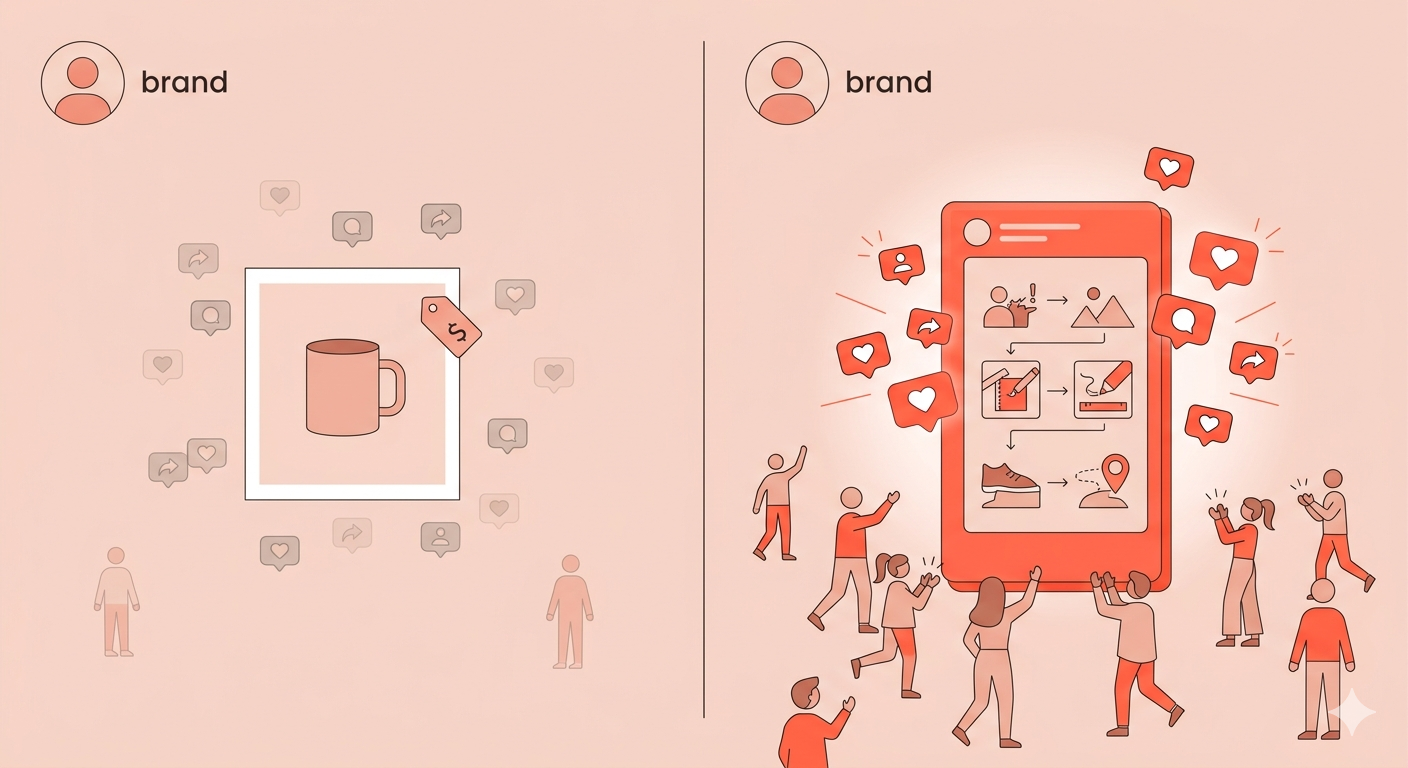
Open Instagram right now and scroll through your feed for two minutes. You will see two distinct types of brand content.
The first type shows a product on a clean background. Maybe a discount code. Maybe a caption that says something like "Our best-selling item is back in stock — link in bio." The brand is telling you what they sell. They are presenting information. They are asking for a transaction.
The second type shows something completely different. A founder sitting in their car talking honestly about why they almost gave up on their business last year. A behind-the-scenes video of a product being made by hand. A customer whose life changed in a specific, measurable way after using the product. A short series about the problem the brand was created to solve and why it matters. The brand is not asking for a transaction. They are inviting you into something.
The first type of content gets scrolled past. The second type gets saved, shared, and followed.
This is brand storytelling — and in 2026 it is the single most powerful differentiator between brands that grow rapidly on social media and brands that post consistently without ever building real audience momentum. The brands growing fastest on TikTok and Instagram right now are not the ones with the best product photography or the biggest ad budgets. They are the ones whose content makes people feel something — curiosity, recognition, inspiration, trust — and keeps them coming back.
This guide explains exactly what brand storytelling is, why it works at a psychological level, and how small brands with no professional production resources can build a storytelling content strategy that grows their social media presence and drives real sales in 2026.
What Brand Storytelling Actually Is
Brand storytelling is not writing long captions. It is not making cinematic videos with dramatic music. It is not sharing your founding story once on your About page and calling it done.
Brand storytelling is a systematic approach to communicating your brand's identity, values, and purpose through narrative rather than information. It is the difference between telling your audience what you sell and showing them why it matters, who it is for, and what it means to the people whose lives it touches.
The distinction matters because of how human brains process different types of content. When we receive information — a product feature, a price point, a specification — we process it analytically. We evaluate it, compare it, and file it away. When we receive a story — a specific person facing a specific problem finding a specific solution — we process it experientially. We feel it. We see ourselves in it. We remember it.
This neurological difference is why brand storytelling drives engagement, loyalty, and sales in a way that product-focused content simply cannot replicate. Stories create emotional connection. Emotional connection creates brand preference. Brand preference drives purchase decisions — even when a cheaper alternative exists.
For small brands, this is the great equalizer. A small brand with a genuine story told authentically can create stronger audience connection than a large brand spending millions on polished advertising — because authenticity and specificity are the currencies of effective storytelling, and small brands have access to both in ways that large corporate brands often cannot manufacture.
The Four Elements of a Compelling Brand Story
Not all stories are equally compelling. The brands building massive social followings through storytelling in 2026 are not just sharing random authentic moments — they are building stories around four specific elements that consistently drive audience connection and engagement.
Element 1 — A Relatable Problem
Every great brand story starts with a problem. Not a vague, generic problem — a specific, relatable problem that your target audience recognizes from their own life.
The more specific the problem, the more powerful the story. "We wanted to make healthy snacking easier" is a vague problem. "We kept reaching for chips at 10pm because every healthy snack we tried either tasted like cardboard or cost $8 for five pieces" is a specific problem. Anyone who has experienced that exact moment of frustration recognizes themselves in it immediately — and that recognition is the hook that makes them want to know what came next.
Your brand's founding problem is the richest source of storytelling material you have. Why did this product or service need to exist? What was happening in the world — or in your own life — that no existing solution adequately addressed? The honest, specific answer to that question is the beginning of your brand's most compelling story.
Element 2 — A Genuine Journey
Stories need movement. A problem that gets immediately and effortlessly solved is not a story — it is a testimonial. The journey between the problem and the solution — the attempts that failed, the pivots that changed direction, the moments of doubt, the small breakthroughs — is where audience connection is built.
Small brands have an enormous advantage here. Your journey — building something from scratch, navigating challenges without a corporate safety net, making decisions with real personal stakes — is inherently compelling because it is real. The struggles are not manufactured for marketing purposes. The moments of uncertainty are not scripted. And audiences in 2026 who have developed sophisticated radar for inauthentic brand content can feel the difference between a real journey and a performed one.
Share the parts of the journey that felt hardest at the time. The month you almost ran out of inventory. The customer complaint that made you rethink your entire product. The decision to quit your job and bet everything on the idea. These are not weaknesses in your brand story — they are the moments that make your audience root for you.
Element 3 — A Specific Transformation
The resolution of your brand story is not "and then the business succeeded." It is the specific transformation that your product or service creates in the lives of real people.
Transformation is the engine of social media storytelling because it gives your audience something to aspire to. When you show a specific customer who had a specific problem and experienced a specific, measurable change as a result of your product, you are not just demonstrating that the product works — you are showing your audience a version of their own future that includes your product in it.
The specificity is everything. "Our customers love the product" is not a transformation story. "Sarah used to spend two hours every Sunday planning her social media content and still felt behind — three months after switching to AI-assisted content scheduling she spends 20 minutes a week and has grown her following by 40 percent" is a transformation story. The specificity makes it believable and the outcome makes it aspirational.
Element 4 — An Authentic Voice
The final element that separates brand stories that build genuine audience connection from brand stories that fall flat is the voice in which they are told. Authentic voice means your brand communicates the way a real person talks — not the way a marketing department writes.
In 2026 audiences are extraordinarily good at detecting the difference between genuine human communication and corporate content production. The brands that have built the deepest social media communities are the ones that communicate with specific, imperfect, genuinely human voice — that admits uncertainty, uses humor that is actually funny rather than carefully calculated, and addresses their audience the way a knowledgeable friend would rather than the way a press release is written.
This does not mean your content should be unpolished or unstrategic. It means the voice should feel like it is coming from a real person who genuinely cares about both the audience and the product — because that is exactly what the most effective brand storytellers are.
The Six Brand Storytelling Formats That Perform Best in 2026
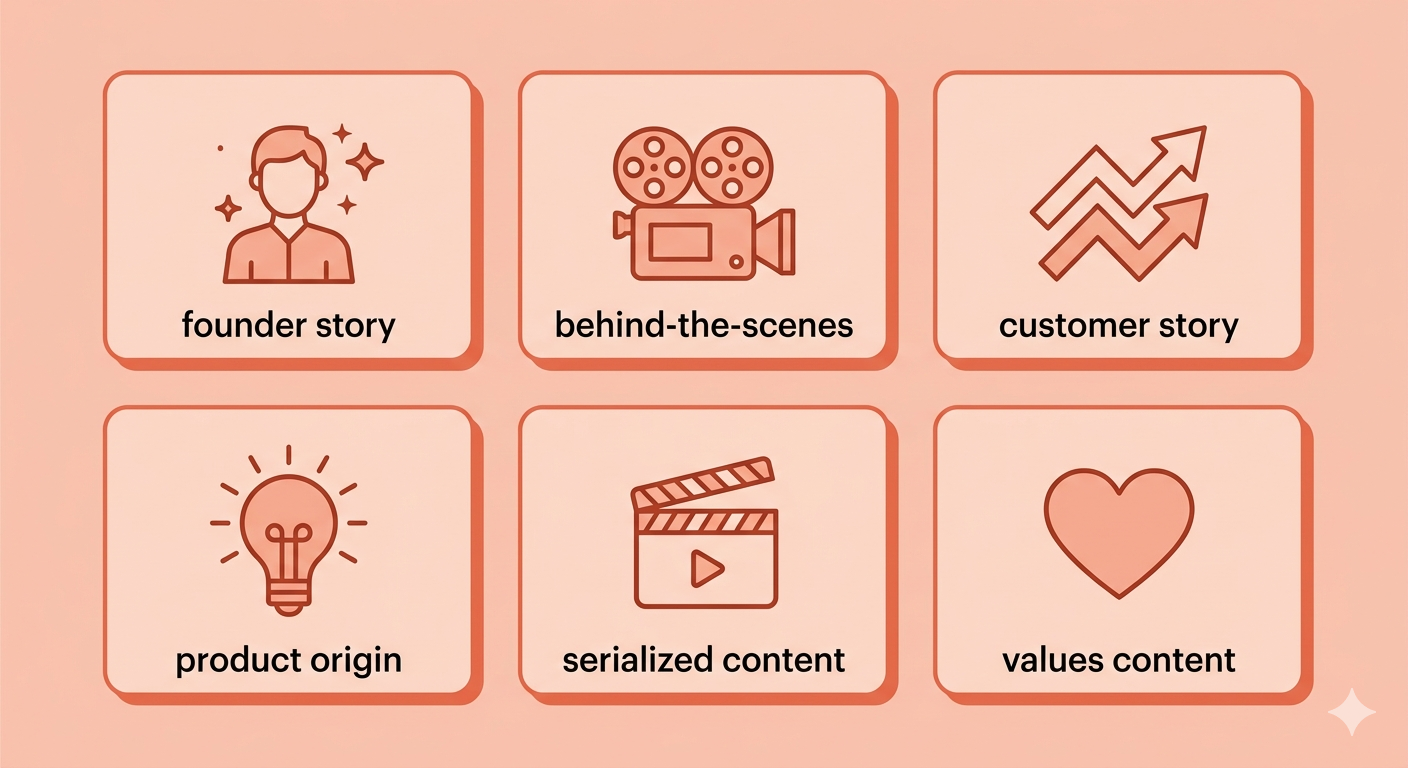
Understanding the principles of brand storytelling is one thing. Knowing which specific content formats to use on social media to tell those stories effectively is another. Here are the six formats that consistently drive the strongest engagement and audience growth for brand storytelling content in 2026.
Format 1 — The Founder Story
The founder story is the most direct expression of brand storytelling and often the highest-performing content format for early-stage brands. A founder speaking directly to camera — or even to a phone propped against a coffee cup — about why they started the brand, what problem they experienced personally, and what they sacrificed to build the solution creates an immediate human connection that no amount of production budget can replicate.
The founder story works because it provides something that no product description can — a face, a voice, a specific person whose life and values are the origin point of everything the brand stands for. Audiences who connect with a founder's story do not just buy the product. They become advocates for the person behind it.
Short-form founder content — 60 to 90 second TikTok or Instagram Reels format — works particularly well because the constrained length forces specificity and economy of storytelling. You cannot fit every detail into 90 seconds, which means you have to identify the most emotionally resonant moments and lead with those.
Format 2 — Behind-the-Scenes Content
Behind-the-scenes content gives audiences access to the parts of your brand they would never normally see — and in doing so, builds the kind of transparency and authenticity that creates deep trust.
The most effective behind-the-scenes content is not a perfectly produced tour of a beautiful workspace. It is genuinely unfiltered access to the real process — the messy packing station during a busy launch week, the raw ingredients before they become the finished product, the team meeting where a difficult decision gets made, the quality check that catches a problem before it reaches a customer.
This format is particularly powerful on Instagram Stories and TikTok because both platforms have native formats — vertical, informal, unedited — that feel naturally suited to behind-the-scenes content. The informality of the format matches the intimacy of the content and signals to the audience that this is real access, not produced content.
Format 3 — Customer Transformation Stories
Customer transformation stories are the social proof layer of brand storytelling — and in many ways the most persuasive content format available to product brands because the protagonist is not the brand but the customer.
The formula is simple: identify a real customer who experienced a meaningful transformation as a result of your product, tell their story in their words, and show the specific before-and-after in whatever form is most visually compelling for your product category.
The transformation story works because it allows potential customers to see themselves in the person being featured. If the customer in the story shares their demographic, their problem, and their context — and the transformation is specific and credible — the watching audience naturally maps the story onto their own situation. The leap from "this happened to them" to "this could happen to me" is the moment that drives purchase intent.
Format 4 — The Product Origin Story
The product origin story explains why a specific product exists — what gap it fills, what problem inspired it, what decisions shaped it into what it is today. This format is particularly powerful for brands whose products have a genuinely interesting development story — an ingredient that took years to source, a design decision that required complete reinvention, a discovery that changed everything about how the product works.
The product origin story also functions as implicit quality signaling. A brand that explains the specific decisions behind every element of their product — why this ingredient rather than a cheaper alternative, why this process rather than a faster one — is demonstrating a level of craft and intentionality that builds premium brand perception without explicitly claiming premium status.
Format 5 — The Serialized Content Series
The serialized content series is one of the most powerful brand storytelling strategies in 2026 because it transforms passive followers into active audience members who return specifically to see what happens next.
A content series is a recurring format where each episode builds on the last — following a theme, a character, or a narrative arc across multiple posts. A founder documenting the real experience of building a business week by week. A monthly update on how a customer is progressing toward a specific goal using the brand's product. A recurring format where the brand tests a specific question, addresses a common misconception, or explores a new angle of their product category.
The series format works because it trains the audience to expect and anticipate your content rather than passively encountering it. A follower who is invested in a narrative — who wants to know how the story continues — is not the same as a follower who casually encountered your brand. They are an engaged audience member. And engaged audience members are the foundation of brand communities that convert consistently over time.
Format 6 — Values-Led Content
Values-led content tells stories about what your brand believes — not just what it sells. It shares your perspective on your industry, your stance on how things should be done differently, your position on issues that matter to your customers and to your team.
This format creates the deepest brand loyalty because it gives audiences something to align with beyond the product itself. When a brand communicates genuine values — not carefully researched positions designed to appeal to a target demographic, but actual beliefs that shaped how the brand was built — they attract customers who share those values. And customers who share your brand's values are not just buyers. They are advocates. They recommend the brand to friends, defend it in comment sections, and stay loyal through price increases and temporary product issues that would cause less aligned customers to defect.
Tell your brand story every single day — SnapReel generates fresh branded content automatically.
Stay ahead with SnapReel — your AI-powered social media manager.
How to Build Your Brand Story System
The brands that grow consistently through storytelling are not creating individual pieces of content and hoping for the best. They have built a story system — a repeatable framework that produces brand storytelling content consistently without requiring a creative breakthrough every time they sit down to post.
Here is how to build yours.
Step 1 — Write Your Brand's Core Narrative
Your core narrative is the single story that underlies everything else your brand communicates. It answers three questions in sequence: What problem existed before your brand did? What did your brand do about it? What does the world look like for the people your brand serves now?
Write this narrative in 300 to 500 words — enough to capture the specificity and emotional truth of the story, short enough that it stays focused. This document becomes the foundation of every piece of storytelling content you create. Every social media post, every campaign, every piece of content should connect back to this core narrative in some way.
Step 2 — Build Your Story Bank
A story bank is a living document of all the specific stories your brand has access to — founder moments, customer transformations, product development milestones, team experiences, challenges overcome, decisions made. Spend two to three hours building this document and add to it continuously as new stories emerge.
The story bank solves the most common problem in brand storytelling — not knowing what to talk about. When you have 40 specific stories documented and organized, the blank page problem disappears. You never have to invent something to share because the raw material is already captured and waiting to be formatted for content.
Step 3 — Map Stories to Content Formats
For each story in your bank, identify which content format it fits best. A short, emotionally resonant founder moment belongs in a 60-second Reel or TikTok. A complex product development decision is better suited to a carousel or LinkedIn post. A customer transformation with visual results belongs in a before-and-after format. A behind-the-scenes process belongs in Instagram Stories.
Mapping stories to formats in advance means that when you sit down to create content, you are not making two decisions simultaneously — what to say and how to say it. You have already made both decisions. You are executing, not ideating.
Step 4 — Use AI to Scale Story Production
Brand storytelling at volume — across six platforms, every day, consistently for months — requires a production system, not just a creative approach. AI tools in 2026 handle the production layer of brand storytelling without touching the strategic and emotional layer that makes the stories compelling.
You provide the story — the specific human moment, the authentic detail, the real outcome. The AI translates it into platform-optimized script, formats it for the right content type, adapts the tone for each platform's native style, and generates the visual and audio direction for production. What used to take hours of writing, formatting, and adaptation happens in minutes.
The result is a brand that tells its story consistently across every platform — in the format each platform rewards, at the volume the algorithm requires — without the creative burnout that kills most brands' storytelling ambitions six weeks after they start.
The Storytelling Mistakes That Undermine Brand Growth
Understanding what works in brand storytelling is essential. Understanding what undermines it is equally important — because several common approaches that feel like storytelling are actively damaging brand growth on social media.
Telling the brand story once and moving on. Your brand story is not a one-time disclosure. It is a living narrative that should appear in different formats, from different angles, in different contexts, repeatedly across your entire social media presence. New followers encounter your brand every day. They have not heard your founding story, your product origin, or your customer transformations before. Your story needs to be told continuously — not recycled verbatim but retold from new angles with new specific details.
Making the brand the hero instead of the customer. The most common storytelling mistake brands make is centering their own perspective — the brand's achievements, the brand's journey, the brand's vision. Powerful brand storytelling centers the customer as the hero. Your brand is the guide — the mentor, the tool, the solution — but the customer is the one who transforms. Stories about your customers' lives and changes consistently outperform stories about your brand's accomplishments.
Performing authenticity rather than practicing it. In 2026 audiences can detect performed vulnerability as clearly as they can detect stock photography passed off as real life. A "raw and honest" post that has clearly been carefully scripted and shot multiple times is not authentic — it is a performance of authenticity, which is arguably more damaging than polished content because it breaks trust in a specific and personal way. Real authenticity means sharing things before you know how they will land — not engineering the appearance of rawness.
Inconsistent voice across platforms. Brand storytelling only builds the compounding effect of recognition and trust when the voice is consistent across every platform. If your TikTok voice is casual and vulnerable and your LinkedIn voice is formal and corporate and your Instagram voice is aspirational and polished, you are not telling one brand story across multiple platforms — you are telling three different stories to three different audiences and building recognition with none of them.

What Brand Storytelling Looks Like at Scale
When brand storytelling is working — when the story system is built, the story bank is full, the content is being produced consistently, and the platform-specific formats are right — the compounding effects become visible in the data within 60 to 90 days.
Follower growth accelerates because story-driven content generates shares at a significantly higher rate than product-focused content. Every share puts your brand story in front of an entirely new audience that arrives with social proof already established — a friend or creator they trust thought this was worth sharing.
Engagement quality improves because storytelling content invites genuine response. People comment on stories in a way they simply do not comment on product posts. They share their own experiences, ask specific questions, tag friends who have had similar journeys. This engagement signals to the algorithm that your content is generating genuine community value — which earns broader distribution.
Customer loyalty deepens because people who have connected with your brand story are not just buyers — they are participants in a narrative they care about. They follow the next chapter. They root for your success. They tell others about the brand not because they were incentivized to but because they feel genuinely invested in what you are building.
And revenue follows naturally — not because you sold harder but because you built an audience that trusts you, believes in your product's value, and returns repeatedly rather than being acquired once and lost.
Final Thoughts
The brands that win on social media in 2026 are not the ones with the biggest budgets, the most polished production, or the most aggressive posting schedule. They are the ones that give their audience something to believe in — a story worth following, a transformation worth aspiring to, a brand worth talking about.
Brand storytelling is not a marketing strategy reserved for companies with dedicated creative teams and professional production budgets. It is available to any brand with a genuine origin, a real problem worth solving, and customers whose lives have actually changed. Which means it is available to every small brand that took a real risk to build something real.
Your brand has a story. In 2026 the only question is whether your social media content is telling it.
SnapReel AI turns your brand story into a consistent stream of platform-optimized storytelling content — founder narratives, customer transformations, behind-the-scenes formats, and serialized content — automatically generated and published across every platform your audience is on.