Best Buffer Alternative in 2026 — Why Small Brands Need More Than Just Scheduling
SnapReel
May 16, 2026 · 12 min read
Table of Contents
Buffer built its reputation by doing one thing extremely well.
It made posting to social media simple. You connect your accounts, write your posts, pick a time, and Buffer handles the publishing. The interface is clean. The setup takes minutes. And for a brand that just needed a reliable way to stop manually posting everything in real time, Buffer was genuinely useful.
That simplicity is still Buffer's strongest selling point in 2026. It is also its most significant limitation.
Social media management for small brands has changed fundamentally in the past two years. The question is no longer just "when do we post?" — it is "what do we post, how do we produce it, which format performs best on each platform, and what do our analytics tell us to do differently next week?" Buffer answers the first question. It barely touches the rest.
The brands outgrowing Buffer in 2026 are not brands that have become too sophisticated for a simple tool. They are brands that have realized simple scheduling is no longer the hardest part of their social media challenge — and that the hardest part is exactly what Buffer was never designed to solve.
This guide breaks down what Buffer does well, where its structural limits show up most clearly for growing small brands, and why SnapReel AI is the Buffer alternative that solves the full problem rather than just the scheduling slice.
What Buffer Gets Right — And Why It Still Has a Place for Some Brands
Buffer's strengths are real and worth naming clearly before discussing where it falls short.
The interface is one of the cleanest in the social media management category. New users can connect their accounts and start scheduling posts within the first fifteen minutes without watching tutorial videos or consulting help documentation. For a brand whose team members are not social media specialists, this low barrier to entry has genuine practical value.
The free plan is more generous than most competing tools. Three social channels, basic scheduling, and access to a content calendar at no cost gives solo creators and very early-stage small brands a functional starting point without a financial commitment. For a brand that is still figuring out whether social media is worth investing in, Buffer's free tier removes the risk from trying.
Buffer's reliability as a basic scheduler — publishing posts to the correct accounts at the scheduled time — is solid for most standard use cases. For simple text posts and image posts across the platforms Buffer supports, it generally does what it promises.
The AI writing assistance added to Buffer's plans provides caption suggestions and content ideas that are useful as a starting point for brands that struggle with blank-page syndrome. It is not a content creation engine, but it reduces the friction of getting words onto the page before editing them into something publishable.
These strengths make Buffer a reasonable choice for a specific profile of user — a solo creator or very small team managing a limited number of accounts, primarily posting text and image content, with modest reporting needs, and without the requirement for video-first content production.
The problem is that most growing small brands in 2026 do not fit that profile for long.
The Four Problems That Push Small Brands Away From Buffer
The limitations that drive brands away from Buffer are not edge cases or rare complaints. They are consistent patterns that appear across review platforms and user communities, and they reflect structural constraints in what Buffer was built to be.
Problem One — Per-Channel Pricing That Punishes Growth
Buffer charges per social media channel on its paid plans. The entry-level paid plan costs six dollars per channel per month. That number sounds low in isolation. In practice, it scales in ways that create genuine friction for growing brands.
A small brand managing Instagram, TikTok, Facebook, LinkedIn, YouTube, and Pinterest is running six channels. At the entry-level paid rate, that is thirty-six dollars per month just for basic scheduling — before any team collaboration features, before advanced analytics, and before any of the capabilities that actually help a brand grow rather than just publish.
When that same brand wants to add a second team member to help manage content, the cost structure changes again. When they want to upgrade their analytics, the cost structure changes again. The compounding effect of per-channel pricing means that Buffer's true cost for a growing brand with multiple platforms and a small team bears little resemblance to the entry price that initially attracted them.
Reviews consistently flag this as one of the primary reasons users switch away from Buffer. A tool that feels affordable when you have two accounts and one team member feels significantly less affordable when your social media presence has grown to match your brand's ambitions.
Problem Two — Analytics That Are Too Surface-Level to Guide Strategy
Buffer provides basic post-level analytics — views, likes, reach, engagement rate for individual posts. For a brand that simply wants to know which posts performed best in a given week, this is functional.
For a brand that wants to understand why certain content performs, how different formats compare across platforms, what their audience's most active time windows are, how their growth compares to benchmarks in their category, or what content types are driving actual website traffic and conversions — Buffer's analytics run out of depth quickly.
Multiple G2 and Capterra reviews from 2026 flag the analytics as the primary reason for not renewing Buffer subscriptions. The recurring complaint is not that the analytics are inaccurate — it is that they are too shallow to actually inform strategy. Knowing that a post got four hundred impressions is not the same as knowing what to post next week.
The brands that grow on social media in 2026 are the ones making data-informed decisions about content type, format, timing, and platform prioritization. A tool that cannot provide that level of insight is leaving its users to make those decisions by guesswork.
Problem Three — No Content Creation — Just a Publishing Queue
This is the limitation that matters most in 2026 and the one Buffer has no clear answer for.
Buffer is a publishing queue. You create content somewhere else, you bring it into Buffer, and Buffer publishes it. The tool has never been designed to help you produce the content itself — and in 2026, content production is where small brands face their biggest bottleneck.
The brands that are winning on social media right now are not winning because they found a better scheduler. They are winning because they found a way to produce consistent, high-quality, video-first content at a volume that keeps their audience engaged — without requiring a full production team to do it.
Buffer's AI writing assistance helps with captions. That is genuinely useful. But a caption is the smallest piece of the content production challenge. The video, the creative, the thumbnail, the format for each platform — none of those are things Buffer helps with. Every brand using Buffer still has to solve the full content creation problem separately, in other tools, before anything gets scheduled.
For a small brand running a lean team, that separate content creation workflow is where the most time gets spent and where the most inconsistency creeps in. A tool that handles scheduling but not production is solving fifteen percent of the problem.
Buffer schedules. SnapReel creates AND schedules — fully autonomous social media for small brands.
Put these tips into action — start creating with SnapReel for free.

Problem Four — Silent Post Failures and Reliability Issues at Scale
One of the most consistently reported complaints about Buffer in recent reviews is silent post failures — situations where a scheduled post does not publish, and no notification is sent to tell the user that anything went wrong.
For a brand that posts once or twice a week and checks their feed regularly, a missed post is annoying but quickly noticed and corrected. For a brand maintaining an active content calendar across multiple platforms, a silent failure means content gaps appear in the feed without the brand knowing until they manually check — sometimes hours or days later.
The frustration with silent failures is not just about the missed post itself. It is about the unreliability signal. A scheduling tool that cannot be trusted to publish what you scheduled, when you scheduled it, without requiring you to manually verify every post has gone live, is adding work rather than removing it.
This reliability issue, combined with the analytics and pricing limitations, creates the pattern that drives growing small brands to start searching for alternatives.
What Small Brands Actually Need From a Buffer Alternative in 2026
The brands switching from Buffer are not looking for a tool that does what Buffer does slightly better. They are looking for a tool that reframes what "social media management" means for a small brand in 2026.
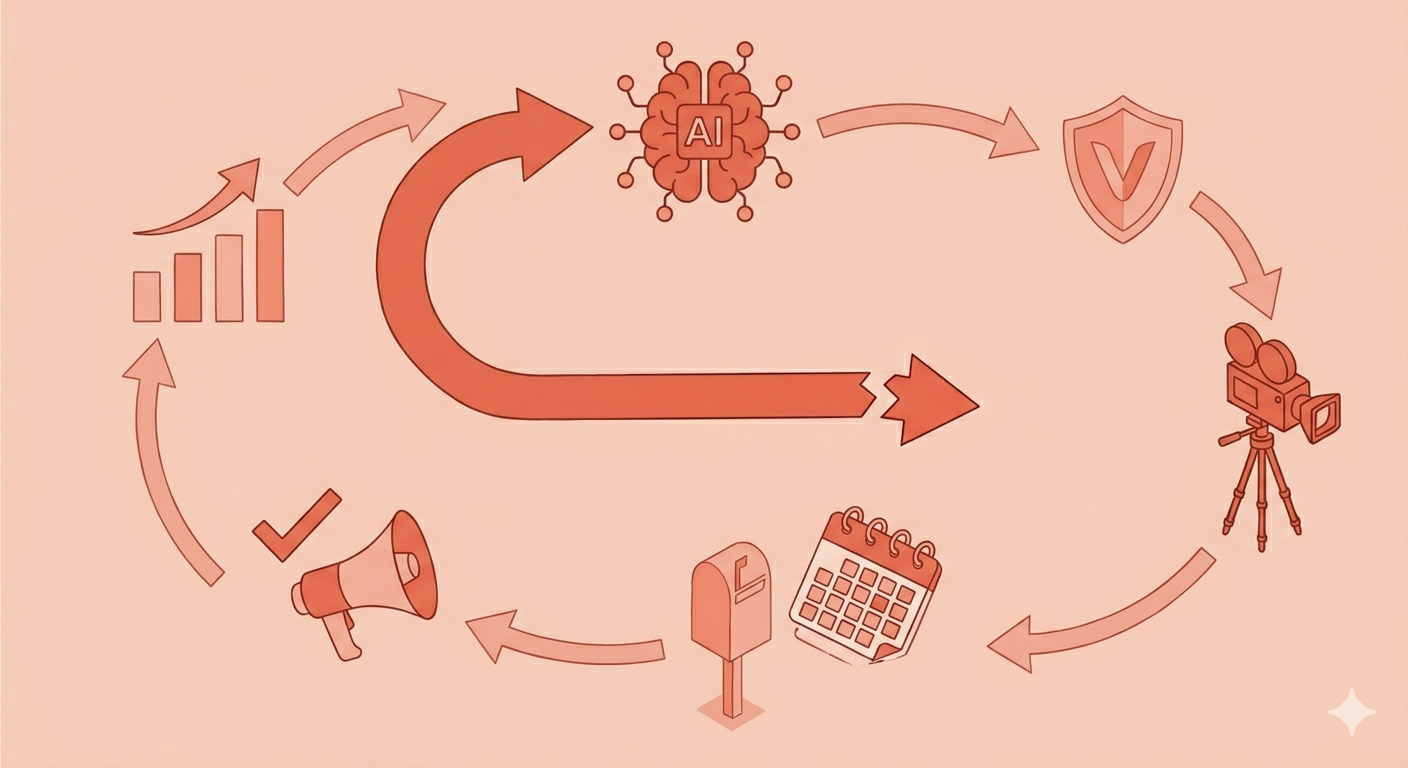
The reframe looks like this: social media management is not just scheduling. It is the full cycle of producing content that resonates with a specific audience, distributing it across the right platforms at the right times, understanding what the performance data says about what to produce next, and doing all of that consistently over time without it consuming every hour of the working week.
Buffer handles one step in that cycle. A genuine Buffer alternative in 2026 handles the full cycle — or at minimum, handles significantly more of it in a single workflow without requiring constant context-switching between tools.
The specific capabilities a Buffer alternative needs to provide for growing small brands are content creation, not just scheduling. Video production, not just caption assistance. Actionable analytics that guide what to create next. Reliable publishing that does not require manual verification. Pricing that scales with a brand's growth rather than penalizing it.
Why SnapReel AI Is the Buffer Alternative Small Brands Choose When They Are Ready to Grow
SnapReel AI was designed for the full cycle that Buffer only partially covers — and specifically for the small brand that needs to grow its social media presence without growing its team proportionally.
Content Creation Is Built In, Not Bolted On
SnapReel AI generates your content. Not just captions — full video content, built specifically for the platforms where short-form video drives the most growth. You do not bring content from elsewhere and schedule it. You describe your brand, your products, and your audience, and SnapReel AI produces ready-to-publish video content that fits each platform's native format and algorithm behavior.
For a small brand that has been running two separate workflows — producing content in one set of tools and scheduling it in Buffer — collapsing those into one connected workflow is not a marginal efficiency gain. It is a fundamental change in how much the team can produce without additional headcount.
Video-First Output for the Platforms That Drive Growth in 2026
Buffer supports video post scheduling. SnapReel AI generates video content from scratch.
The distinction matters because the brands that are actually growing their audiences in 2026 are not the ones that found a better way to schedule videos they already had. They are the ones that found a way to produce short-form video content consistently — for TikTok, Instagram Reels, and YouTube Shorts — without building a video production operation.
SnapReel AI's video output is built natively for each platform. The format, the pacing, the aspect ratio, the caption placement — all of it is produced for how each platform's algorithm actually works, not just adapted from a generic video template.
Analytics That Tell You What to Create Next
SnapReel AI's performance analytics go beyond post-level metrics. The platform identifies which content formats, topics, and video styles are driving the most meaningful engagement for your specific audience — and uses those insights to inform the next round of content generation.
The goal is not just to tell you how a post performed. It is to close the loop between performance data and content production so that every piece of content you create is informed by what actually worked before.
Predictable Pricing That Grows With Your Brand
SnapReel AI's pricing model does not penalize brands for adding platforms, increasing content volume, or bringing a second team member into the workflow. The cost is predictable from month to month, without the compounding effect of per-channel charges that makes Buffer increasingly expensive as a brand grows its social presence.
For small brands that have felt the frustration of Buffer's pricing scaling faster than its value, the switch to a predictable model is immediately felt in the monthly budget conversation.

Making the Decision — When to Stay With Buffer and When to Switch
Buffer is still the right tool for a specific type of user. Being honest about that distinction helps brands make the switch decision clearly rather than emotionally.
Stay with Buffer if your social media strategy is genuinely simple — one or two platforms, basic text and image content, a single team member doing the posting, and no urgent need for video content or deep analytics. If Buffer is doing what you need it to do within those parameters, the friction of switching tools is not worth the benefit.
Switch to SnapReel AI if you are managing more than two or three social channels and the per-channel pricing is making Buffer expensive relative to the value you are getting. Switch if you are spending significant time and energy on content creation in tools outside Buffer before anything gets scheduled. Switch if your growth strategy requires consistent video content on TikTok, Instagram Reels, or YouTube Shorts — and you currently have no efficient way to produce it. Switch if you are making content decisions based on gut feeling rather than analytics because Buffer's reporting is not deep enough to guide your strategy.
The brands that benefit most from SnapReel AI are not the brands looking for a better scheduler. They are the brands that have realized the scheduling is the easy part — and that what they actually need is a tool that solves the hard part too.
SnapReel AI handles content creation, video production, scheduling, publishing, and analytics in a single workflow so your small team can focus on building an audience rather than managing a content pipeline.