How to Build a Social Media Brand From Zero — The Complete 90-Day Launch Strategy for 2026
SnapReel
May 9, 2026 · 20 min read
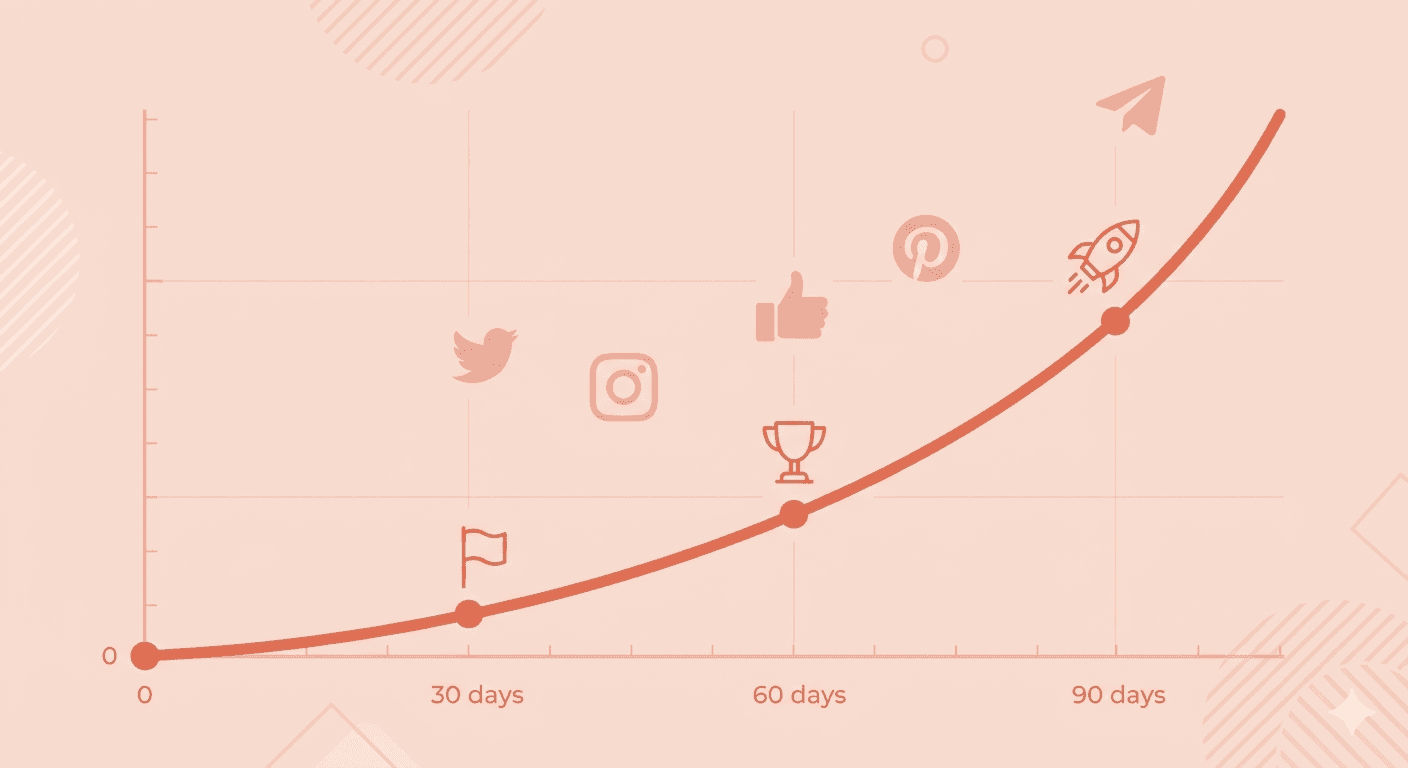
Table of Contents
The Zero-Follower Problem Is Not What You Think It Is
Starting a social media brand from zero in 2026 feels uniquely daunting. Every platform you open is already saturated with established accounts, polished content, and audiences that took years to build. The gap between where you are — zero followers, zero content library, zero algorithmic standing — and where you want to be feels impossibly large.
Here is what nobody tells you about that gap: it is not as wide as it looks, and the brands that close it fastest are almost never the ones with the most resources. They are the ones with the clearest strategy.
The zero-follower problem is actually a clarity problem. Most new brands post randomly, on random platforms, about random topics, without a defined audience or a consistent voice — and then conclude that social media growth is slow and hard because they have not yet gathered enough of an audience to know what works. The reality is that random posting produces random results on any platform, at any follower count. The brands that grow from zero to a genuine, engaged following in 90 days are not getting lucky — they are executing a specific system that removes randomness from the equation.
This guide is that system. It is the complete 90-day strategy for building a social media brand from zero — covering everything from platform selection and brand setup to content production, posting cadence, community building, and the specific milestones you should be hitting at each stage of the process.

Before You Post Anything — The Foundation Week
The most common mistake new brands make is posting before they have built the foundation that makes posting worthwhile. Rushing to get content out before establishing clarity on your audience, your voice, your visual identity, and your platform strategy produces content that does not represent your brand well — and first impressions on social media are difficult to overcome.
Spend the first week — before creating a single piece of content — building the foundation that everything else runs on.
Define Your Audience With Radical Specificity
The single most important strategic decision a new brand makes is defining exactly who their social media content is for. Not generally — specifically. Not "women aged 25 to 40 interested in fitness" but "women in their early thirties who work full-time, have tried multiple fitness programs without sticking to them, and are specifically looking for a sustainable approach that fits into a busy schedule rather than a total lifestyle overhaul."
The more specific your audience definition, the more specifically you can speak to them in your content — and specific content that resonates deeply with a narrow audience consistently outperforms broad content that vaguely addresses everyone. Algorithms surface content to audiences who engage with it. If your first 100 followers are exactly the right people — genuinely interested in what you are building — the algorithm learns to show your content to more people like them. If your first 100 followers are a mixed audience who happened to see your content, the algorithm has no clear signal about who to reach next.
Write your audience definition in one paragraph. Name a specific person — give them a name, a job, a specific problem they face, a specific thing they want that they have not been able to find yet. Every piece of content you create for the next 90 days should be written specifically for that person.
Choose Your Primary Platform
New brands make a critical mistake by trying to launch on every platform simultaneously. Managing five platforms from zero followers requires five times the content production, five times the community management, and five times the strategic attention — all before you have figured out what works for your brand's specific audience and content style.
Choose one primary platform to launch on based on where your specific target audience spends the most time and which content format plays to your brand's natural strengths.
If your brand is highly visual and your target audience skews 18 to 35, TikTok is almost certainly your highest-potential launch platform in 2026. Its algorithm distributes content to non-followers more aggressively than any other platform — meaning a brand with zero followers can reach thousands of potential customers with a single well-performing video.
If your brand is in a visual product category and your target audience skews 25 to 44, Instagram is your primary platform — particularly for brands where aesthetic coherence and social proof through visual content are central to the purchase decision.
If your brand has a B2B component or your target audience is professional, LinkedIn is your primary platform. LinkedIn's algorithm rewards thought leadership content heavily and its audience arrives with genuine professional intent.
You will add secondary platforms in Day 31 to 60. For the first 30 days, all of your energy goes into one platform.
Build Your Visual Identity
Before posting, establish the visual elements that will make your brand immediately recognizable across every piece of content you create. This does not require a professional brand designer — it requires consistency.
Choose three colors that work together and reflect your brand's personality. Choose one or two fonts that you will use for all on-screen text. Decide on your visual style — are your videos bright and clean, dark and cinematic, warm and natural, bold and graphic? Choose a style and commit to it.
Create a simple brand kit document that contains these elements. Every piece of content you produce should reference this kit. Visual consistency is one of the fastest ways to build brand recognition — audiences begin to recognize your content before they see your name because the visual signature is familiar.
Write Your Brand Brief
Your brand brief is the document that drives everything — your content, your captions, your voice, your storytelling. It contains your audience definition, your brand voice and tone, your content pillars, your visual identity, your primary keyword phrases, and your brand story.
Spend two to three hours on this document in your foundation week. It will save you hundreds of hours of decision-making over the next 90 days because every content decision references it rather than starting from scratch.
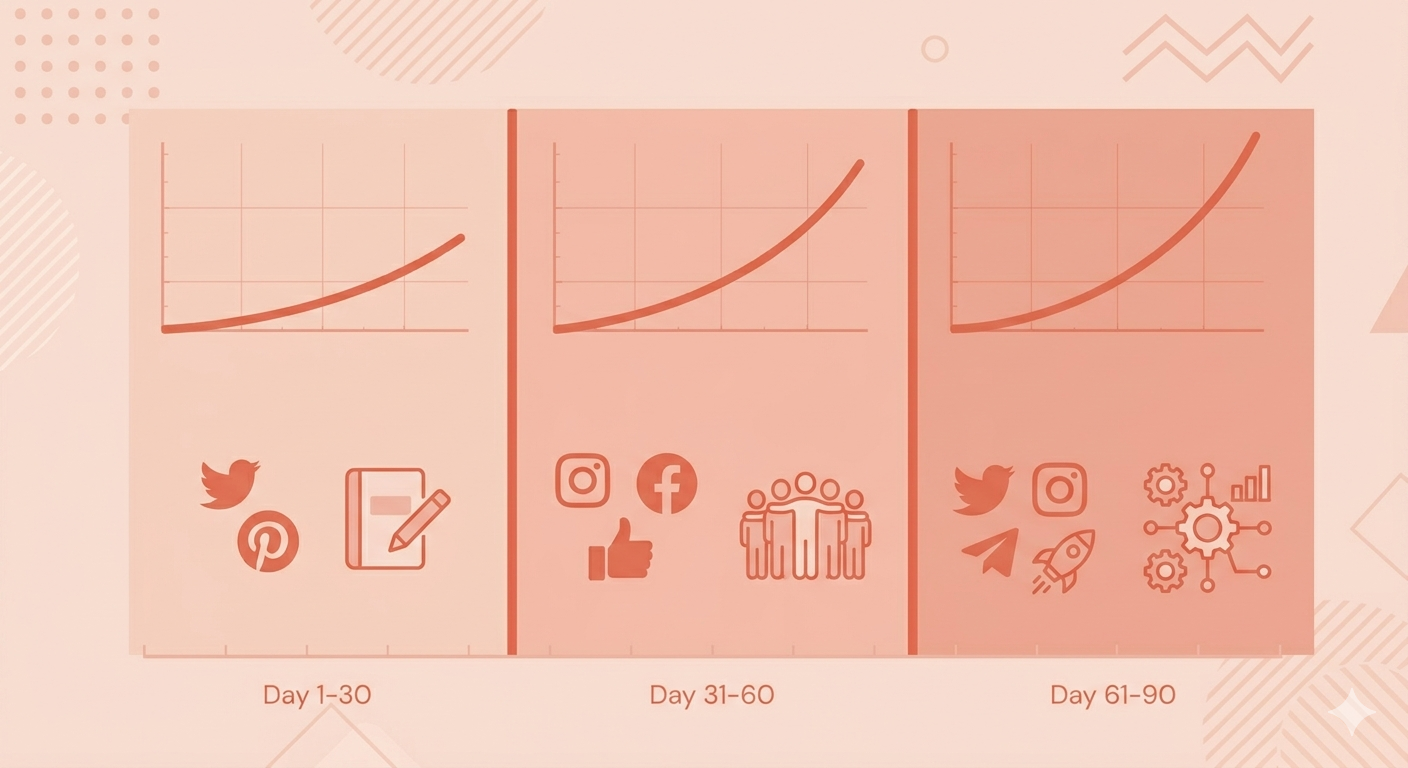
Days 1 to 30 — Building the Foundation on Your Primary Platform
The first 30 days have one goal: establish your brand's presence on your primary platform with enough content depth and consistency to give the algorithm enough data to understand who your content is for and begin distributing it to the right audience.
The Posting Strategy for Days 1 to 30
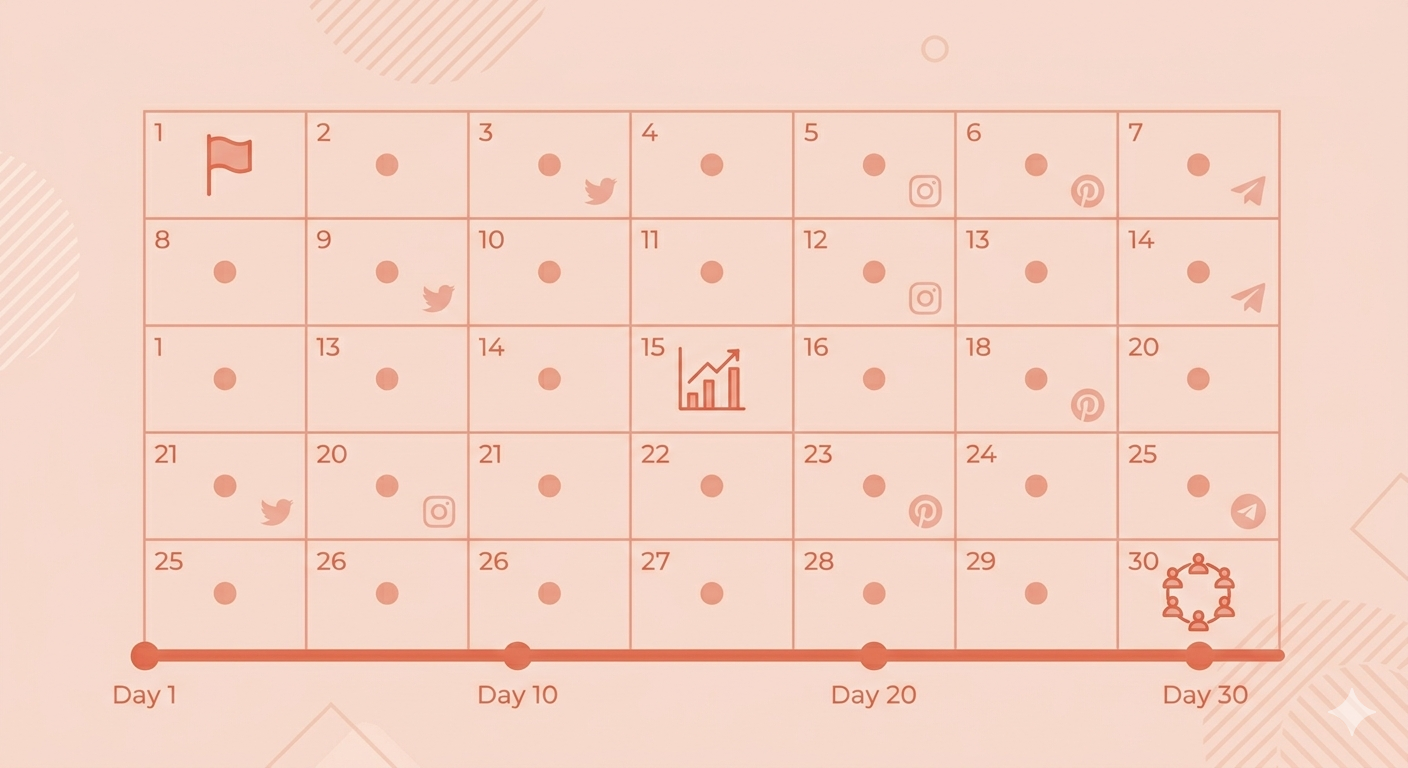
Post five times per week on your primary platform during this phase. This frequency is high enough to build algorithmic momentum without requiring so much production that quality falls.
Every post in the first 30 days should be doing one of three things. Introducing your brand to a new potential audience — these are your widest-reach posts, typically educational or entertaining content that does not require prior brand knowledge to be valuable. Demonstrating your product or service in a real context — these are your conversion-intent posts, showing specifically what you offer and how it works. Building trust through authenticity — these are your storytelling posts, founder content, behind-the-scenes, and customer stories.
Rotate across these three content types deliberately rather than posting whatever feels easiest. A content calendar that balances all three ensures you are building reach, demonstrating value, and establishing trust simultaneously rather than over-indexing on any one goal.
The Hook Strategy That Accelerates Early Growth
In the first 30 days your content does not have the benefit of an established audience or algorithmic trust. Every post is essentially cold reach — it needs to earn attention from people who have never seen your brand before.
This means your first two seconds of every video and your first line of every caption are doing maximum work. They need to stop a scroll from someone who has no prior reason to care about your brand. The hook strategies that work best for new brands in this phase are the pattern interrupt — saying something surprising or counterintuitive about your niche — and the specific problem statement — naming a precise pain point that your target audience recognizes immediately.
"Everything you have been told about skincare routines is backwards — here is what the science actually shows" is a pattern interrupt. "If you have ever spent $200 on skincare products and still woken up with dry skin every morning, this is for you" is a specific problem statement. Both strategies assume nothing about the viewer's prior knowledge of your brand and earn attention on their own merits.
Engaging Your First Followers
The first 100 followers on any platform are your most important followers — not because of their direct reach impact but because of what they tell the algorithm about who your content is for. Treat them accordingly.
Respond to every comment, every DM, every question in the first 30 days. Not with generic responses — with specific, genuine replies that continue the conversation the commenter started. When someone leaves a thoughtful comment, ask a follow-up question. When someone shares a personal experience related to your content, acknowledge it specifically.
This level of engagement is not scalable forever — but in the first 30 days it is the highest-leverage activity available to you for accelerating algorithmic learning. Accounts with high comment response rates signal to platform algorithms that they are active community builders rather than passive content broadcasters — and algorithms favor community builders with broader distribution.
Proactive engagement — going into the comments of content in your niche and leaving genuine, specific contributions to the conversation — is the other side of this strategy. Not promotional comments, not "check out our page" — genuine contributions that demonstrate expertise and draw curious viewers to your profile naturally.
Day 30 Milestones
By the end of day 30 a brand executing this strategy correctly should have published 20 pieces of content, established a clear visual identity and consistent voice, identified which content types are performing best based on engagement data, begun to see algorithmic reach extending beyond their immediate network, and built an initial community of engaged followers who are responding to content and following the brand with genuine interest.
The follower count at day 30 varies enormously by niche, platform, and content quality — but engagement rate and content consistency are more important indicators of health than raw follower numbers at this stage.
Days 31 to 60 — Expanding to Secondary Platforms and Deepening Content
By day 31 you have enough data from your primary platform to understand what is working — which content types generate the most reach, which hooks drive the most engagement, which topics your audience responds to most enthusiastically. This data is your content intelligence for the next phase.
Adding Your Secondary Platform
On day 31 add one secondary platform. Choose it based on your primary platform's performance data and your audience profile.
If your primary platform is TikTok, Instagram is almost always the right secondary platform — its audience overlap is significant, the content formats are compatible, and Instagram functions as the brand's more curated, considered presence that TikTok audiences check when they want to learn more.
If your primary platform is Instagram, TikTok or YouTube Shorts is the right secondary choice — TikTok for broader discovery reach, YouTube Shorts for long-term search visibility.
Do not cross-post identical content to your secondary platform. Adapt it. The same core message, topic, and content type — with platform-specific caption, hashtags, and minor format adjustments. This takes 10 to 15 minutes per post rather than the full production time of creating original content, which means adding a second platform does not double your production workload.
Introducing Content Series
Days 31 to 60 is when you introduce your first content series — a recurring format that gives your growing audience something to return for specifically.
Choose a format that fits naturally with your brand story and your audience's interests. A weekly behind-the-scenes update. A recurring format where you answer one specific audience question in depth. A series documenting a specific aspect of your product or process. A monthly customer transformation feature.
The series does not need to be complex. It needs to be consistent — same format, same day, same recurring theme — so that your audience begins to expect and anticipate it. This is the shift from passive follower to active audience member, and it happens when content is predictable enough that people look forward to it rather than simply encountering it.
Deepening Community Through Collaboration
Days 31 to 60 is also when you begin your first creator collaborations. Using the micro-influencer outreach strategy — gifting products, setting up affiliate codes, writing personalized outreach messages — identify five to ten creators in your niche and begin building relationships.
Creator collaborations in this phase serve two purposes beyond immediate sales impact. Each collaboration exposes your brand to an established audience that already trusts the creator — providing social proof at a scale that organic growth alone cannot match in this timeframe. And each piece of creator content that features your brand adds to the social proof library that new visitors encounter when they check your profile.
Day 60 Milestones
By day 60 your brand should have an established presence on two platforms with consistent visual identity and voice, a recognizable content series that a portion of your audience actively follows, first data from creator collaborations beginning to inform your understanding of which audiences convert, a content library of 60 or more posts that together tell your brand story comprehensively, and early signs of compounding algorithmic momentum — posts reaching broader audiences without paid promotion.
Start your 90-day brand launch with daily AI-generated content from day one — no team required.
Create AI-powered videos and auto-post to all your platforms.
Days 61 to 90 — Compounding Growth and System Building
The third phase is where early-stage brands either accelerate dramatically or plateau — and the difference almost always comes down to whether they have built a repeatable content system or are still creating content reactively day by day.
Building Your Content System
By day 61 you have enough performance data to build a genuine content system — a repeatable monthly workflow that produces consistent, high-quality content without requiring a creative breakthrough every time you sit down to post.
Your content system should include a monthly content planning session where you review the previous month's performance data, identify the content types and topics that performed best, and build your next 30 days of content briefs based on that intelligence.
A weekly production batch where you generate or produce all content for the week in a single session rather than creating content on the day it needs to go out. This removes time pressure from content creation — the primary cause of quality decline for brands that start strong and fade.
An AI-assisted content pipeline that handles the production layer — scripts, captions, platform adaptation, scheduling — so your creative energy goes into strategy and storytelling direction rather than mechanical content production.
Adding Your Third Platform
On day 61 or shortly after, add your third platform. By this point you have a functional content system on two platforms and enough operational confidence to expand without quality degradation.
Choose your third platform based on strategic gap analysis. What audience segment are you not yet reaching? LinkedIn if your brand has professional relevance. YouTube if long-term search visibility is a priority. Pinterest if your product is highly visual and your audience skews female. The third platform should fill a specific strategic gap rather than being added arbitrarily.
Doubling Down on What Is Working
The most important strategic decision in days 61 to 90 is identifying your highest-performing content types and producing significantly more of them. This sounds obvious but most brands in this phase continue producing an even mix of everything rather than concentrating resources on what is demonstrably working.
Your analytics data at day 60 tells you which content types drive the most reach, which drive the most engagement, which drive the most profile visits, and which drive the most follower growth. These are your highest-leverage content investments. Double the frequency of your best-performing format and reduce effort on your lowest-performing formats.
This concentration effect — investing more in what works and less in what does not — accelerates growth compounding because the algorithm distributes more content to more people as engagement rates rise, which drives follower growth, which expands the audience for future content, which enables higher engagement counts even at the same engagement rate.
Building Your Email List From Social
Day 61 to 90 is also when you begin converting social media followers into email subscribers — because email is the only audience you truly own. Social media platforms can change their algorithms, restrict your reach, or disappear entirely. Your email list is yours regardless of what any platform does.
Every piece of content in this phase should have at least one clear path to email list capture — a lead magnet promoted in captions, a free resource mentioned in video content, a discount code that requires email signup, a newsletter that delivers more depth than your social content provides.
Converting even two to three percent of your growing social media audience into email subscribers creates a direct communication channel that compounds in value indefinitely — and that no algorithm can take away.
Day 90 Milestones
By day 90 a brand executing this strategy correctly should have an established presence on three platforms with consistent brand identity, a genuine content community — followers who comment substantively, share content, and return specifically for recurring formats, a content system that produces 30 or more posts per month without requiring daily reactive creation, an active creator collaboration program generating external social proof, an email list beginning to grow from social media traffic, and measurable revenue attribution from social media activity — proof that the audience being built is converting into customers.
The follower count at day 90 depends heavily on niche, platform, content quality, and whether any content goes viral — but engagement rate, content consistency, and revenue attribution are the metrics that actually matter. A brand with 2,000 highly engaged followers who are actively buying is in a better position than a brand with 20,000 passive followers who never convert.
The Mistakes That Kill New Brand Growth in the First 90 Days
Understanding what to do is essential. Understanding what actively destroys early-stage brand growth is equally important — because several natural instincts new brands have are directly counterproductive.
Chasing follower count instead of engagement quality. New brands obsessively watch their follower count and feel discouraged when it grows slowly. The metric that actually predicts long-term growth is engagement rate — what percentage of the people who see your content actively respond to it. A brand with 500 followers and a 10% engagement rate is in a far stronger algorithmic position than a brand with 5,000 followers and a 0.5% engagement rate.
Posting in multiple niches simultaneously. New brands often feel that posting about multiple topics will attract a wider audience. The opposite is true. Posting consistently within one to three tightly related content pillars builds topical authority that algorithms reward. Posting across unrelated topics signals to the algorithm that your account has no clear niche — which means it has no clear audience to distribute your content to.
Giving up after the first plateau. Most new brands experience their first growth plateau around day 20 to 35. Initial curiosity-driven growth slows, the novelty of a new account wears off, and the algorithm is still learning who to show your content to. This plateau is normal and temporary for brands executing correctly — but it causes many brands to abandon their strategy and try something completely different, which resets all the algorithmic learning they have built and extends the plateau indefinitely.
Competing on production value instead of authenticity. New brands often feel that their content needs to match the production quality of established accounts to compete. In 2026 the platforms that drive the most brand growth — TikTok and Instagram Reels — specifically reward authentic, genuine content over polished production. A founder speaking directly to camera with genuine enthusiasm for their product consistently outperforms an expensive product video that feels corporate.
Ignoring the data. Posting without reviewing performance data is building without feedback. Every platform provides detailed analytics on what is working — watch time, engagement rate, reach, profile visits, follower growth from specific posts. Reviewing this data weekly and adjusting content strategy based on what it shows is the difference between a brand that learns and improves and a brand that repeats the same content hoping for different results.
The Role of AI in Accelerating 90-Day Brand Growth
The 90-day strategy above is achievable without AI tools — but it is significantly more difficult, more time-consuming, and more prone to the quality degradation that comes from creating content under daily time pressure.
AI content tools in 2026 handle the most friction-heavy parts of building a new brand on social media. Content ideation — what to post about — is solved by AI tools that identify what your target audience is actively searching for on each platform and generate content briefs around those topics. Script writing — the blank page problem that kills content consistency — is solved by AI generation that turns a brief into a platform-optimized script in minutes. Production — the filming, editing, and formatting barrier that most new brands cite as their primary obstacle — is solved by AI video generation that produces short-form video content without requiring a camera, a studio, or editing skills.
The result is that a new brand using AI tools can produce the posting volume — five times per week on a primary platform — that the 90-day strategy requires without the time investment that makes that volume unsustainable for a one-person or small-team brand. The creative decisions — what story to tell, which angle to take, what transformation to demonstrate — remain human. The production execution that turns those decisions into finished content is handled by AI.
This combination — human strategy and storytelling direction, AI production execution — is what allows small brands to compete with the posting volume and content quality of accounts that have been building for years, from their very first day on any platform.
What Happens After Day 90
Day 90 is not a finish line. It is the point at which a new brand has enough data, enough community, and enough content infrastructure to shift from launch mode to growth mode.
The system you have built — the content pillars, the monthly workflow, the creator relationships, the platform presence — is now the engine. Your job from day 90 forward is not to rebuild it but to optimize it. Add more creator relationships. Deepen the community through higher-quality engagement. Expand to additional platforms as your production system stabilizes. Begin testing paid amplification on the organic content that has already proven it resonates.
Every month of consistent execution compounds the advantages you built in the first 90 days. Your content library grows. Your algorithmic standing improves. Your creator network expands. Your audience converts into customers who become advocates who bring new audiences.
The brands that look like overnight successes at 18 months almost always have a 90-day foundation story that looks exactly like the strategy in this guide — specific, consistent, data-driven, and focused on building genuine audience connection rather than chasing vanity metrics.
Your 90 days start the moment you decide to start building.
Final Thoughts
Zero followers is not a disadvantage. It is a blank page — and blank pages are the only place where brand stories begin.
Every established social media brand that commands an audience worth having started from exactly the same place you are starting from. The difference between the brands that built something real and the brands that stayed invisible is not luck, not timing, and not budget.
It is a system. Specific audience definition. Consistent voice. Strategic platform selection. Deliberate content rotation. Data-driven iteration. Community building through genuine engagement.
Build the system. Execute for 90 days. Then execute for 90 more.
SnapReel AI gives new brands the content production system they need to execute the 90-day strategy — AI-generated scripts, videos, captions, and automated publishing across every platform, so your brand shows up consistently from day one without burning out on content creation.