How AI Is Changing Social Media Marketing for Small Brands in 2026 — And What You Need to Do Now
SnapReel
May 7, 2026 · 12 min read

Table of Contents
- 1.
How AI Is Changing Social Media Marketing for Small Brands in 2026 — And What You Need to Do Now
Something Fundamental Has Shifted
There is a before and after moment happening in social media marketing right now — and most small brands are either not aware of it or not acting on it fast enough.
The before looks like this: large brands with big budgets, in-house creative teams, and expensive agencies dominate social media. They post more, produce better content, run more ads, and reach more people. Small brands compete by being scrappier, more authentic, and more personal — but they are always playing catch-up on volume, production quality, and reach.
The after looks like this: a one-person brand with a $150 monthly AI budget is producing more content than a competitor spending $8,000 a month on a social media agency. That one-person brand is posting daily across six platforms, generating professional-quality video content, showing up in TikTok search results, and growing an audience that converts — all without a team, without a studio, and without working extra hours.
This is not a hypothetical. This is happening right now in 2026 across every industry and every product category. AI has not just made social media marketing more efficient — it has fundamentally restructured who can compete and how.
For small brands, this is the biggest opportunity in the history of social media marketing. But the window to take advantage of it is not unlimited. The brands that move now will build a compounding content advantage that becomes harder and harder for late movers to close.
This guide explains exactly what has changed, why it matters, and the specific actions your brand needs to take to be on the right side of this shift.

What Has Actually Changed in 2026
To understand the opportunity, you need to understand specifically what AI has changed in social media marketing — not in theory, but in practice.
Content Production Is No Longer a Resource Game
Until recently, content production was the great equalizer — or more accurately, the great divider. Brands with bigger budgets could produce more content, higher quality content, and more varied content. Small brands were constrained by time, money, and access to talent.
AI has collapsed that constraint entirely.
In 2026, an AI tool can take your brand information — your product, your audience, your tone, your visual identity — and generate a full month of social media content in a single afternoon. Scripts, videos, captions, graphics, hashtags, and publish schedules — all produced automatically, all optimized for each platform, all consistent with your brand voice.
The output quality is not perfect. But it is consistently good enough to perform — and it is available to every brand regardless of budget. A solopreneur with $99 per month now has access to content production capabilities that a mid-size agency was charging $4,000 per month for three years ago.
This is not incremental improvement. This is a category collapse. The resource advantage that large brands held in content production has been effectively eliminated.
Video Is Now Accessible to Every Brand
Video has been the dominant content format on social media for years. But for small brands, producing video consistently has always been the hardest part of the job. You need a camera, a location, someone willing to be on screen, editing software, editing skills, and hours of time — for every single video.
AI video generation has changed this completely in 2026.
Today a brand can generate a polished, professional short-form video from a text prompt alone. Describe the scene, the product, the tone, and the message — and an AI system produces the footage, adds voiceover, inserts captions, selects background music, and formats the final output for Instagram Reels, TikTok, and YouTube Shorts simultaneously.
No camera. No filming. No editing. No skills required beyond writing a clear brief.
This means the brands that were previously invisible on video-first platforms — because they could not afford or execute video production — now have no excuse and no barrier. Video is available to every brand in 2026. The only question is whether you are using it.
The Algorithm Now Rewards Consistency Over Budget
One of the most significant shifts in how social media algorithms work in 2026 is the relationship between posting consistency and reach. Paid reach — boosting posts, running ads — still works. But organic reach has become increasingly tied to consistent posting behavior rather than individual post quality or ad spend.
Platforms reward accounts that show up reliably. An account posting daily tells the algorithm it is a dependable source of content, which means the algorithm distributes it more broadly. An account posting sporadically — even if individual posts are high quality — gets deprioritized.
This shift benefits AI-powered brands directly. Consistency is exactly what AI does better than any human-managed operation. An AI content system does not miss posting days. It does not go silent for two weeks because the person running it got busy. It publishes at the optimal time every single day across every platform — which is precisely the behavior the algorithm rewards most.
Personalization at Scale Is Now Possible
Previously, personalizing social media content — tailoring messaging for different audience segments, different platforms, different cultural moments — required a team of people and significant time investment. Most small brands defaulted to posting the same content everywhere and hoping it resonated.
AI has made personalization at scale available to any brand. In 2026, AI tools can automatically generate platform-specific variations of every piece of content — a LinkedIn version that is professional and data-driven, an Instagram version that is visual and emotional, a TikTok version that is fast and trend-aware — all from the same core brand message.
This means your brand can show up differently and appropriately on each platform without producing separate content from scratch for each one. The AI handles the adaptation. Your brand message stays consistent. Your audience on each platform gets content that feels native to where they are.
The Five Ways AI Is Being Used Right Now by Small Brands
Understanding what has changed is useful. Understanding specifically how smart small brands are deploying AI in their social media strategy right now is more useful.
1 — Automated Content Calendars
The brands growing fastest in 2026 have stopped thinking about social media as a daily task and started thinking about it as a monthly production cycle. Once a month they feed their brand information into an AI system, review the generated content plan, make minor adjustments, and approve the schedule. From that point the AI handles everything — production, scheduling, publishing — for the next 30 days.
This shift from reactive daily posting to proactive monthly automation is the single most impactful operational change a small brand can make to their social media strategy right now.
2 — AI-Generated Video at Volume
Small brands that previously could not compete on video are now producing 20 to 30 short-form videos per month using AI generation tools. These videos cover product demonstrations, educational tips, brand storytelling, trend participation, and social proof content — the full mix that platform algorithms reward.
The competitive implication is significant. If your brand is posting two videos a week and a competitor using AI is posting one video a day, your competitor is accumulating six times more algorithmic data, six times more audience touchpoints, and six times more searchable content assets every month. That gap compounds quickly.
3 — Social Search Optimization
As covered in depth elsewhere, social search has become a primary discovery channel in 2026. AI tools are now being used to identify the exact keyword phrases target audiences are searching for on TikTok and Instagram, then automatically incorporate those phrases into scripts, captions, on-screen text, and hashtag sets.
Brands using AI for social search optimization are building organic discoverability that does not require ad spend — content that surfaces in search results and drives consistent new audience discovery indefinitely after it is posted.
4 — Performance Analysis and Content Iteration
AI analytics tools in 2026 do something human managers struggle to do consistently — they analyze every post's performance across multiple metrics simultaneously and extract actionable patterns. Which hook styles drove the most watch time. Which caption formats generated the most saves. Which posting times produced the highest reach for each platform.
This data feeds directly back into the next month's content generation. The AI produces more of what worked and less of what did not — automatically, without requiring the brand owner to spend hours in analytics dashboards making manual judgments.
5 — Multi-Platform Management From One System
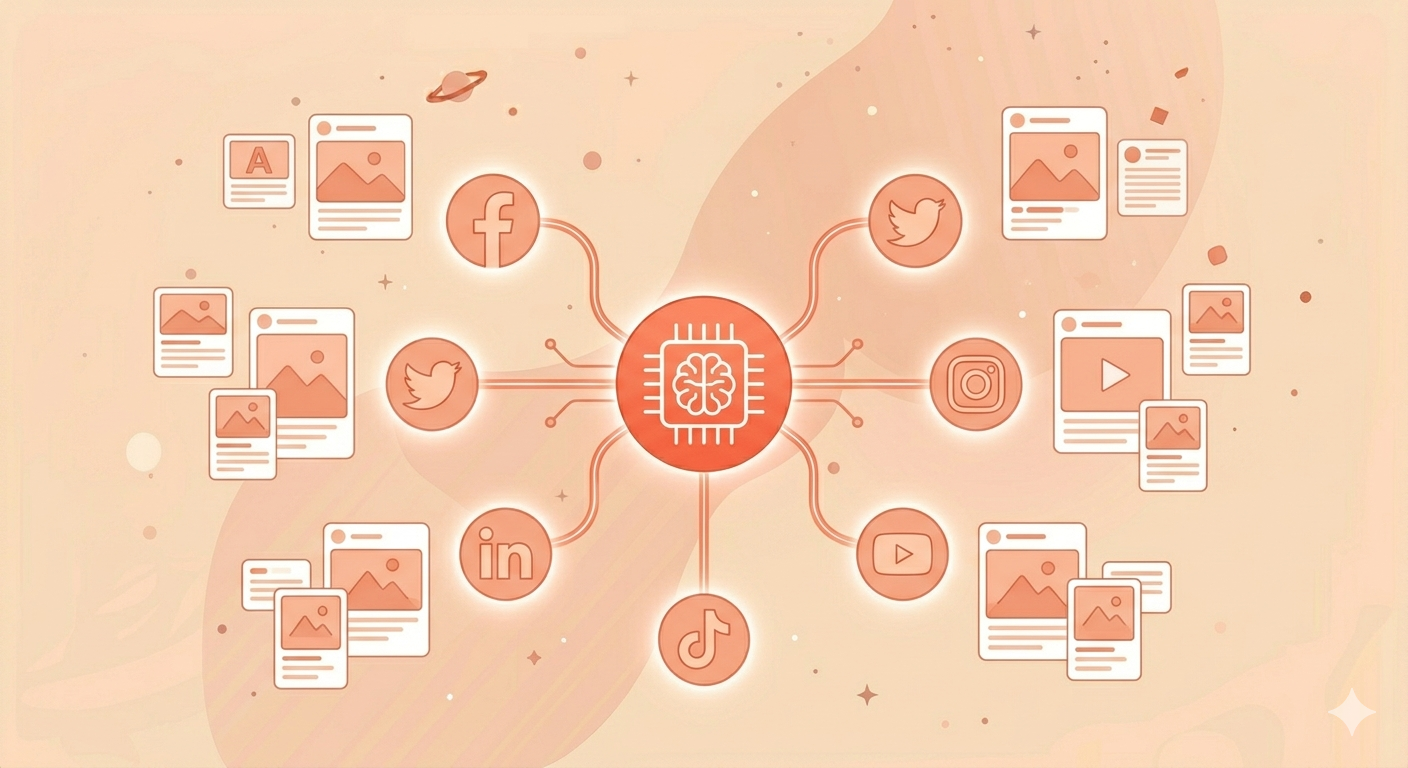
Managing presence across Instagram, TikTok, YouTube, LinkedIn, Facebook, and X simultaneously used to require either a dedicated team or a chaotic mix of different tools. AI platforms in 2026 manage all of it from a single dashboard — generating platform-appropriate content for each channel, scheduling optimally for each audience, and reporting unified performance data across all channels in one view.
For a small brand owner who previously had to choose between platforms because managing multiple was impossible, this is a transformational capability.
Join the small brands already using AI to run their entire social presence on autopilot.
Ready to follow along? Create your first AI video for free.
What Small Brands Are Getting Wrong About AI
Despite the opportunity, most small brands that are trying to use AI for social media are not getting the results they expected. The reason is almost always one of three mistakes.
Mistake 1 — Using AI as a Replacement for Strategy
AI is a production tool. It generates content extremely well. But it generates content based on the brief you give it — and if your brief is vague, your content will be generic. Brands that point an AI tool at their Instagram account and say "make me posts" and expect growth are going to be disappointed.
The brands getting results from AI have done the strategic work first. They know their audience precisely. They have defined their content pillars. They have identified the keywords their customers are searching for. They have a clear brand voice documented. They give the AI a rich, specific brief — and the AI produces rich, specific content in return.
AI amplifies your strategy. It cannot replace it.
Mistake 2 — Setting and Completely Forgetting
AI automation does not mean zero involvement. The brands treating their AI content system as a set-it-and-forget-it operation are producing content that gradually drifts off-brand, misses emerging trends, and fails to incorporate real-world events and moments that matter to their audience.
The right model is monthly oversight with daily automation. Once a month you review performance, update your brand brief, make strategic adjustments, and approve the next content cycle. The AI handles daily execution. You handle monthly direction.
Mistake 3 — Ignoring the Human Layer
AI handles production. Humans handle connection. The brands performing best in 2026 use AI to generate and publish content at volume while maintaining a genuine human presence in their community — responding to comments personally, engaging with their audience in DMs, and showing the real people behind the brand in occasional unscripted moments.
AI content builds reach and consistency. Human connection builds loyalty and trust. Both are necessary. Brands that automate everything including community interaction often find that their metrics grow while their genuine audience connection shrinks.
What You Need to Do Right Now
If your brand is not yet using AI in your social media strategy, the gap between you and competitors who are is growing every week. Here is where to start.
This week: Audit your current posting consistency across every platform. Count how many times you posted last month on each channel. Be honest about how consistent you actually were. This baseline tells you exactly how much improvement AI can deliver.
This month: Build your brand input document — your niche, audience, tone, content pillars, and keyword list. This is the foundation everything else runs on. Without it, AI produces generic content. With it, AI produces content that sounds like your brand.
This quarter: Implement a monthly batch content cycle. Use AI to generate your full content calendar, review and approve it in one session, and let the scheduling automation handle the rest. Measure the difference in posting consistency, reach, and audience growth after 90 days.
This year: Build a content bank from your best performing posts. As your AI system runs for months, you accumulate data on what works for your specific audience. Feed that data back into your briefs and watch content quality compound over time.

The Window Is Open — But Not Forever
Every major platform shift in social media history has had an adoption curve. The brands that got on Instagram early built audiences that late movers could never replicate. The brands that mastered TikTok in 2020 built presences that took competitors years to catch up to.
AI-powered social media is the same curve. Right now the early adopters are pulling ahead. In 12 to 18 months, AI-managed social media will be the baseline expectation — every brand will be using it, the content volume will be standardized, and the competitive advantage of being early will be gone.
The window to build a compounding content advantage using AI is right now. The brands moving in 2026 are building libraries of searchable content, training their AI systems on audience data, and accumulating algorithmic momentum that compounds every month.
The brands waiting are losing ground they may not be able to recover.
This is not about chasing a trend. It is about recognizing a permanent structural shift in how social media works and getting ahead of it before the competitive landscape hardens around the new reality.
Final Thoughts
AI has not just made social media marketing faster or cheaper for small brands. It has fundamentally changed what is possible — who can compete, at what volume, and with what consistency.
In 2026 a small brand with the right AI setup is not competing against other small brands. It is competing with mid-size companies, regional brands, and in some cases national players — and winning, because its content system is more consistent, more optimized, and more responsive to platform data than a team of humans trying to manage it manually.
This is the opportunity. It is real, it is available right now, and it is not going away.
The only question is whether your brand is building that system today — or watching competitors who already have it pull further ahead every single week.
SnapReel AI gives small brands the same content production capabilities as a full social media team — AI-generated scripts, videos, captions, and automated publishing across every platform. Start building your content engine today.