How to Use AI Without Losing Trust — The Small Brand Guide to Authentic AI Content in 2026
SnapReel
May 14, 2026 · 15 min read

Table of Contents
There is a term that started appearing in marketing conversations in late 2024 and has become one of the most discussed concepts in brand strategy by 2026. The term is AI slop. It refers to content that is obviously, unmistakably generated by an AI without meaningful human input — generic captions that sound like no real person has ever spoken them, product descriptions that list features in the same lifeless order every time, brand voices that shift subtly from post to post because a different prompt produced a different output. Content that technically says the right things but feels like no one actually said them.
AI slop is a real phenomenon with real consequences. More than 30% of consumers say they are less likely to choose a brand if they know its ads are AI-generated. Over half of social media users — 52% — are worried about brands posting AI-generated content without disclosing it. McDonald's Netherlands pulled an AI-generated advertisement after it went viral for entirely the wrong reasons. The backlash against AI slop is not theoretical. It is happening, it is visible, and it is damaging brands that have not thought carefully about how they are using AI.
But here is what makes this topic genuinely complicated: AI is also unavoidable in 2026. The brands growing fastest are using AI agents to produce content at a volume and consistency that manual operation cannot match. The economics of content creation have changed permanently — a small brand that tries to compete on social media without any AI assistance is fighting with one hand tied behind its back. Refusing to use AI is not a strategy. It is a competitive disadvantage dressed up as a principle.
The real question is not whether to use AI. It is how to use AI in a way that makes your brand stronger rather than weaker — that accelerates your content production without sacrificing the authenticity, consistency, and human soul that make audiences trust you.
This guide is the answer to that question.
Understanding Why AI Content Loses Trust — And Why It Does Not Have To
Before discussing what to do, it is worth understanding precisely why AI content erodes trust when it is done badly. Because the problem is not actually the AI. The problem is what brands do with AI output.
When a brand publishes AI-generated content without any human layer on top of it, several things happen simultaneously that audiences — consciously or not — pick up on.
The voice becomes inconsistent. AI language models generate text based on the prompt they receive, and different prompts produce subtly different voices. A brand that prompts an AI differently each time it creates content ends up with posts that sound vaguely similar but never quite like the same person. Regular followers notice this inconsistency even if they cannot articulate what is wrong. The brand starts to feel hollow.
The specificity disappears. AI-generated content defaults to general truths rather than specific observations. A human brand owner writing about their product says things like "we spent six months getting this texture exactly right because it kept pilling on dry skin and we refused to launch until it didn't." An AI writing about the same product says "our formula is carefully developed with quality in mind." Both technically communicate product quality. Only one communicates it in a way that feels real, earned, and trustworthy.
The cultural awareness lags. AI models are trained on data with a cutoff date, and even the most current models have a slight delay in understanding the specific cultural nuances, platform-specific language patterns, and community in-jokes that make content feel genuinely native to a space. Human creators who are immersed in their community every day understand these nuances instinctively. AI content, without human editing, often misses them in ways that feel slightly off to an audience that is deeply embedded in the same space.
None of these problems are inherent to AI. They are all problems of implementation — of using AI output as a finished product rather than as a starting point that a human refines, personalizes, and makes genuine.
The Spectrum of AI Use — Where Brands Are Getting It Wrong and Right
Not all AI use in marketing is equal. Understanding the spectrum from problematic to powerful helps you identify where your current AI use falls and where to aim.

At the problematic end of the spectrum is what can be called pure AI output publishing — taking whatever an AI generates and posting it directly with no human review, editing, or personalization. This is the AI slop zone. The content is technically there, the posting schedule is technically maintained, but the brand voice is absent and the audience can feel it. This approach optimizes for volume at the expense of everything that actually makes content valuable.
One step better but still problematic is templated AI use — using AI to generate content from the same template prompts repeatedly without evolving the prompts based on what the brand is actually doing, learning, or experiencing. Templated AI content is consistent but static. It sounds like the brand but has nothing new to say. It fills the feed without building the relationship.
In the middle of the spectrum is AI-assisted human creation — using AI to generate first drafts, ideas, or structural outlines that a human then substantially rewrites, personalizes, and makes their own. This is where most effective small brand AI use lives. The AI handles the blank-page problem and the structural heavy lifting. The human handles the voice, the specific details, the cultural nuance, and the genuine insight. The output is better than what either could produce alone.
Further toward the positive end is AI as infrastructure — using AI not to generate the words and visuals your audience sees, but to handle the operational logistics that would otherwise consume your creative time. Scheduling, analytics, format optimization, platform-specific resizing, performance reporting. When AI handles these invisible layers of content operation, the human creative time that remains goes entirely toward producing authentic, high-quality content rather than being diluted by operational tasks.
At the most positive end of the spectrum is what the best brands are doing in 2026: using AI as a force multiplier for human creativity and strategy rather than a replacement for it. The human sets the direction, defines the brand voice, creates the genuine insights and specific stories, and makes the strategic decisions. The AI amplifies the reach, consistency, and production capacity of that human creativity. The audience receives content that feels genuinely human because it is — the AI made more of it possible, but the humanity in it came from a person.
SnapReel generates content in your brand voice — so your audience gets authenticity and you get automation.
Ready to follow along? Create your first AI video for free.
The Five Principles of Trustworthy AI Content
Translating this spectrum into practical behavior requires five specific principles that, applied consistently, allow a small brand to use AI at full power without sacrificing the trust that drives purchasing decisions.
Principle One — Document Your Brand Voice Before You Prompt
The single most important thing a small brand can do before using AI for content creation is create a detailed brand voice document. Not a vague description like "friendly but professional." A genuinely detailed document that captures specific language patterns, recurring phrases, topics the brand talks about and topics it never touches, the emotional register of the brand at its best, examples of content the brand has published that perfectly captures its voice, and examples of content from other brands that the brand would never produce.
This document becomes the foundation of every AI prompt. When you give an AI model a detailed, specific brand voice document as context for every piece of content it generates, the output is dramatically closer to your actual brand voice than anything a generic prompt produces. It also makes your AI output consistent across every session, because the AI is always working from the same foundation rather than improvising from scratch.
A brand voice document takes a few hours to create and saves hundreds of hours of editing AI output into something that sounds like you. It is the highest-leverage investment a small brand can make in its AI content strategy.
Principle Two — Always Add One Specific True Thing
The single most effective edit you can make to any piece of AI-generated content is adding one specific, true detail that only someone with genuine knowledge of your brand could know. Not a general claim about quality or care — a specific, verifiable, unique detail.
If the AI writes "our candles are made with natural ingredients," you add "our candles are made with 100% coconut wax sourced from a single farm in the Philippines that we have worked with since 2021." If the AI writes "our skincare is designed for sensitive skin," you add "we spent four months reformulating after a customer in our community told us the original version broke her out — the version you are buying today exists because she was honest with us."
Specific true details do three things simultaneously. They make the content feel unmistakably human. They communicate brand values through evidence rather than claims. And they give the audience something genuinely memorable and shareable — a detail that sticks in a way that generic quality claims never do.
Principle Three — Disclose Thoughtfully Without Over-Explaining
The disclosure question — whether and how to tell your audience that you use AI — is one that brands in 2026 are navigating with varying degrees of skill. Two extremes both create problems.
Hiding AI use entirely is increasingly untenable. Audiences are becoming more sophisticated at recognizing AI-generated content, platform regulations around AI disclosure are tightening, and the trust damage of being perceived as deceptive about AI use is far greater than the trust damage of transparent disclosure.
But over-explaining AI use — prefacing every post with a lengthy disclaimer about the role of AI in its creation — creates a different problem. It makes AI the story rather than your brand. It signals insecurity about your content strategy. And it is simply unnecessary: audiences do not need to know the production process behind every piece of content any more than they need to know which editing software a photographer uses.
The middle path is contextual disclosure — being open about your use of AI when directly asked, including a brief note when AI played a particularly significant role in a piece of content, and building a general public understanding of your brand's AI philosophy through occasional, natural conversation about how you work rather than per-post disclaimers.

Principle Four — Keep Storytelling Human Always
There is one category of content that AI should never generate without substantial human authorship: your brand's stories. The founding story. The product development stories. The customer stories. The behind-the-scenes moments that show who the people behind the brand are and what they care about.
These stories are the heart of your brand's trustworthiness. They are what audiences return to when they are deciding whether to buy, whether to recommend, whether to trust. And they are the category of content that AI genuinely cannot generate from scratch — because AI cannot know what actually happened, what you actually felt, what the customer actually said, what the product actually cost you to get right.
Use AI to help structure and refine your stories after you have written the raw version. Use AI to adapt stories for different platforms and formats. But write the raw version yourself. The unpolished truth that comes from a human remembering and telling a real experience is irreplaceable — and it is what audiences mean when they say they want authentic content.
Principle Five — Let Performance Data Guide Your AI Strategy
The brands that use AI most effectively treat it as an evolving system rather than a fixed tool. They track which AI-assisted content performs best with their audience, analyze what specific elements drove that performance, and use those insights to improve their prompts and processes over time.
If your audience consistently responds better to AI-assisted content that includes a specific personal detail at the opening, you build that into your prompting process. If your audience responds better to shorter AI-generated captions than longer ones, you adjust your instructions accordingly. If you find that certain topics produce AI output that consistently needs heavy editing while others produce output you can use with minimal changes, you restructure your workflow to invest human editing time where it matters most.
This data-driven approach to AI content strategy is what separates the brands using AI as a genuine competitive advantage from the brands using it as a cost-cutting measure that eventually backfires.
How to Audit Your Current AI Content Strategy
If your brand is already using AI for content creation, a simple audit reveals where on the spectrum your current approach falls and what specific changes would move you toward more trustworthy output.
Read the last twenty pieces of content your brand published. For each one, ask whether a stranger reading it could identify a single specific detail that proves a real human was involved in creating it. If most of your content fails this test — if it is competent and on-topic but could have been written about any brand in your category — your AI use has drifted toward the problematic end of the spectrum.
Next, ask a person who knows your brand well — a close friend, a longtime customer, a business advisor — to read ten pieces of your recent content without telling them which you created manually and which were AI-assisted. If they cannot reliably identify the difference, your human layer is working. If they immediately identify the AI-assisted pieces as feeling different, your prompting and editing process needs refinement.
Finally, check your engagement patterns. AI slop consistently produces a specific engagement signature: lower comment rates, higher surface-level reactions, fewer saves, and almost no genuine conversation in the comments. If your engagement has shifted in this direction since you started using AI heavily, the content quality deterioration is already affecting your audience relationship.
Building a Sustainable Human-AI Content System
The goal is not to minimize AI use out of concern for trust. The goal is to build a system where AI and human contribution each do what they do best — and where the audience receives content that is both genuinely authentic and consistently excellent.
A sustainable human-AI content system for a small brand has four components working in concert.
A human-authored brand voice foundation that is updated regularly as the brand evolves — the document, the examples, the principles that every AI prompt is built on.
An AI production layer that handles the volume, consistency, formatting, and distribution work that would otherwise consume all available human creative time.
A human review and personalization layer that adds the specific true details, catches the cultural misses, maintains the voice consistency, and makes the final call on every piece of content before it reaches the audience.
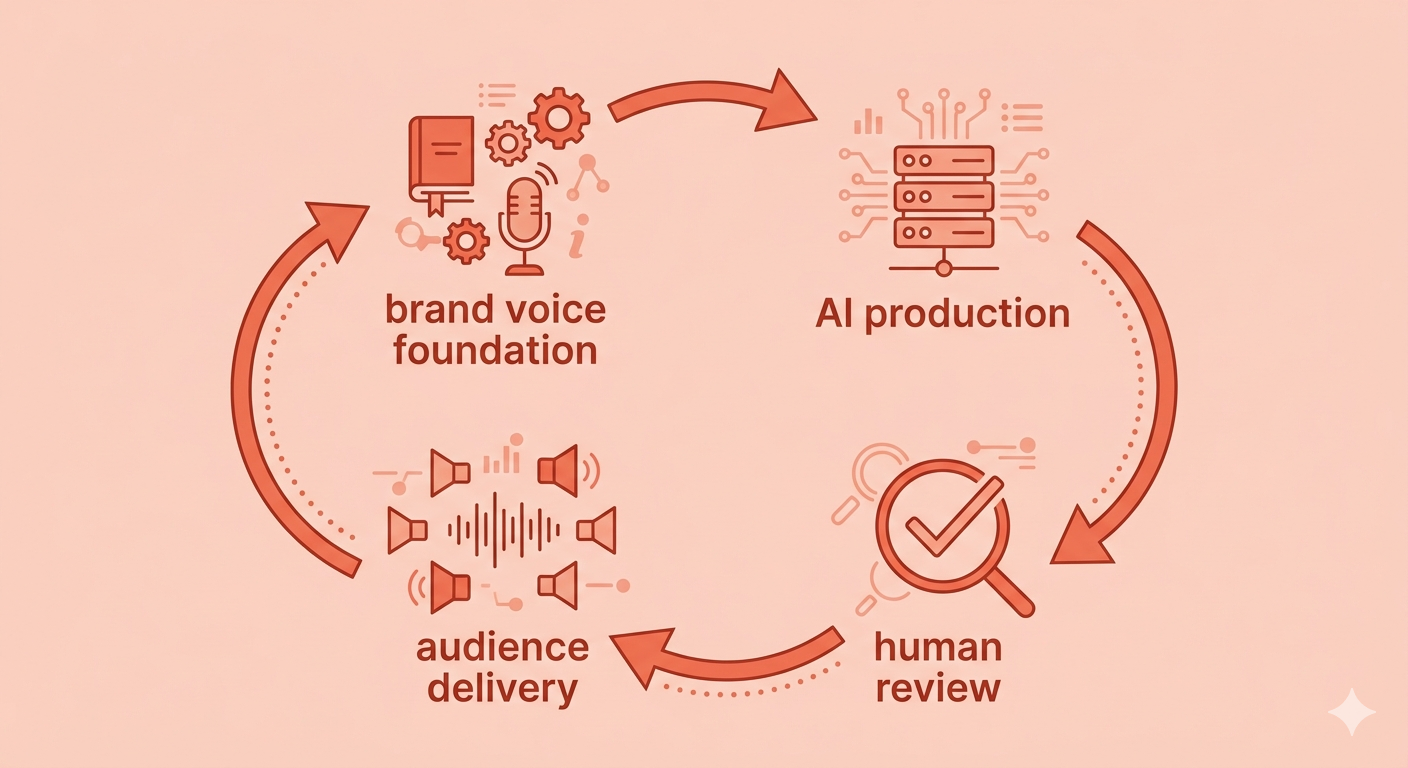
A feedback loop that brings performance data back into the brand voice foundation and the AI prompting strategy — so the system learns and improves over time rather than producing the same output indefinitely.
This system is not more work than fully manual content creation. It is different work — more strategic, more focused on the things only a human can contribute, and more scalable as the brand grows. The brands that build this system in 2026 will be producing better content at higher volume with less total effort than brands that are still doing everything manually — while also producing more trustworthy content than brands that have handed everything to AI without a human layer.
The Trust Dividend of Getting This Right
There is a significant and underappreciated business advantage available to small brands that figure out the human-AI balance before their competitors do. As AI slop proliferates across social media — as audiences become increasingly skilled at recognizing and disengaging from content that feels machine-generated — the brands that maintain genuine human authenticity within an AI-assisted production system will stand out with increasing clarity.
The contrast effect works in your favor. When most content in a category feels hollow and automated, content that feels genuinely human becomes remarkable by comparison. The bar for standing out has in some ways been lowered by the proliferation of low-quality AI content — because genuine human presence in content is now rarer and more valuable than it has ever been.
The brands that earn the trust dividend are the ones that use AI exactly as it should be used: as a tool that expands what humans can do, not as a replacement for the human judgment, creativity, and specific knowledge that makes content trustworthy. They produce more content than their manual competitors and more authentic content than their AI slop competitors. They occupy the competitive space that is genuinely difficult to reach and genuinely difficult to displace once you are there.
SnapReel AI is built on exactly this philosophy — autonomous social media management that handles the production, scheduling, and distribution work at scale, while keeping your brand voice, your specific stories, and your human strategic direction at the center of everything your audience sees.