The Complete Guide to Multi-Platform Social Media Management for Small Brands in 2026
SnapReel
May 8, 2026 · 19 min read
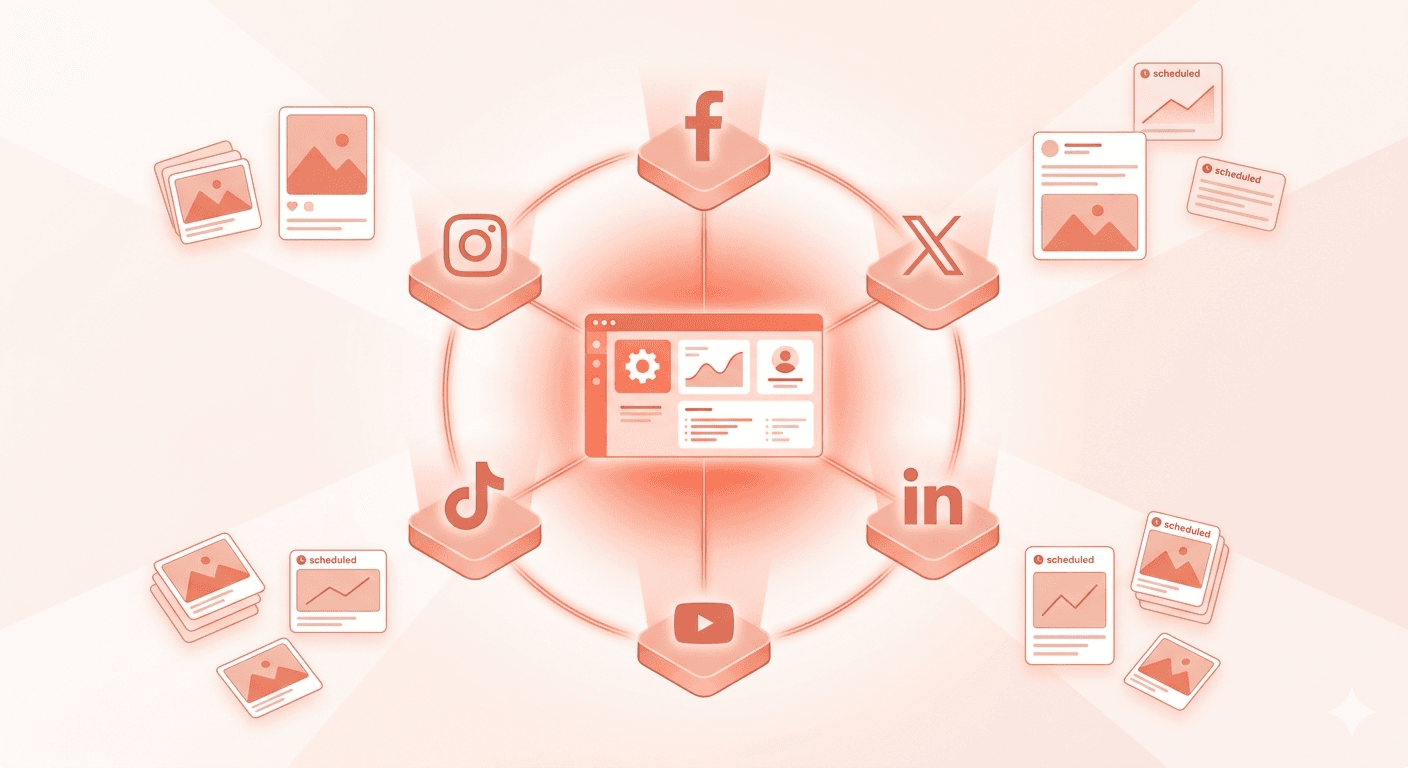
Table of Contents
The Platform Problem Every Small Brand Faces
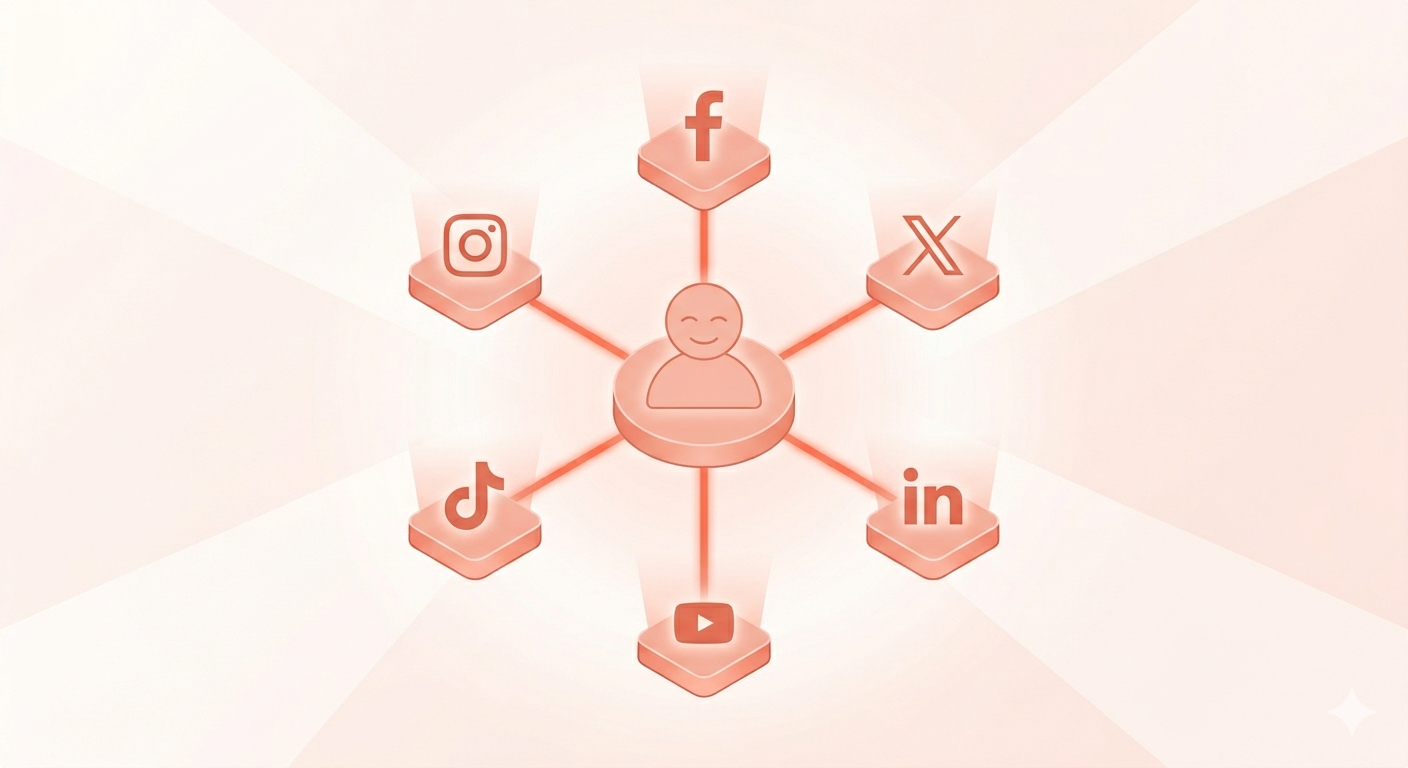
Your customers are not on one platform. They are on six.
The 25-year-old discovering your product is on TikTok. The 35-year-old comparing options is on Instagram. The 42-year-old business owner evaluating your service is on LinkedIn. The 28-year-old researching in depth is on YouTube. The 50-year-old who saw your brand mentioned by a friend is on Facebook. And all of them expect your brand to have a presence — consistent, active, and relevant to their specific platform — when they arrive to look.
This is the multi-platform reality of social media marketing in 2026. It is not enough to be excellent on one platform and absent from others. Your customers move fluidly between platforms throughout their day, and they encounter your brand — or your competitors — at multiple points in that journey. The brands showing up consistently across all of those touchpoints are building compounding brand recognition and trust. The brands showing up on one or two platforms are invisible at every other touchpoint.
For large brands with dedicated social media teams, managing six platforms simultaneously is a solved problem. For small brands with one person or a handful of people managing everything, it feels impossible.
This guide explains why it is not impossible — and exactly how small brands in 2026 are managing a genuine, high-quality presence across every major social platform without a team, without working extra hours, and without sacrificing the platform-specific content quality that each channel requires.
Why Most Small Brands Fail at Multi-Platform Management
Before getting into the solution, it is worth being precise about why multi-platform management breaks down for most small brands — because understanding the failure mode helps identify the right fix.
The most common approach small brands take to multi-platform management is what could be called the sequential overwhelm model. They start on Instagram. They get some traction. Someone tells them they need to be on TikTok. They add TikTok. Someone else says LinkedIn is important for their industry. They add LinkedIn. Each new platform adds roughly the same time commitment as the last — because they are managing each one manually, creating separate content for each, scheduling separately, and monitoring separately.
By the time a brand is attempting to manage four or five platforms manually, the time investment has become unsustainable. Quality starts to fall on all platforms because the person managing them is spread too thin. Posting becomes inconsistent because there is not enough time to do everything. And the brand ends up with a mediocre, inconsistent presence everywhere instead of a strong presence somewhere.
The other common failure mode is the cross-posting trap. The brand realizes they cannot create separate content for every platform, so they post exactly the same content everywhere simultaneously. A vertical video filmed for TikTok gets posted to LinkedIn unchanged. A text-heavy LinkedIn post gets cross-posted to Instagram with no visual adaptation. This approach saves time but actively damages performance on every platform — because each platform's algorithm penalizes content that does not feel native, and each platform's audience has different expectations for format, length, tone, and style.
The solution to multi-platform management in 2026 is neither of these approaches. It is a third model entirely — centralized content strategy with AI-powered platform adaptation and automated publishing — that produces genuine platform-native content for every channel simultaneously from a single brief.
Understanding Each Platform's Role in Your Brand Ecosystem
Before building a multi-platform management system, you need a clear model of what each platform does for your brand — because not every platform serves the same function, and managing them as if they do leads to misaligned content strategy.
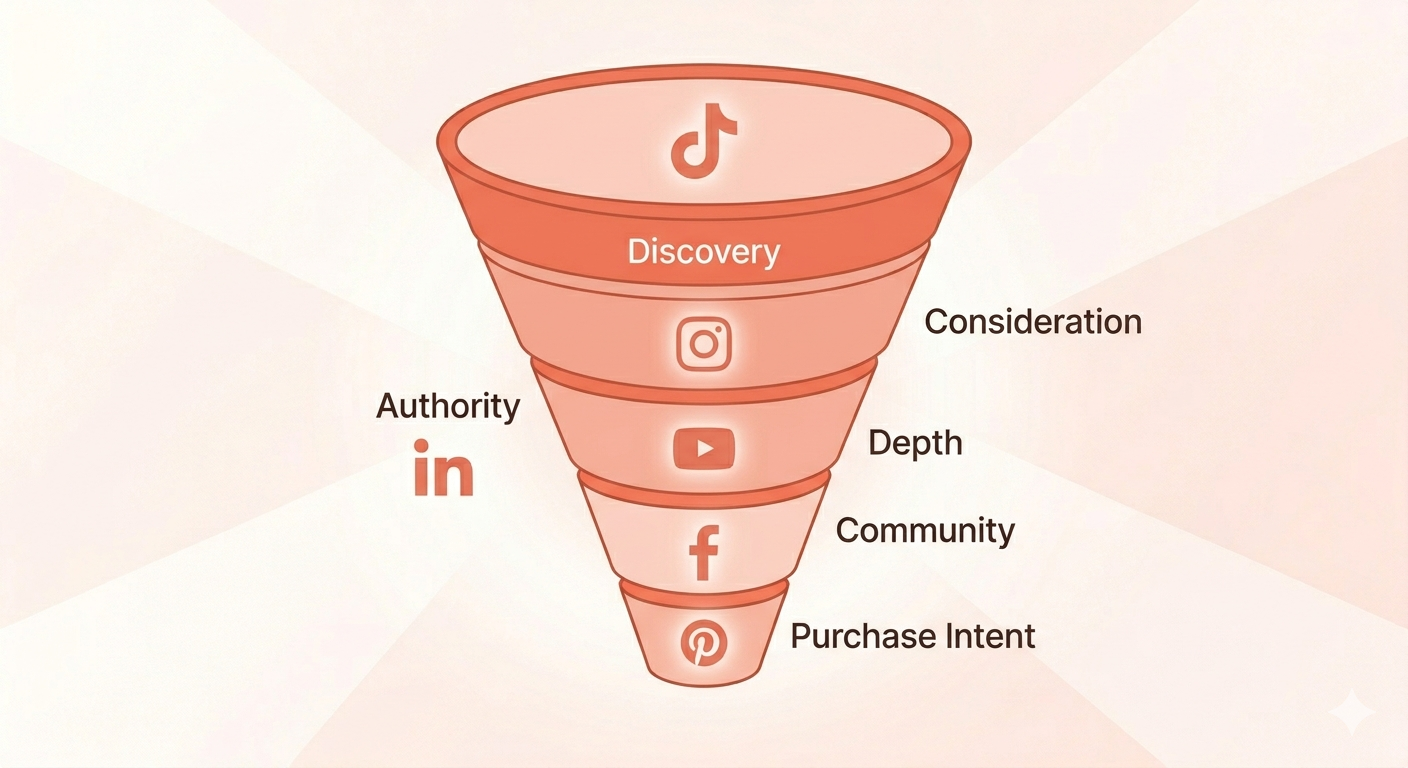
Think of your social media platform mix as a funnel with different entry points.
TikTok — Discovery and Top-of-Funnel Reach
TikTok is your highest-reach discovery platform in 2026. Its algorithm distributes content to non-followers more aggressively than any other platform — a brand with 500 followers can reach 50,000 people with a single well-performing video. TikTok is where new audiences first encounter your brand, often without ever actively searching for you.
Content on TikTok should prioritize reach over conversion. Educational tips, entertaining product demonstrations, trend participation, and authentic behind-the-scenes content all perform well because they are designed for discovery — to stop a scroll and introduce your brand to someone who has never heard of you.
Instagram — Consideration and Community Building
Instagram sits at the consideration stage of the funnel. Users who discover your brand on TikTok often check your Instagram profile next — it functions as a more curated brand homepage where potential customers evaluate whether your brand is legitimate, consistent, and worth following.
Instagram rewards visual consistency and brand identity more than any other platform. Your grid, your Reels, your Stories, and your Highlights should all present a coherent brand aesthetic. Shoppable content, social proof posts, and product demonstration Reels perform well on Instagram because the audience is in an evaluation mindset — comparing your brand against alternatives and deciding whether to purchase or follow.
LinkedIn — Authority and B2B Consideration
For brands with a business-to-business component — software, services, consulting, or any product sold to business owners — LinkedIn is where you build authority and credibility with a professional audience. LinkedIn content should demonstrate expertise, share insights, and engage with the professional community in your industry.
LinkedIn audiences respond to thought leadership, case studies, and honest professional perspective. They do not respond well to promotional content, lifestyle aesthetics, or entertainment-first formats. Your LinkedIn presence should make your brand look like the credible, knowledgeable option for any business decision-maker in your target market.
YouTube — Depth and Long-Term Organic Traffic
YouTube serves a specific and valuable function in your multi-platform ecosystem — it is where depth-seekers go. Customers who are seriously considering a purchase, researchers who want to understand a product category thoroughly, and viewers who prefer longer-form content all turn to YouTube for the kind of detail that short-form platforms cannot accommodate.
YouTube content — both long-form videos and Shorts — has a significantly longer shelf life than content on other platforms. A well-optimized YouTube video continues driving search traffic for months or years, making it the highest long-term ROI content format in your platform mix. Every brand should have at least a Shorts presence on YouTube in 2026, even if long-form video is not feasible.
Facebook — Community and Older Demographics
Facebook's organic reach for brand pages has declined significantly over the past several years. In 2026 it is not the primary growth platform for most small brands. However, it remains valuable for two specific functions: reaching older demographics who are not active on TikTok or Instagram, and building private community spaces — Facebook Groups — where your most engaged customers gather.
For brands whose primary customer base skews 45 and older, Facebook remains a first-tier platform. For brands targeting younger demographics, Facebook is a secondary channel that deserves presence but not primary investment.
Pinterest — Visual Discovery and Purchase Intent
Pinterest occupies a unique position in the platform ecosystem — it is the only major platform where users arrive explicitly in a discovery and planning mindset rather than an entertainment mindset. Pinterest users are actively looking for products, ideas, and inspiration — which means they have significantly higher purchase intent than users on other platforms.
For brands in visual product categories — fashion, beauty, home, food, wellness, travel — Pinterest should be a priority platform rather than an afterthought. Its AI-powered visual search surfaces products to users whose browsing behavior indicates purchase intent, creating a discovery channel that functions more like a product search engine than a social media platform.
Manage every platform without the overwhelm — SnapReel creates and posts branded content everywhere automatically.
Create AI-powered videos and auto-post to all your platforms.
The Multi-Platform Content System — One Brief, Six Platforms
The breakthrough that makes multi-platform management achievable for small brands in 2026 is the concept of a single content brief that generates platform-adapted content for every channel simultaneously.
Here is how it works.
The Brand Brief — Your Foundation Document
The brand brief is a document you create once and update quarterly. It contains everything an AI content system needs to produce on-brand content for every platform without requiring you to reinvent the wheel for each post.
Your brand brief should include your core product and the specific problem it solves, your target audience with precise demographic and psychographic detail, your brand voice and tone with examples of what sounds right and what sounds wrong, your content pillars — the three to five recurring themes that every post fits within, your visual identity — colors, fonts, and aesthetic direction, your keyword list — the search phrases your customers use on each platform, and your content boundaries — topics you avoid, claims you do not make, competitors you do not reference.
This document is the instruction set for your entire multi-platform content operation. Every piece of content generated from it will feel like it came from the same brand — because it does.
The Content Brief — Your Per-Post Input
For each piece of content, you provide a short content brief alongside your brand brief. The content brief specifies the topic, the angle, the primary platform, any specific product being featured, and any time-sensitive context like a promotion or seasonal relevance.
The content brief does not need to be elaborate. A single paragraph of specific direction — "explain how small brands can post on six platforms simultaneously without a team, angle is empowering not overwhelming, feature SnapReel as the solution example" — gives the AI system enough direction to generate platform-adapted content for every channel.
Platform Adaptation — Six Outputs From One Brief
From the brand brief and content brief combined, an AI content system generates six platform-specific pieces of content simultaneously.
For TikTok it produces a 30 to 60 second script with a strong two-second hook, casual and direct language, on-screen text suggestions, and a keyword-optimized caption targeting discovery search phrases.
For Instagram Reels it produces a slightly longer script with more brand identity emphasis, a visual direction for the production, and a caption with the first line keyword-optimized for Instagram search, a mid-length body with engagement prompt, and 8 to 10 niche hashtags.
For LinkedIn it produces a 600 to 1,000 character professional post that takes the same core insight and reframes it for a business audience — more reflective tone, professional context, ending with a discussion question.
For YouTube Shorts it produces a script optimized for slightly longer watch time, a title formatted as a search query, and a description with keyword-rich first sentence.
For Facebook it produces a conversational post in the brand's community voice — slightly warmer and more personal than LinkedIn, shorter and less formal than Instagram, ending with a question that invites comments.
For Pinterest it produces a visual description optimized for the platform's image-based search, with product tags and relevant category keywords incorporated.
Six platform-native pieces of content from one brief, generated in minutes. This is what makes multi-platform management achievable for a one-person brand.
The Weekly Workflow — What Multi-Platform Management Actually Looks Like
Understanding the system is useful. Understanding what your week looks like when you are running it is what makes it real. Here is the practical weekly workflow for a small brand managing six platforms with an AI-powered multi-platform system.
Monday — Content Brief Creation (30 minutes)
On Monday morning you spend 30 minutes creating content briefs for the week. These are the per-post inputs that combine with your standing brand brief to drive AI content generation. For a brand posting three to five times per week on each platform, this means creating three to five content briefs — each one a short paragraph of specific direction.
You are not writing the posts. You are not creating the content. You are deciding what topics to cover and what angles to take — the strategic decisions that require your brand knowledge and your understanding of your audience. Everything else the AI handles.
Tuesday — Generation and Review (60 to 90 minutes)
On Tuesday you run your content briefs through your AI content system and generate all platform-adapted content for the week. Then you review everything. Watch each video. Read each caption. Check that the platform adaptation feels genuine — that the TikTok version sounds like TikTok and the LinkedIn version sounds like LinkedIn.
Most content will be ready to schedule with minor edits. A small percentage will need more significant revision. Flag anything that feels off-brand, inaccurate, or below quality standard and either edit it manually or regenerate with a more specific brief.
Wednesday — Scheduling (20 to 30 minutes)
Once content is approved, schedule everything for the week across all six platforms. Your AI scheduling tool determines the optimal posting time for each platform based on your audience's activity data. You assign each piece to its platform, confirm the schedule, and walk away.
From this point everything publishes automatically — the right content, on the right platform, at the right time — without you opening a single app.
Thursday and Friday — Community Management (15 to 20 minutes daily)
Community management is the one multi-platform task that cannot be fully automated — and should not be. Responding to comments, answering DMs, and engaging with your audience authentically are how you build the brand relationships that convert followers into customers and customers into advocates.
Set aside 15 to 20 minutes on Thursday and Friday to respond to the week's most meaningful comments across all platforms. You do not need to respond to every comment — prioritize genuine questions, specific feedback, and high-engagement conversations. This focused community management time delivers more relationship value than scattered throughout the day because you can give it proper attention rather than squeezing responses between other tasks.
Sunday — Performance Review (20 minutes)
On Sunday you spend 20 minutes reviewing the week's performance data across all platforms. Which posts drove the most reach? Which generated the most saves or comments? Which platforms are showing growth and which are plateauing?
This review informs Monday's content brief creation — you double down on what worked and adjust away from what did not. Over time this weekly feedback loop compounds your content quality because every week's output is informed by the performance data of every previous week.
Total active time per week: approximately three hours. Total posts published: fifteen to thirty across six platforms. This is what multi-platform management looks like when the system is running correctly.
Platform-Specific Mistakes That Kill Multi-Platform Performance
Even with the right system in place, there are platform-specific mistakes that consistently undermine multi-platform performance for small brands. Here are the most common ones and exactly how to avoid them.
Posting vertical video to LinkedIn. LinkedIn's feed is designed for horizontal and square content. Vertical video — optimized for TikTok and Instagram — displays poorly on LinkedIn's interface and signals immediately that the content was not created for the platform. Always adapt format to platform, not just text and tone.
Using Instagram hashtags on TikTok. Hashtag strategy is platform-specific. The niche hashtag sets that work on Instagram are different from the ones that drive discovery on TikTok. Generate platform-specific hashtag sets for every post rather than copying them across platforms.
Ignoring YouTube's search optimization. Most brands treat YouTube Shorts as an extension of their TikTok or Instagram Reels strategy — posting the same videos with the same captions. YouTube's search algorithm is fundamentally different from TikTok's and Instagram's discovery algorithms. Every YouTube Shorts title should be a search-optimized phrase, not a hook or a caption repost.
Over-posting on LinkedIn. LinkedIn's professional audience notices over-posting more acutely than audiences on other platforms. Posting more than once per day on LinkedIn creates fatigue and actually reduces per-post reach because your connections are less likely to engage with the fourth post they have seen from you this week. Two to three posts per week is the optimal LinkedIn frequency for most small brands.
Neglecting Pinterest's visual requirements. Pinterest content requires vertical imagery with specific aspect ratios, keyword-rich pin descriptions, and board organization that mirrors how users browse the platform. Brands that treat Pinterest as simply another place to post their Instagram content consistently underperform brands that create Pinterest-specific visual content.
Treating Facebook as a primary growth platform. Investing primary content creation effort in Facebook organic reach is a poor allocation of resources for most brands targeting audiences under 45. Facebook's organic reach for brand pages is minimal — it serves better as a community hub and a channel for reaching older demographics than as a primary growth platform.
Measuring Multi-Platform Performance — The Metrics That Matter
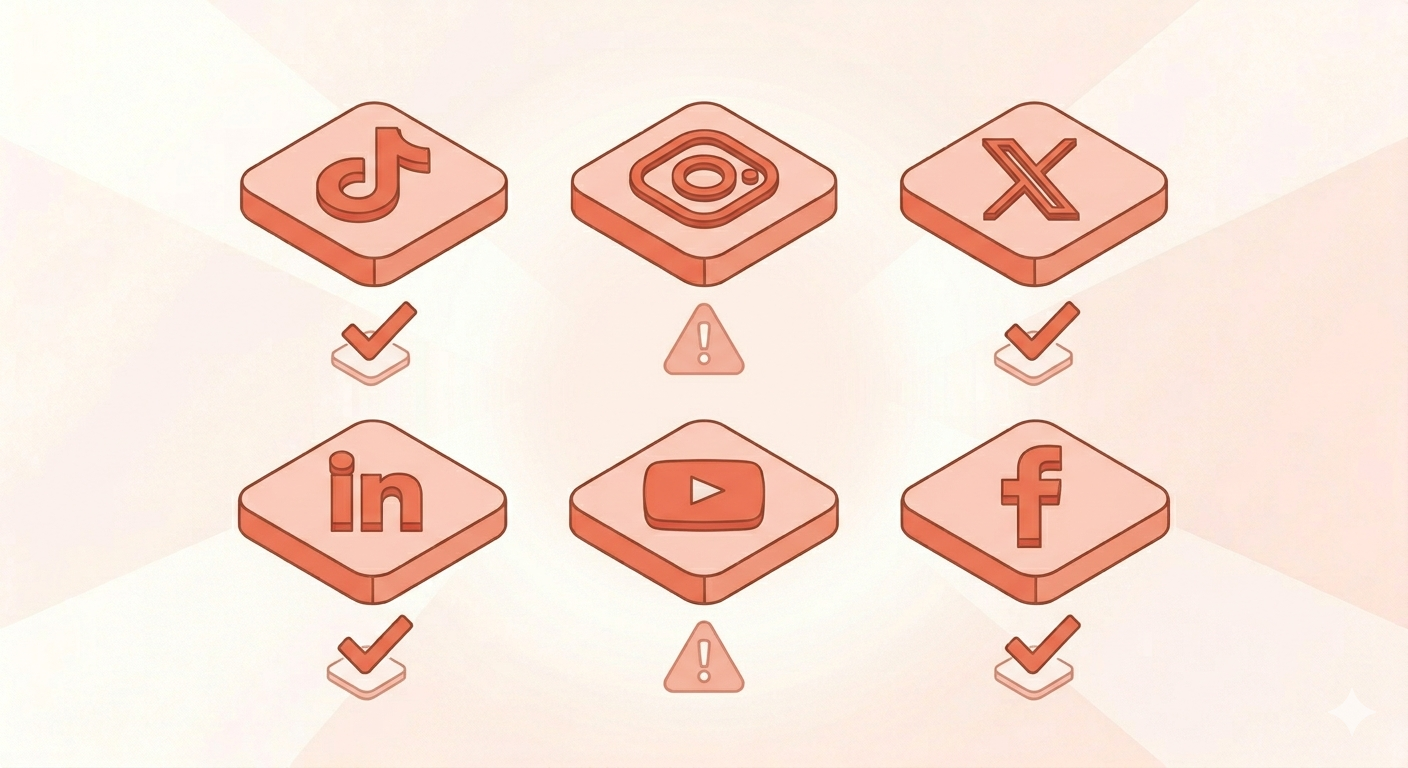
Managing six platforms creates a data challenge — there is a lot of it, and not all of it is equally important. The brands that improve their multi-platform performance over time focus on a small set of high-signal metrics rather than trying to monitor everything.
Cross-platform audience growth rate. Track your follower or subscriber growth rate on each platform monthly. Declining growth rate on a platform is an early warning signal that your content quality or posting consistency on that platform needs attention. Growing growth rate confirms that your content strategy is working.
Engagement rate by platform. Calculate your average engagement rate — total engagements divided by total reach — for each platform monthly. Declining engagement rate signals algorithmic suppression, audience mismatch, or quality decline. Comparing engagement rates across platforms tells you which channels your audience is most responsive on and deserve the most content investment.
Traffic from social to owned channels. How much traffic is each platform sending to your website, your email list, or your e-commerce store? This metric connects social media activity to business outcomes and tells you which platforms are driving real business results versus just social engagement. A platform with high reach but low traffic contribution is delivering awareness but not conversion — which may or may not be the right role for that platform in your funnel.
Content performance by format and platform. Track which content formats — Reels, carousels, text posts, live videos — perform best on each platform. Over time, patterns emerge that tell you where to concentrate your AI content generation effort for maximum impact per piece of content produced.
Revenue attribution from social. If your brand has e-commerce capability, track which platform-specific UTM parameters appear in your order data. This tells you which platforms are driving actual purchases — which is ultimately the metric that justifies the investment in multi-platform management.
Review these metrics monthly, not daily. Daily metrics fluctuate too much to provide reliable strategic signal. Monthly trends reveal the patterns that should drive your content strategy adjustments.
The Long-Term Compounding Advantage of Multi-Platform Presence
There is a compounding effect to multi-platform management that most brands do not account for when deciding whether to invest in it.
In month one, being on six platforms instead of two feels like a lot of work for limited additional return. Your audience on each new platform is small. Your content library on each platform is thin. Your algorithmic standing on each platform is unproven.
By month six, the picture looks different. Your TikTok audience is discovering your brand and checking your Instagram. Your Instagram audience is following you to LinkedIn where they see your professional credibility content. Your YouTube Shorts are driving search traffic from people who have never heard of you on any other platform. Your Pinterest presence is generating purchase intent traffic from an entirely different demographic. Your Facebook community is the highest-retention audience segment in your customer base.
Each platform is not just a standalone channel — it is a node in a brand ecosystem where audiences discovered on one platform migrate to others, increasing the number of touchpoints they have with your brand and significantly raising their likelihood of purchase and long-term loyalty.
The brands that have been building this multi-platform ecosystem for 12 to 18 months have an audience infrastructure that single-platform brands cannot replicate quickly. Their content library is searchable across six platforms. Their audience relationships span multiple contexts. Their algorithmic standing on each platform is established and self-reinforcing.
This is what multi-platform presence compounds into over time. And the brands that start building it today are establishing the 12-month head start that becomes increasingly difficult for later entrants to close.
Getting Started — The Right Order to Add Platforms
If your brand is currently strong on one or two platforms and looking to expand, the order in which you add platforms matters. Here is the priority sequence for most small consumer brands in 2026.
Start with TikTok and Instagram together. These two platforms share enough content overlap — both are vertical video first, both reward similar formats — that managing them simultaneously is the most efficient first step. Content produced for one can be adapted for the other with minimal additional effort.
Add YouTube Shorts as your third platform. YouTube Shorts content is largely the same vertical video format as TikTok and Instagram Reels — the primary difference is title and description optimization for search. Adding YouTube Shorts to an existing TikTok and Instagram workflow requires minimal additional production effort and adds a significant long-term organic search channel.
Add LinkedIn as your fourth platform if your brand has a B2B component, if your customers are professionals, or if thought leadership is part of your brand strategy. LinkedIn content requires the most tonal adaptation from other platforms — it is the platform where the same insight needs to be expressed most differently — but AI tools handle this adaptation automatically.
Add Pinterest as your fifth platform if your product is in a visual category — fashion, beauty, home, food, wellness. Pinterest's high purchase intent audience makes it particularly valuable for product brands in these categories.
Add Facebook as your sixth platform primarily to activate the social commerce connection with Instagram Shopping through Meta's Commerce Manager and to create a community space for your most engaged customers.
This sequence means you are never adding a platform without having the infrastructure in place to manage it properly — and each new platform adds audience reach without adding proportionally more management time.
Final Thoughts
Multi-platform social media management is not a big-team problem anymore. It is a systems problem. And in 2026 the systems exist to solve it at a cost and time investment that is accessible to any small brand.
The brands winning across six platforms simultaneously are not working six times harder than brands on one platform. They have built a content system — one brief, AI-powered platform adaptation, automated scheduling — that produces genuine platform-native content for every channel from a single strategic input.
Your customers are on six platforms. They expect your brand to show up on all of them. And in 2026 there is no longer any structural barrier — no team requirement, no budget requirement, no time requirement beyond what you can realistically invest — that prevents a small brand from building that presence.
The only remaining barrier is deciding to build the system.
SnapReel AI manages your brand's presence across every social platform simultaneously — generating platform-adapted content, scheduling at optimal times, and publishing automatically so your brand shows up consistently on TikTok, Instagram, LinkedIn, YouTube, Facebook, and Pinterest every single day.