Why Posting More on Social Media Actually Hurts Your Brand — And What to Do Instead in 2026
SnapReel
May 8, 2026 · 17 min read

Table of Contents
The Advice That Is Quietly Killing Small Brand Growth
Open any social media growth guide from the last five years and you will find the same advice repeated endlessly. Post every day. Post multiple times a day. Consistency is everything. Never go silent. The algorithm rewards volume.
This advice made sense when social media platforms were less sophisticated, when content volume was lower, and when algorithms distributed content more broadly regardless of quality signals. It does not make sense anymore.
In 2026 social media algorithms have become dramatically more sophisticated about quality. They measure watch time, completion rate, saves, shares, and genuine engagement — not just posting frequency. They track your account's historical engagement rate and use it as a baseline for how broadly to distribute your future content. They can detect low-effort, repetitive, or audience-irrelevant content and suppress its distribution even when the posting schedule is perfectly consistent.
The result is that many small brands following the "post more" advice are not just failing to grow. They are actively damaging their algorithmic standing by accumulating a pattern of low-engagement posts that trains the platform to distribute their content to smaller and smaller audiences over time.
This is the posting trap. And most brands that are stuck in it do not realize it is the reason their reach has plateaued.
This guide explains exactly how this happens, how to diagnose whether it is happening to your brand, and the quality-first content strategy that actually builds sustainable reach and revenue in 2026.
How Algorithms Actually Work in 2026 — The Quality Signal System
To understand why posting more can hurt your brand, you need to understand how modern social media algorithms actually evaluate and distribute content — because the mechanics are fundamentally different from what most people assume.
Every piece of content you post goes through what is effectively a testing process. When you publish a post, the algorithm does not immediately show it to all your followers. It shows it to a small test audience — typically 5 to 15 percent of your followers — and measures how that test audience responds.
If the test audience responds well — high watch time, strong completion rate, saves, shares, comments — the algorithm interprets this as a signal that the content is valuable and distributes it more broadly. First to the rest of your followers, then to non-followers who share similar interest signals, then potentially to the explore or discover pages where accounts with no prior connection to your brand encounter your content.
If the test audience responds poorly — low watch time, early exits, no saves or shares — the algorithm interprets this as a signal that the content is not valuable and limits its distribution. The post reaches a small percentage of your followers and stops there.
Here is where the posting trap begins. Every low-performing post is not just a missed opportunity. It is data that the algorithm uses to recalibrate your account's baseline engagement expectation. If you post consistently but your content consistently underperforms — because you are prioritizing volume over quality — the algorithm progressively lowers the reach it grants to your future content, because your historical performance suggests your content is not worth distributing widely.
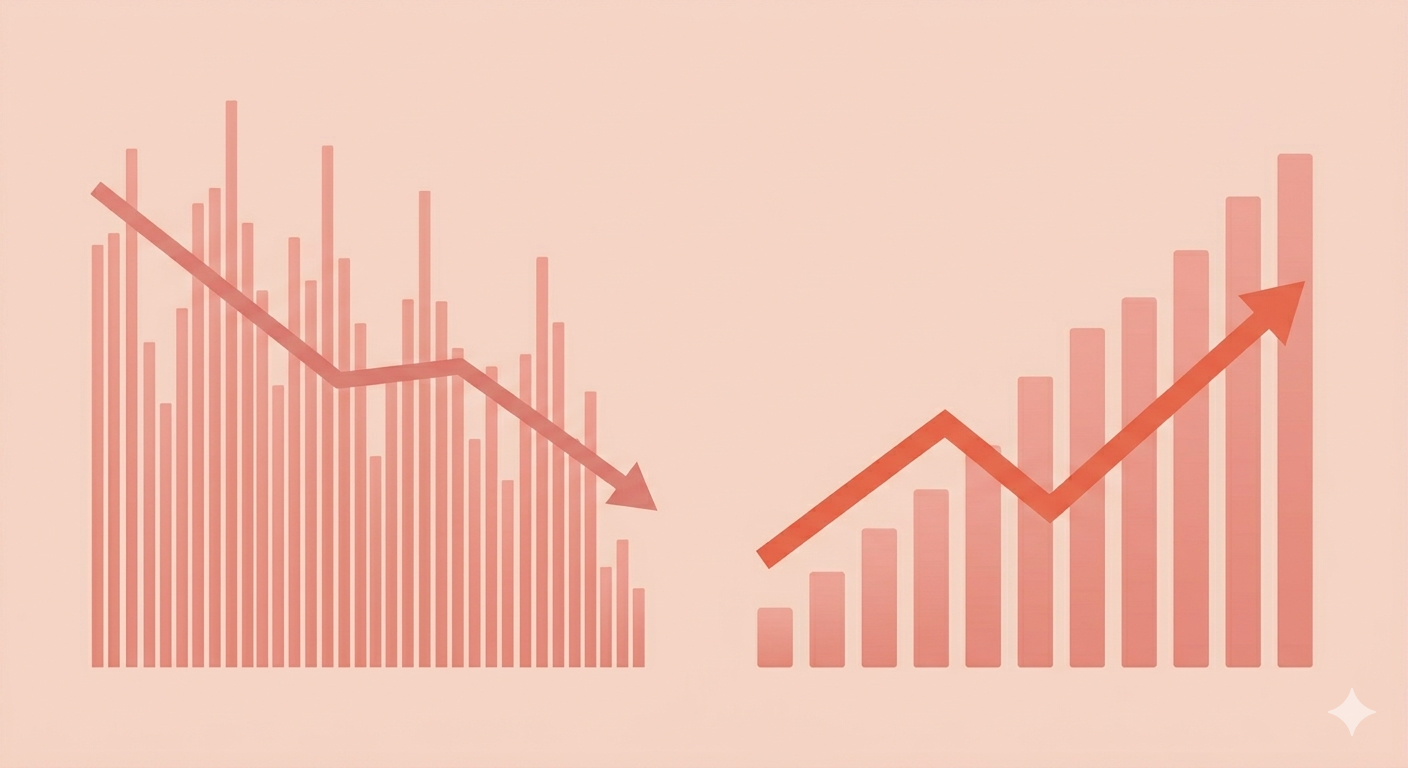
Over time, a brand that posts daily with average-quality content ends up with lower reach per post than a brand that posts three times a week with high-quality content — because the high-quality account has built a stronger engagement baseline that the algorithm responds to more generously.
This is not a bug in the system. It is the algorithm working exactly as intended — rewarding content that genuinely engages audiences and limiting the distribution of content that does not. The problem is that most posting-frequency advice was developed before algorithms became this sophisticated.
The Three Signs Your Posting Volume Is Hurting You
How do you know if you are in the posting trap? Here are the three clearest diagnostic signals.
Your reach is declining despite consistent posting. If you are posting the same frequency or more than six months ago but your average post reach has declined, this is a strong signal that your content quality is not keeping pace with your posting volume. The algorithm is responding to a pattern of underperformance by restricting your distribution.
Your engagement rate is dropping. Engagement rate — the percentage of your reach that actively engages with your content — is the metric most closely correlated with algorithmic favor. If your follower count is stable or growing but your engagement rate is falling, you are reaching more people who do not find your content relevant. This happens when posting volume forces content quality down and the algorithm begins showing your content to less precisely matched audiences.
Your best posts are not getting significantly more reach than your worst posts. On a healthy account, high-quality content gets substantially more reach than average content because the algorithm amplifies what performs well. If all your posts are reaching roughly the same small audience regardless of quality, your account's engagement baseline has been suppressed — likely by a sustained pattern of underperforming content.
If any of these three patterns apply to your brand, the solution is not to post less and give up. It is to change the relationship between volume and quality — which is exactly what the second half of this guide addresses.
The Real Reason Brands Post Too Much
Before getting into the solution, it is worth being honest about why brands fall into the posting trap in the first place. It is almost never laziness or indifference. It is usually one of three genuine problems that posting frequency feels like a solution to.
Fear of the algorithm going silent. There is a widespread belief that if you stop posting for even a few days, the algorithm will forget you exist and your reach will collapse. This belief drives brands to post low-quality content just to maintain a presence — which, as explained above, actually accelerates the reach decline they are trying to prevent.
The blank page problem. Consistently producing high-quality content is genuinely hard. When you are out of good ideas, posting something — anything — feels better than posting nothing. But the algorithm disagrees. A poor post does more damage to your account's engagement baseline than no post at all.
Misunderstanding what consistency means. Most brands interpret consistency as posting frequency — showing up every day. The algorithm interprets consistency as delivering reliable engagement — showing up every time with content that your audience genuinely values. These are not the same thing. A brand that posts three times a week with high-quality content is more consistent in the algorithmic sense than a brand that posts seven times a week with mixed quality.
Understanding the real cause of over-posting helps identify the right solution — which is not simply posting less, but building a content system that produces fewer, better posts without the blank-page problem that drives low-quality volume in the first place.
Post less
Put these tips into action — start creating with SnapReel for free.

What the Algorithm Actually Rewards in 2026
If posting volume is not the primary driver of algorithmic reach, what is? The answer is a combination of engagement quality signals that the algorithm uses to determine how valuable your content is to its users.
Watch time and completion rate are the most heavily weighted signals on video-first platforms. TikTok and Instagram Reels both measure how much of your video the average viewer watches before scrolling away. A video that 60% of viewers watch to completion tells the algorithm that the content is compelling and worth showing to more people. A video that most viewers skip after three seconds tells the algorithm the opposite — regardless of how many videos you post.
This single metric explains why shorter, tighter, higher-quality videos consistently outperform longer or lower-quality videos in algorithmic distribution. A perfectly crafted 25-second video that 70% of viewers complete will reach more people than a 60-second video that 20% of viewers finish — even if the longer video contains more information.
Saves are Instagram's most valued engagement signal because they indicate that a viewer found your content worth returning to — which is a strong proxy for genuine value delivery. A post that generates 50 saves from 1,000 views will be distributed more broadly by Instagram than a post that generates 500 likes from 1,000 views, because saves signal deeper value than passive likes.
Shares drive reach growth most directly because every share puts your content in front of an entirely new audience that has no prior connection to your brand. Content that people share is content they are willing to put their own social credibility behind — a high-trust signal that algorithms weigh accordingly.
Comments — specifically substantive comments rather than emoji reactions — signal that your content sparked enough genuine engagement to prompt a response. Algorithmic systems can increasingly distinguish between "great post!" emoji comments and genuine discussion, and they weight the latter significantly more heavily.
Profile visits from content indicate that a viewer found your content compelling enough to want to know more about you — suggesting purchase consideration, follow intent, or genuine brand interest. High profile visit rates from a piece of content signal audience quality that the algorithm responds to by distributing the content to more users likely to have similar responses.
The common thread across all of these signals is that they measure genuine audience value rather than posting activity. And genuine audience value comes from content quality, relevance, and specificity — not from posting frequency.
The Quality-First Strategy — What to Do Instead
Shifting from a volume-first to a quality-first content strategy does not mean posting less and hoping for the best. It means building a system that produces fewer posts that each generate stronger engagement signals — and using that stronger engagement baseline to earn more algorithmic distribution per post than you were getting from a higher volume of weaker content.
Here is the framework.
Define Your Content Pillars and Stick to Them
One of the most common quality problems in brand social media is topic inconsistency. A brand posts about their product on Monday, a trending meme on Tuesday, an inspirational quote on Wednesday, and a behind-the-scenes video on Thursday. Each post is in a different category, targeting a slightly different audience interest, sending mixed signals to the algorithm about what your account is actually about.
Algorithms in 2026 reward topical consistency — accounts that consistently produce content within a defined subject area build topical authority that earns broader distribution within that topic's audience. Define three to five content pillars that are all tightly related to your brand's core topic. Every post you publish should fit clearly within one of these pillars. This topical consistency is one of the most powerful quality signals an account can send.
Obsess Over the First Three Seconds
The first three seconds of every video are the only seconds that matter for your watch time and completion rate metrics — because they determine whether a viewer stays or scrolls. Every resource you invest in content production should be disproportionately concentrated in making those first three seconds as compelling as possible.
A strong opening hook is specific, immediately relevant to the viewer's interest, and creates a reason to keep watching. "I spent $500 on social media ads last month and made zero sales — here is what I did instead" is a hook. "Hey guys, welcome back, today I want to talk about social media" is not a hook. The first version creates a narrative tension that compels the viewer to keep watching. The second version gives them every reason to scroll.
The quality-first approach means refusing to publish any video whose first three seconds do not meet a high standard — even if that means publishing fewer videos overall.
Invest In Research Before Production
The highest-quality content is content that precisely addresses what your specific audience wants to know right now. This requires research — not guessing based on what you find interesting or what you have seen other brands post.
Before producing any piece of content, spend 10 minutes researching what your target audience is actively searching for on TikTok, Instagram, and Google. Search your product category, read the comments on competitor posts, look at what questions your audience is asking in the content you have already published. The content that comes out of this research phase will consistently outperform content produced from intuition or trend-chasing because it is directly mapped to existing audience demand.
Use AI to Maintain Quality at Sustainable Volume
Here is where the quality-first strategy and the efficiency argument come together. The reason most brands sacrifice quality for volume is that producing high-quality content consistently is genuinely time-intensive. Research, scripting, production, editing, caption writing — done properly for every post, this is a full-time job.
AI content tools in 2026 compress this time investment dramatically without compromising quality. AI handles the research phase by identifying trending keyword phrases and audience questions automatically. It handles scripting by generating platform-optimized scripts from your brand brief. It handles production by generating video content from those scripts. It handles captions by writing keyword-optimized, platform-adapted text for each post.
The result is that a small brand can produce 15 to 20 high-quality, well-researched, properly produced posts per month — rather than 30 rushed, low-quality posts — in the same or less time. And 15 high-quality posts will consistently outperform 30 low-quality posts on every algorithmic metric that matters.
This is the resolution of the quality-versus-quantity tension. AI does not let you post more junk faster. It lets you produce genuinely good content at a volume that was previously only achievable with a full content team.
The Optimal Posting Frequency by Platform in 2026
If volume is not the primary driver of reach, what is the right posting frequency? The honest answer is that there is no universal number — but there are evidence-based ranges that balance consistency with the quality standard required for each platform.
Instagram Reels: Three to five per week. This frequency is sustainable at a quality standard that drives strong completion rates and saves, while maintaining enough consistency to signal algorithmic reliability.
TikTok: Five to seven per week. TikTok rewards higher frequency than Instagram because its discovery algorithm is more content-volume sensitive — but quality still matters. Five high-quality posts per week consistently outperforms seven low-quality posts per week on TikTok's key engagement metrics.
LinkedIn: Two to three posts per week. LinkedIn's professional audience has a lower content consumption volume than entertainment-first platforms. Two to three substantive posts per week is optimal — more than that and you risk audience fatigue in a network where over-posting is particularly noticeable.
YouTube Shorts: Three to five per week. YouTube's search-driven distribution rewards consistent publishing within a topic area, but completion rate and like-to-view ratio are the primary quality signals — and these are hard to maintain at very high volume.
Facebook: Three to four posts per week. Facebook's organic reach for brand pages is lower than other platforms, making quality especially important — low-quality posts reach almost nobody while high-quality posts can still achieve meaningful organic distribution.
The underlying principle across all platforms is the same: post at a frequency where you can consistently maintain the quality standard that drives strong engagement signals — and not one post more than that.

How to Recover If You Are Already in the Posting Trap
If you have identified that your account is in the posting trap — declining reach, falling engagement rate, suppressed algorithmic distribution — recovery is possible but it requires patience and a deliberate reset.
Step 1 — Stop posting for 48 to 72 hours. This is counterintuitive but important. A brief pause allows the algorithm's recency bias to reset slightly and gives you time to build a small library of genuinely high-quality content before resuming.
Step 2 — Audit your last 30 posts. Identify the three to five posts with the strongest engagement rate — not the most likes, but the highest ratio of saves, shares, and comments relative to reach. These are your quality benchmarks. Study what made them perform — the hook, the topic, the format, the call to action. Every future post should aim to meet or exceed this standard.
Step 3 — Resume with a lower frequency and higher quality standard. Start posting at three times per week instead of daily. Every post must meet the quality benchmark you identified in your audit. Do not publish anything that does not meet that standard — even if it means posting less than three times in a given week.
Step 4 — Monitor engagement rate weekly. As your content quality improves and your engagement baseline rebuilds, you will see engagement rate stabilize and then begin to rise. When your engagement rate has recovered to a healthy level — typically after four to eight weeks — you can gradually increase posting frequency while maintaining the quality standard.
Step 5 — Build a content buffer. One of the main causes of quality degradation is posting under time pressure — creating content on the day it needs to go out because there is nothing prepared in advance. Build a buffer of at least two weeks of prepared, approved content so that you are never posting under pressure. AI content generation makes building and maintaining this buffer achievable for even a one-person brand.
The Mindset Shift That Makes Everything Else Work
The technical strategies in this guide are straightforward. The harder change is the mindset shift — from measuring success by how much you post to measuring success by how much your content genuinely engages the people who see it.
This shift feels uncomfortable at first because posting less feels like doing less. In reality, producing fewer pieces of content at a higher quality standard, and watching each one reach significantly more people, accomplish significantly more engagement, and drive significantly more brand growth than twice the volume of average content is doing more with less.
The brands that have made this shift are not posting less because they ran out of ideas or lost motivation. They are posting strategically — with intention, research, and quality control behind every piece of content — and building algorithmic momentum that compounds every month.
The brands still chasing the daily posting quota are working harder for diminishing returns, convinced that if they just post enough eventually something will break through.
In 2026 the algorithm is not impressed by volume. It is impressed by value. And value comes from quality, relevance, and genuine audience understanding — none of which are functions of how many posts you publish per week.
Final Thoughts
The advice to post more was never wrong exactly — it was just incomplete. Consistency matters. Showing up regularly matters. But showing up with genuinely good content matters infinitely more than showing up every day with something that barely qualifies as content.
In 2026 the algorithm has made this distinction clear in the data. Brands that post strategically — fewer posts, stronger engagement signals, deeper topical authority — are growing faster than brands that post frantically and hope volume overcomes quality.
You do not need to post more. You need to post better. And building a content system that produces better content consistently — whether through disciplined manual creation, AI-assisted production, or a combination of both — is the highest-leverage investment your brand can make in its social media presence right now.
Post with intention. Track what works. Raise your standard with every piece of content you publish.
That is the growth strategy for 2026.
SnapReel AI helps small brands produce high-quality, strategically planned social media content automatically — so every post meets the engagement standard that algorithms reward, without the time pressure that forces quality down.