How to Turn One Video Into 30 Days of Social Media Content Using AI
SnapReel
May 8, 2026 · 15 min read
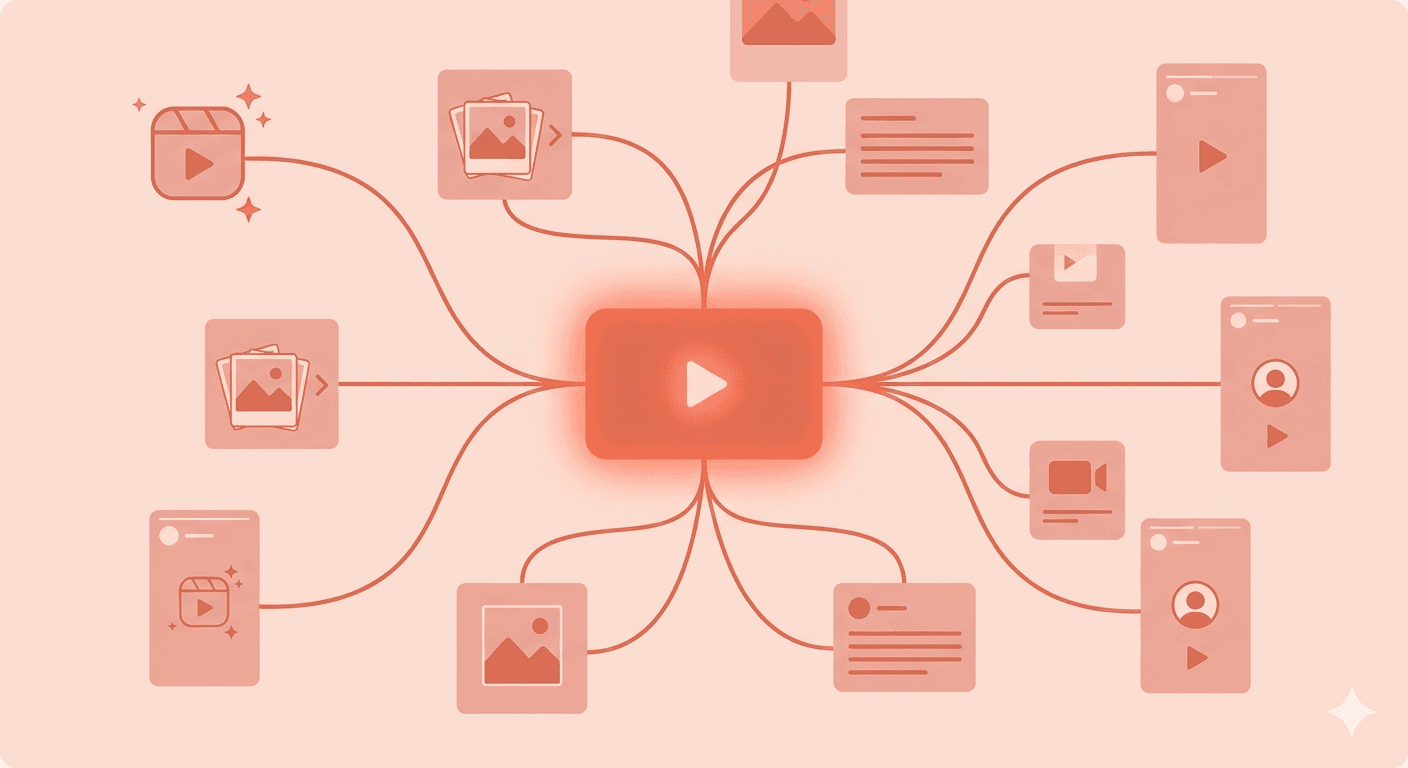
Table of Contents
The Content Creation Trap Every Small Brand Falls Into
Here is a pattern that plays out for almost every small brand trying to build a social media presence.
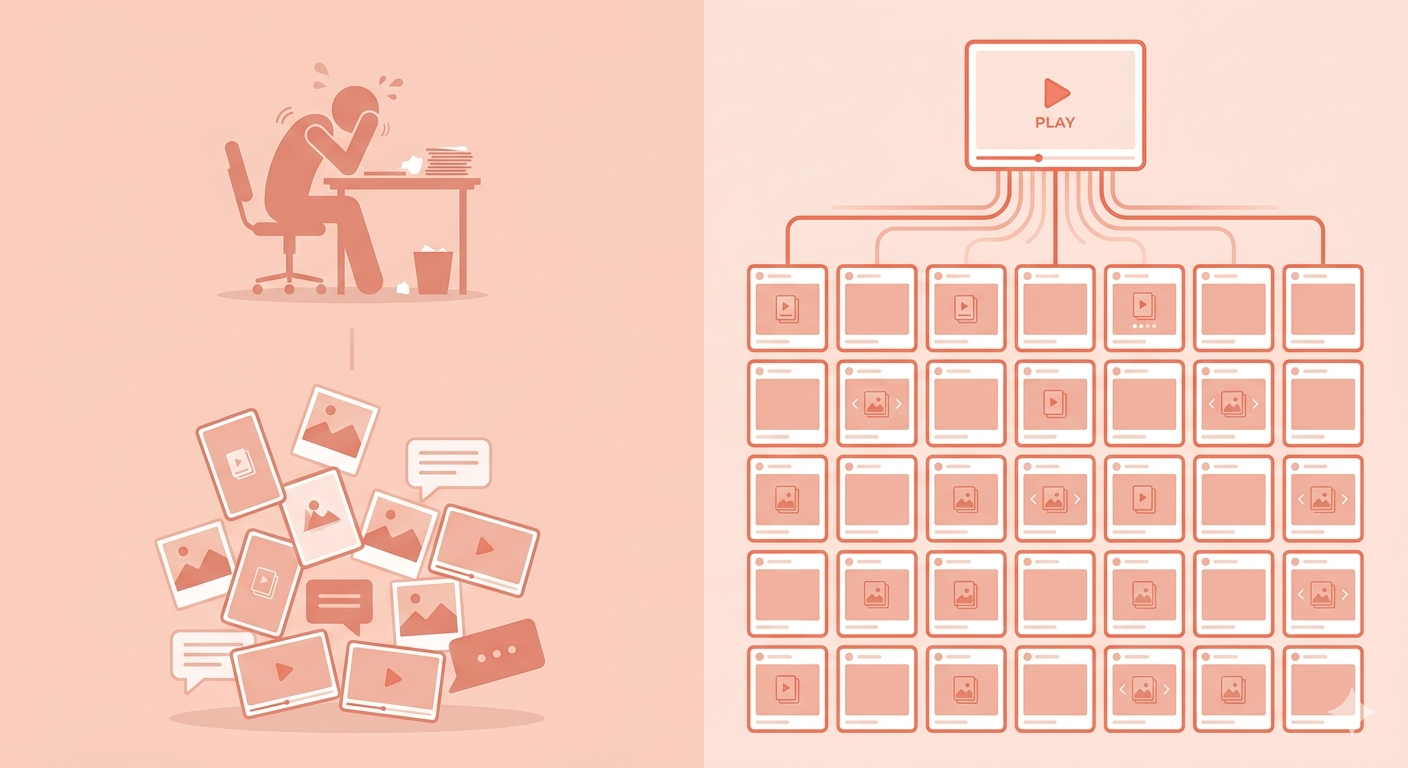
Monday: spend two hours filming a product video. Tuesday: edit it, write a caption, post it on Instagram. Wednesday: stare at a blank screen trying to figure out what to post next. Thursday: skip posting because nothing came together. Friday: post something rushed that does not perform. Saturday and Sunday: feel guilty about the inconsistency and resolve to do better next week.
Then next week begins and the cycle repeats.
The problem is not effort. The problem is the model. Creating one piece of content for one platform at a time is the least efficient way to build a social media presence that exists. It burns time, drains creativity, and produces the inconsistency that kills algorithmic reach.
The brands growing fastest on social media in 2026 have solved this problem — not by working harder or creating more, but by extracting more value from everything they already produce. They create once and distribute many times. They turn one strong piece of content into a month of platform-ready posts using AI repurposing systems that do the heavy lifting automatically.
This guide explains exactly how that system works — from the source video through to a full 30-day content calendar across every platform your brand needs to be on.
Why Repurposing Is the Highest-ROI Content Strategy in 2026
Before getting into the how, it is worth understanding why content repurposing has become the defining content strategy for smart brands in 2026 — because the numbers are not marginal.
Brands that repurpose content see 40% more overall content output without proportionally increasing creation time. AI-driven repurposing reduces production costs by up to 65% compared to creating original content for each platform separately. And perhaps most importantly, repurposed content that is properly adapted for each platform performs comparably to original platform-native content — which means you are not sacrificing quality for efficiency.
The math works out strikingly in favor of repurposing. One well-produced video, properly repurposed across six platforms, generates the equivalent content volume of six separate production sessions — at roughly one sixth of the cost and time investment.
But the real advantage is consistency. The single biggest driver of organic reach growth on every social platform in 2026 is posting consistency. Algorithms reward accounts that show up reliably. Repurposing is the mechanism that makes consistency achievable for a small brand without a content team — because it removes the blank-page problem entirely. You never have to wonder what to post next when you have a system that automatically generates 30 posts from every video you produce.
What Makes a Good Source Video
Not every video is worth repurposing. The brands that get the most mileage from this strategy are deliberate about what they record — they create content specifically designed to be a repurposing asset, not just a one-time post.
A high-quality source video for repurposing has several characteristics.
It is long enough to contain multiple ideas. A 3 to 10 minute video that covers multiple angles of a topic gives the AI more material to work with. Short 30-second videos can be repurposed but the yield is lower — you get fewer derivative pieces because there is simply less source material.
It is structured around clear points or segments. A video that covers five tips, three steps, or a clear before-and-after structure can be sliced into discrete segments, each of which becomes its own standalone piece of content. Unstructured, rambling video content is harder for AI tools to extract value from.
It covers a topic with multiple audience angles. The best source videos address a topic that different segments of your audience care about in different ways. A product demonstration, for example, can become educational content for new customers, comparison content for considering customers, and social proof content for nearly-converted customers — all from the same source footage.
It contains genuine value, not just promotion. Repurposing amplifies whatever is in the source. If the source is thin promotional content, the repurposed pieces will be equally thin. If the source is genuinely useful — answering real questions, demonstrating real results, explaining real concepts — the repurposed pieces inherit that value and perform accordingly.
The most effective approach is to plan your source videos as repurposing assets from the start. Before filming, ask yourself: what are the five to eight discrete pieces of content I could extract from this video? If you can answer that question, the video is worth producing. If you cannot, rethink the concept.
The Complete Repurposing Framework — One Video Into 30 Posts
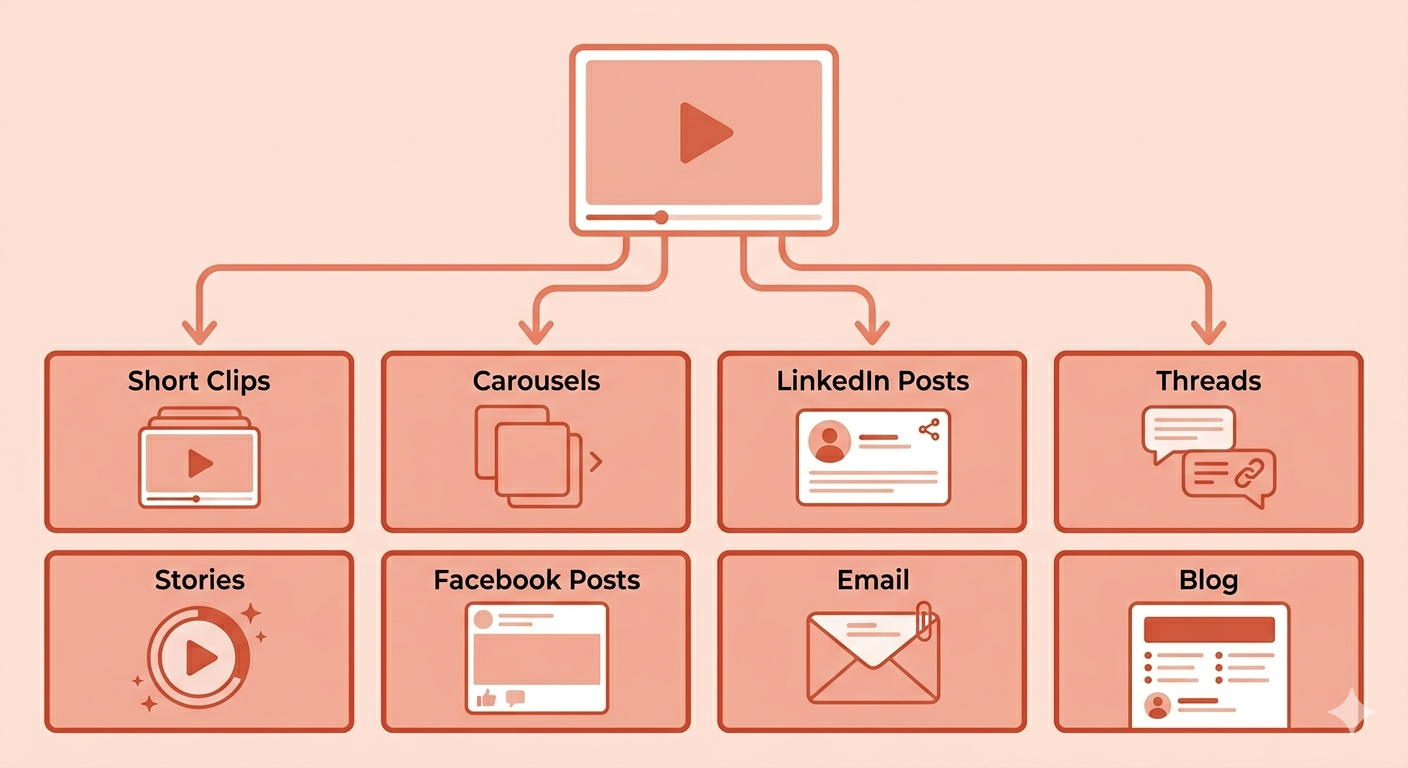
Here is the exact breakdown of how a single well-produced video becomes a full month of content across every platform. This is not theoretical — this is a working system that AI tools can execute automatically once the source video is uploaded.
Short-Form Video Clips — 8 to 10 Posts
The most direct repurpose is extracting short clips from the source video. AI tools analyze the full video, identify the highest-engagement moments — strong hooks, key insights, surprising data points, clear demonstrations — and cut them into standalone 15 to 60 second clips optimized for TikTok, Instagram Reels, and YouTube Shorts.
Each clip gets its own caption, its own hashtag set, and its own platform-specific framing. A clip that becomes a TikTok post might be positioned as a quick tip. The same clip on Instagram Reels might be framed as a product insight. The same clip on YouTube Shorts gets a title formatted for search.
From one source video, AI tools typically extract 8 to 10 viable short-form clips — each one a distinct piece of content that can be scheduled across different days without appearing repetitive.
Instagram Carousels — 3 to 4 Posts
Carousels are Instagram's highest-save content format. AI tools extract the key points, steps, or insights from the video transcript and reformat them as carousel slides — each slide containing one key idea, designed in your brand colors and typography.
A video covering five tips for social media automation becomes a five-slide carousel where each slide expands on one tip with a visual and a one-sentence explanation. A product demonstration video becomes a carousel showing the before, the process, and the after — each as a separate swipeable slide.
Three to four carousels from a single source video is a realistic yield, covering different angles of the same topic to maintain variety.
LinkedIn Text Posts — 4 to 5 Posts
LinkedIn rewards text-based content with strong engagement when it is written in a conversational, insight-driven format. AI tools extract the most valuable insights from the video transcript and rewrite them as LinkedIn-native posts — longer format, more professional tone, structured with line breaks for mobile readability.
A video about AI social media tools might yield LinkedIn posts covering the strategic case for AI adoption, a specific data point about time savings, a personal perspective on the shift from manual to automated workflows, and a question-based post that invites community discussion. Four distinct posts from one conversation.
Twitter and X Threads — 2 to 3 Posts
Threads are one of the highest-engagement formats on X and Threads by Instagram. AI tools identify the logical argument structure of the source video and reformat it as a numbered thread — each tweet building on the previous one, culminating in a conclusion or call to action.
A video explaining why small brands are invisible on TikTok becomes a seven-tweet thread covering the problem, the three root causes, the fix for each, and the expected outcome. Concise, shareable, and structured for the platform's native consumption style.
Facebook Posts — 2 to 3 Posts
Facebook rewards slightly longer, more conversational posts with questions that invite comments. AI tools reformat video content for Facebook's native style — less polished than LinkedIn, more community-oriented, often ending with a direct question to followers.
Story Content — 4 to 6 Posts
Stories on Instagram and Facebook are consumed differently from feed content — they are fast, sequential, and designed for quick swiping. AI tools reformat key points from the source video as story sequences — three to five slides that tell a mini-story or walk through a process in quick hits.
A product video might become a story sequence showing the unboxing, the first use, and the result — three slides that work together as a narrative arc, with a swipe-up or link sticker directing viewers to the full content.
Email Newsletter Content — 1 to 2 Pieces
The source video transcript can be reformatted as a newsletter section — a 200 to 300 word summary of the key insights with a link to the full video. This drives traffic back to your primary content while delivering value to subscribers who prefer reading over watching.
Blog Post or Article — 1 Post
A full transcript, properly structured and expanded, becomes a long-form blog article optimized for search. AI tools add headings, subheadings, introductory and concluding paragraphs, and keyword optimization — turning spoken content into written content that ranks on Google and drives organic traffic indefinitely.
One product
Create AI-powered videos and auto-post to all your platforms.
The AI Repurposing Workflow — Step by Step
Understanding what repurposing produces is useful. Understanding how to actually execute it using AI tools is what makes it actionable. Here is the complete workflow from source video to scheduled posts.
Step 1 — Upload and Transcribe
Upload your source video to an AI repurposing platform. The first thing the AI does is generate a full transcript — every word spoken in the video converted to text. This transcript becomes the source material for all text-based repurposed content: captions, blog posts, LinkedIn posts, threads, and newsletter content.
High-quality transcription is the foundation of everything. If the AI misunderstands spoken words or fails to capture key phrases, the downstream content quality suffers. Most modern AI repurposing tools handle transcription with high accuracy — but it is worth reviewing the transcript before moving to the next step, especially for brand-specific terms or product names.
Step 2 — Define Your Brand Parameters
Before generating any content, input your brand parameters into the AI system. This includes your brand voice and tone, your target platforms, your visual style (colors, fonts, logo), and any content guidelines — topics you avoid, claims you do not make, competitors you do not reference.
These parameters ensure that every piece of repurposed content feels like it came from the same brand — even though it is being generated automatically across six different formats and platforms.
Step 3 — Generate Platform-Specific Content
With the transcript uploaded and brand parameters set, the AI generates all repurposed content simultaneously. Clips are identified and cut. Carousels are designed. Captions are written. Posts are formatted for each platform's native style.
This process takes minutes, not hours. What would previously require a video editor, a copywriter, a graphic designer, and a social media manager — working separately on each piece — is completed by the AI in a single automated session.
Step 4 — Review and Approve
This is your quality control step. Go through each piece of generated content and confirm it meets your standards. Most brands find that 70 to 80 percent of AI-generated repurposed content is ready to use without changes. The remaining 20 to 30 percent needs minor edits — a caption that sounds slightly off-brand, a clip that starts a half-second too early, a LinkedIn post that needs a more specific opening line.
This review session typically takes 45 to 90 minutes for a full month of content — compared to the 20 to 40 hours it would take to create the same volume of content from scratch manually.
Step 5 — Schedule Across Platforms
Once approved, every piece of content is assigned to a scheduling slot and set to publish automatically. AI scheduling tools determine the optimal posting time for each piece based on your audience's activity data and platform algorithm patterns.
From this point, your entire month of content publishes automatically — the right piece, on the right platform, at the right time, every day — without you opening a single app.
Platform-Specific Adaptation — Why It Matters
The most common mistake brands make when repurposing content is posting the same thing everywhere. That is not repurposing — that is cross-posting. And it performs poorly because each platform has a distinct culture, format expectation, and algorithm behavior.
True repurposing means adapting the core content to feel native on each platform. The same insight, reframed for each audience.
On TikTok the hook needs to land in the first two seconds. The language should be casual and direct. The pacing should be fast. On-screen text should appear early and stay readable.
On LinkedIn the same content takes a slower, more reflective tone. The opening line is a provocative statement or question rather than a visual hook. The body expands on the idea with professional context. The ending invites discussion.
On Instagram Reels the visual quality carries more weight. The caption is shorter and more emotionally resonant. The hashtag set is larger and more niche-specific.
On YouTube Shorts the title is optimized for search. The content is slightly longer and more complete — Shorts audiences have a longer attention span than TikTok audiences.
AI repurposing tools in 2026 handle these adaptations automatically when you specify the target platform. The same core content gets reframed in the style, tone, and format that each platform's algorithm rewards — without you manually rewriting it for each channel.
How to Build a Monthly Repurposing System
One-time repurposing is valuable. A systematic monthly repurposing cycle is transformational. Here is how to build it.
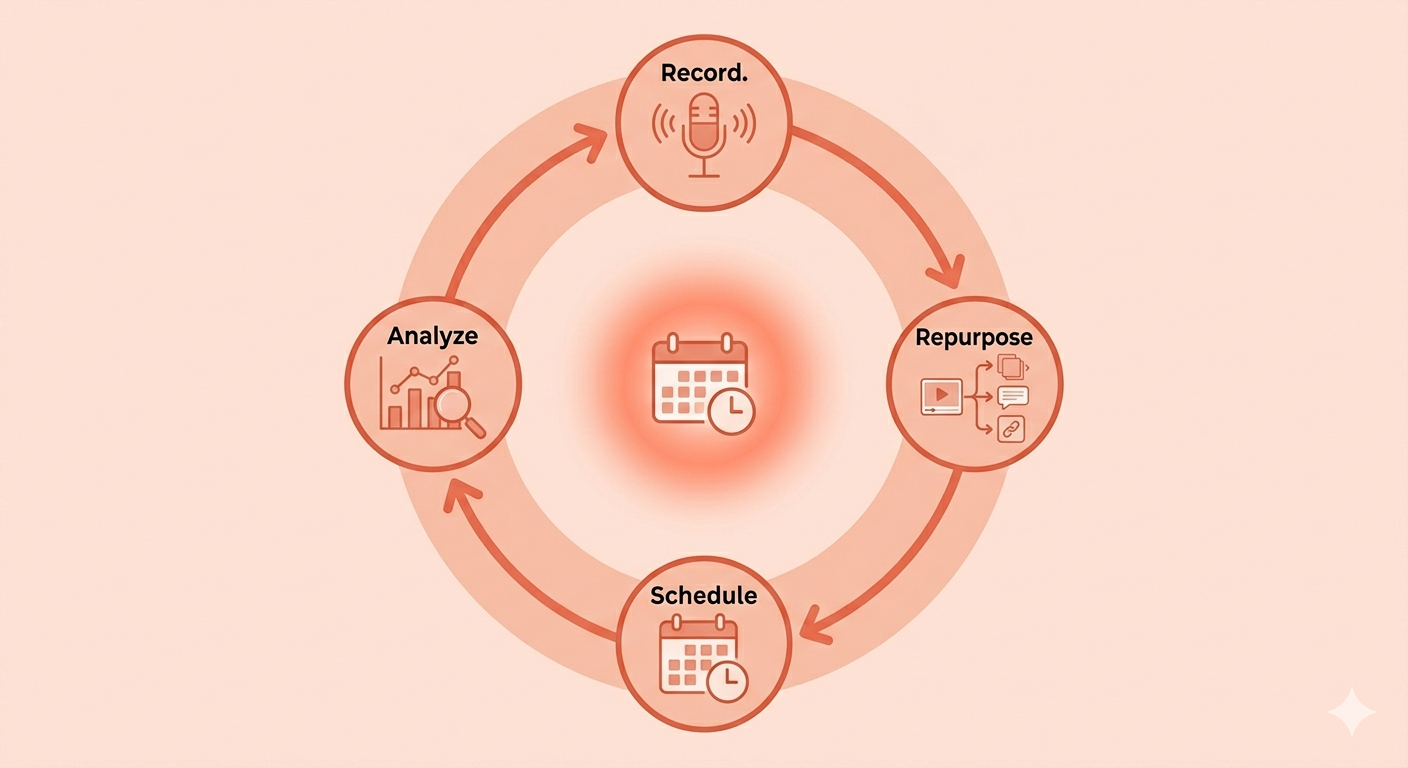
Week 1 of every month: Record your source video. This is your one significant content creation effort for the month. Make it count — cover a topic thoroughly, structure it around clear points, and produce it with enough quality to be the foundation of 30 posts.
Day after recording: Upload to your AI repurposing platform. Let the system generate all derivative content. Block 90 minutes to review and approve everything.
Same day: Schedule all approved content across platforms for the next 30 days. Set it and walk away.
Week 4 of every month: Review performance data. Which clips drove the most reach? Which carousel drove the most saves? Which LinkedIn post generated the most comments? Feed these insights into your next source video concept — double down on the angles that worked.
This monthly cycle means your primary content creation effort is one recording session per month. Everything else — the 30 posts, the scheduling, the platform adaptation — is handled by the AI system.
The Compounding Advantage of a Repurposing System
After three to four months of consistent execution, something significant happens. Your content library reaches a size where the algorithm begins to treat your accounts as authoritative sources in your niche. Your searchable content assets accumulate across platforms. Your audience on each platform grows because you have been showing up reliably every day with relevant, platform-appropriate content.
And your cost per piece of content continues to fall. The first month of using a repurposing system still requires setting up your brand parameters, learning the workflow, and spending time on review. By month three, the process is refined. By month six, review sessions take 30 minutes instead of 90. By month twelve, you have a content engine that produces 360 pieces of content per year from 12 recording sessions — and the cumulative reach advantage over brands creating content manually compounds every single week.
This is the real argument for content repurposing. Not just efficiency. Not just cost savings. The compounding content library that grows with every piece you publish and keeps working for your brand long after the recording session that produced it.
What You Need to Start Today
The barrier to building a repurposing system is lower than most brands expect. You need three things.
A source video worth repurposing. Film one piece of content this week that covers a topic your audience genuinely cares about, structured clearly enough that the AI can extract multiple angles from it. Ten minutes of genuinely useful content is worth more than fifty videos of surface-level promotion.
An AI repurposing platform. Several tools exist in 2026 that handle the full workflow from transcript to scheduled posts. Evaluate them based on which platforms they support, how well they adapt content for each platform's native style, and whether their scheduling integration covers the channels your brand needs.
A review discipline. The system does not run itself entirely — it runs most of itself. Your job becomes curator and quality controller rather than creator. Block 90 minutes once a month to review and approve. That is the human investment required to maintain a 30-post per month content calendar.
The brands that build this system in 2026 are compounding their content advantage every month. The ones still creating one post at a time are working ten times harder for a fraction of the reach.
Final Thoughts
The content game in 2026 is not won by the brands that create the most. It is won by the brands that distribute the most value from what they already create.
One strong video, properly repurposed using AI, reaches your audience on TikTok, Instagram, LinkedIn, YouTube, Facebook, and your blog — simultaneously, consistently, and in the format each platform's algorithm rewards most.
You do not need to produce more. You need to extract more from what you produce. And in 2026, AI makes that extraction automatic.
Start with one video this week. Build the system around it. Then watch what happens when you run it for 90 days.
SnapReel AI turns your brand content into a fully automated multi-platform publishing system — one brief, every platform, every day, without the manual work. Start your content engine today.