What Is Social Commerce — And How Small Brands Are Selling Directly on TikTok and Instagram in 2026
SnapReel
May 8, 2026 · 15 min read

Table of Contents
The Storefront Nobody Told You to Open
There is a storefront your customers visit multiple times every day. They browse it while commuting. They scroll through it during lunch. They spend an average of two and a half hours inside it every single day. It has better product discovery than Amazon, more authentic reviews than Google, and a checkout process that takes less than ten seconds.
It is not a website. It is not an app you built. It is TikTok. It is Instagram. And in 2026, these platforms are not just places where people discover products — they are places where people buy them, without ever leaving the app.
This is social commerce. And for small brands that understand how it works, it represents the most significant revenue opportunity in digital retail right now.
The numbers are not incremental. US social commerce crossed $100 billion in 2026, growing at roughly 30% year over year. TikTok Shop alone commands over $20 billion in US sales. More than 60% of product discovery now happens on TikTok, Instagram, and YouTube — meaning the majority of your potential customers are finding products on social platforms, not on Google or your website.
If your brand is not set up for social commerce in 2026, you are not just missing a channel. You are missing the channel where your customers are already spending their attention and their money.
This guide explains exactly what social commerce is, how it works on each major platform, and the specific steps small brands need to take to start selling directly inside the apps their customers already use every day.

What Social Commerce Actually Is
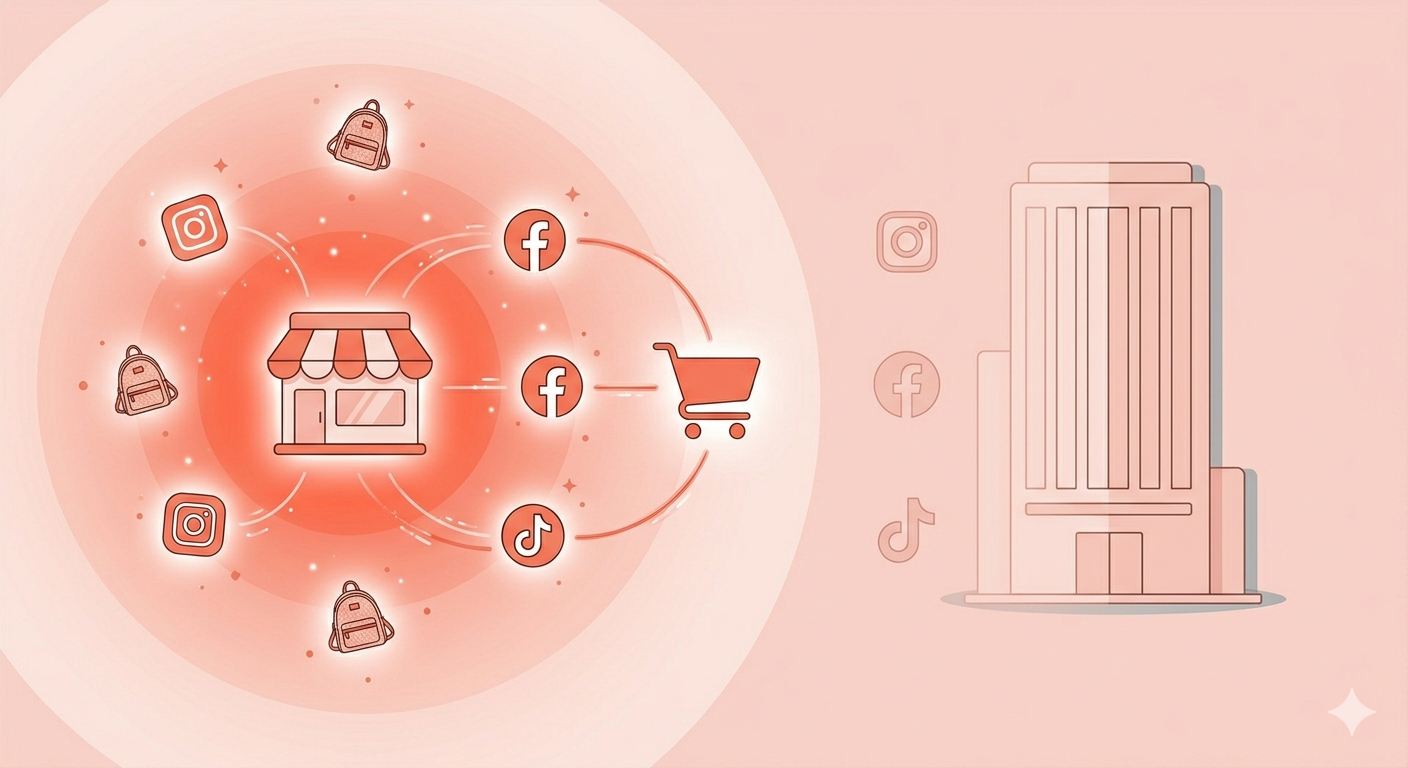
Social commerce is the integration of shopping directly into social media platforms — where product discovery, consideration, and purchase all happen inside a single app without the customer ever needing to visit an external website.
This is a fundamentally different model from traditional social media marketing. In the old model, you post on Instagram to drive traffic to your website, where the customer then navigates to a product page, adds to cart, enters their payment information, and completes a purchase. Every additional step in that journey is an opportunity for the customer to drop off — and most of them do.
In the social commerce model, the customer sees your product in a Reel, taps the product tag, reads reviews, and completes the purchase in two taps using payment information already saved in the app. The entire journey — from discovery to transaction — happens in under 60 seconds inside an app they were already using.
This frictionless buying experience is why social commerce conversion rates are so dramatically higher than traditional e-commerce funnels. When you meet the customer exactly where they are, in the app they are already comfortable in, with a checkout process that requires no new account creation or payment entry, the barrier to purchase effectively disappears.
For small brands, the implication is significant. You no longer need a perfectly optimized website, a sophisticated SEO strategy, or an expensive paid traffic funnel to drive sales. You need content that stops the scroll, a product tagged inside that content, and a frictionless checkout that closes the sale in the moment.
Platform by Platform — How Social Commerce Works in 2026
Each major platform has built its social commerce infrastructure differently. Understanding the specific features and strengths of each helps you decide where to focus first and how to set up your selling presence correctly.
TikTok Shop
TikTok Shop is the most aggressive and fastest-growing social commerce platform in 2026. Its combination of algorithmic content discovery, native checkout, and creator affiliate infrastructure makes it uniquely powerful for product discovery and impulse purchasing — especially for brands targeting consumers under 35.
TikTok Shop lets brands create a fully integrated storefront within their TikTok profile. Products are listed in the Shop tab, tagged directly in videos and livestreams, and purchasable without leaving the app. The checkout process uses TikTok's native payment system — customers save their payment information once and complete future purchases in two taps.
What makes TikTok Shop particularly powerful for small brands is the affiliate ecosystem. Creators can apply to promote your products and earn a commission on every sale they drive. You do not pay for the promotion upfront — you pay only when a sale occurs. For a small brand with a limited marketing budget, this is an extraordinarily efficient customer acquisition model.
The content that performs best on TikTok Shop combines authentic product demonstration with strong storytelling. Videos that show the product in real use — unboxing, application, transformation, result — outperform polished advertising content because TikTok's audience has been conditioned to trust authentic creator content over branded advertising.
To set up TikTok Shop you need a business account, verified identity documentation, and a product catalog. Once approved, you can sync your existing e-commerce catalog automatically, set up creator affiliate access, and begin tagging products in every video you post.
Instagram Shopping
Instagram remains the gold standard for visual social commerce, particularly for fashion, beauty, home decor, and lifestyle brands. With over 2 billion monthly active users and a mature shopping infrastructure, Instagram offers the broadest reach of any social commerce platform combined with the most sophisticated visual merchandising tools.
Instagram Shopping in 2026 includes several interconnected features. Instagram Shops is a fully integrated storefront within your profile, now supporting AI-driven product recommendations that surface relevant products to users based on their browsing behavior and interest graph.
Shoppable Reels and Stories allow you to tag products directly in short-form video content and story slides. A viewer watching your Reel can tap the product tag, see the price and product details in an overlay, and complete the purchase without the video stopping. Reels with product tags see significantly higher engagement than standard posts because the shopping context adds relevance and intent to the viewing experience.
Live Shopping on Instagram allows you to sell in real time during live streams — demonstrating products, answering questions, and driving immediate purchases with in-app checkout. Live shopping conversion rates are among the highest of any social commerce format because the real-time interaction creates urgency and social proof simultaneously.
Setting up Instagram Shopping requires connecting your catalog through Meta's Commerce Manager, completing the business verification process, and enabling checkout in your Instagram settings. Once live, every post, Reel, and Story becomes a potential purchase point.
Pinterest Shopping
Pinterest is the most underestimated social commerce platform for product brands in 2026 — and consequently one of the most opportunity-rich. Unlike TikTok and Instagram where users are primarily in entertainment mode, Pinterest users are explicitly in discovery and planning mode. They are actively looking for products, collecting ideas, and building purchase intent around specific categories.
Pinterest's AI-powered Shop the Look feature lets users tap on any item within an image and instantly find similar products available for purchase. For brands in fashion, home, food, beauty, and lifestyle categories, this visual search capability means your products surface to users who are already in a buying mindset — without you having to fight for attention against entertainment content.
Idea Pins with product tags combine multi-page inspirational content with direct shopping links — allowing brands to inspire and sell in the same content experience. Users who find a product through an inspirational context have significantly higher purchase intent than users who encounter a direct advertisement.
Why Small Brands Have a Structural Advantage in Social Commerce
Here is something counterintuitive about social commerce that large brands are learning the hard way: authenticity outperforms production value on every social commerce platform in 2026.
The content that drives the most TikTok Shop sales is not polished advertising. It is real people — often the brand founder, a loyal customer, or a niche creator — genuinely demonstrating a product in an authentic context. The rough edges, the honest reactions, the real use cases — these signals of authenticity drive trust and purchase intent in ways that no advertising budget can manufacture.
Small brands have this authenticity natively. The founder who genuinely believes in their product and can talk about it with real enthusiasm and specific knowledge is more persuasive than a paid actor delivering scripted lines. The customer who shares an honest review with real results is more convincing than a produced testimonial.
This means the playing field in social commerce is more level than in traditional e-commerce — where large brands can outspend small brands on SEO, paid traffic, and website optimization to dominate search results. On TikTok and Instagram, a small brand with a genuinely good product, authentic content, and the right tagging setup can compete with — and often outperform — brands spending ten times more on their marketing.
The brands that figure this out earliest and build their social commerce presence now are establishing audience relationships and algorithmic positioning that later entrants will struggle to displace.
Turn your social content into a direct sales channel — SnapReel generates daily product content that converts.
Ready to follow along? Create your first AI video for free.
The Content Strategy That Drives Social Commerce Sales
Having your products listed on TikTok Shop or Instagram Shopping is the foundation. The brands generating consistent revenue from social commerce are doing so through a content strategy specifically designed to drive in-app purchases — not just awareness.
Product Demonstration Content
Show the product being used in a real context — not in a studio, not with perfect lighting, but in the actual situation your customer will use it in. A skincare product demonstrated in a real bathroom with real skin. A kitchen tool demonstrated while actually cooking dinner. A fitness product used during a real workout.
This demonstration content does three things simultaneously. It builds trust by showing the product working in real conditions. It answers purchase objections by addressing common questions in the context of actual use. And it creates aspiration by showing the customer a version of their life that includes your product.
Tag the product directly in the video. Include a clear verbal call to action — "link in bio" is dead in the social commerce era. "Tap the product tag below" or "click the shop button" is what drives immediate conversion.
Social Proof and Results Content
User-generated content, customer reviews, and before-and-after demonstrations are the highest-converting content formats in social commerce. When a real customer shares an honest, specific account of their experience with your product — with real results, real timeline, real context — the credibility that content generates is impossible to replicate with branded content.
The social commerce strategy for small brands is to actively encourage this content. Send products to micro-creators whose audiences match your target customer. Make it easy for customers to share their results by providing simple prompts. Feature customer content prominently across your social commerce channels. This creates a self-reinforcing cycle: social proof drives sales, sales create more customers, more customers create more social proof.
Live Shopping Events
Live shopping is one of the most powerful — and most underutilized by small brands — formats in social commerce. A scheduled live session where you demonstrate products, answer questions in real time, and offer exclusive live-only pricing creates a purchasing urgency that no static post can replicate.
Live commerce conversion rates are up to 30% — roughly ten times higher than traditional e-commerce. The combination of real-time demonstration, interactive question answering, and social proof from other viewers watching simultaneously creates a buying environment that closely replicates the experience of a trusted friend showing you a product in person.
Small brands do not need a production setup for live shopping. A smartphone, a well-lit space, and a genuine enthusiasm for your product is enough to run an effective live session. The authenticity advantage that small brands have in social commerce is amplified further in live format.
AI-Generated Product Content at Scale
The practical challenge for small brands in social commerce is content volume. Platforms reward consistent posting. Social commerce performance compounds with the size of your shoppable content library — more tagged videos mean more discovery entry points, more purchase moments, more revenue.
AI video generation tools in 2026 allow small brands to produce product demonstration content at a scale that was previously only achievable with a production team. A brand can generate 20 to 30 product videos per month — each one scripted, produced, and tagged with the relevant product — using an AI content pipeline that requires no filming, no editing, and no production budget beyond the AI tool subscription.
This is the combination that gives small brands a genuine competitive advantage in 2026: the authenticity advantage in social commerce content, amplified by the volume advantage of AI production.
Setting Up Your Social Commerce Presence — The Priority Order
If you are starting from zero, the question is where to begin. Here is the priority order based on where the revenue opportunity is largest for most small brands in 2026.
Start with TikTok Shop if your product is visual, demonstrable, and targets consumers under 40. The affiliate ecosystem, the algorithmic discovery power, and the impulse-purchase behavior of TikTok's audience make it the highest-potential social commerce platform for most consumer product brands right now. Setup is straightforward and the barrier to first sale can be as short as one well-performing video.
Add Instagram Shopping as your second channel. Instagram's older, slightly higher-income audience demographic, combined with its more developed visual merchandising tools, makes it the ideal complement to TikTok Shop. Brands that perform well on TikTok Shop almost always see strong performance on Instagram Shopping when they extend their presence there.
Consider Pinterest for specific categories. If your brand is in fashion, beauty, home, food, or lifestyle, Pinterest should be your third channel. Its high purchase intent audience and visual search capability make it particularly valuable for brands where the product itself is visually compelling.
Use Facebook Shops as a catch-all. Facebook's social commerce infrastructure is the most mature and connects seamlessly with Instagram Shopping through Meta's Commerce Manager. If you are already set up on Instagram Shopping, activating Facebook Shops requires minimal additional effort and adds reach among older demographics.
The Metrics That Actually Matter in Social Commerce
Tracking the right metrics is what separates brands that improve their social commerce performance over time from brands that post consistently but cannot explain why some content drives sales and other content does not.
The metrics that matter most in social commerce are not the same as the metrics that matter in traditional social media marketing.
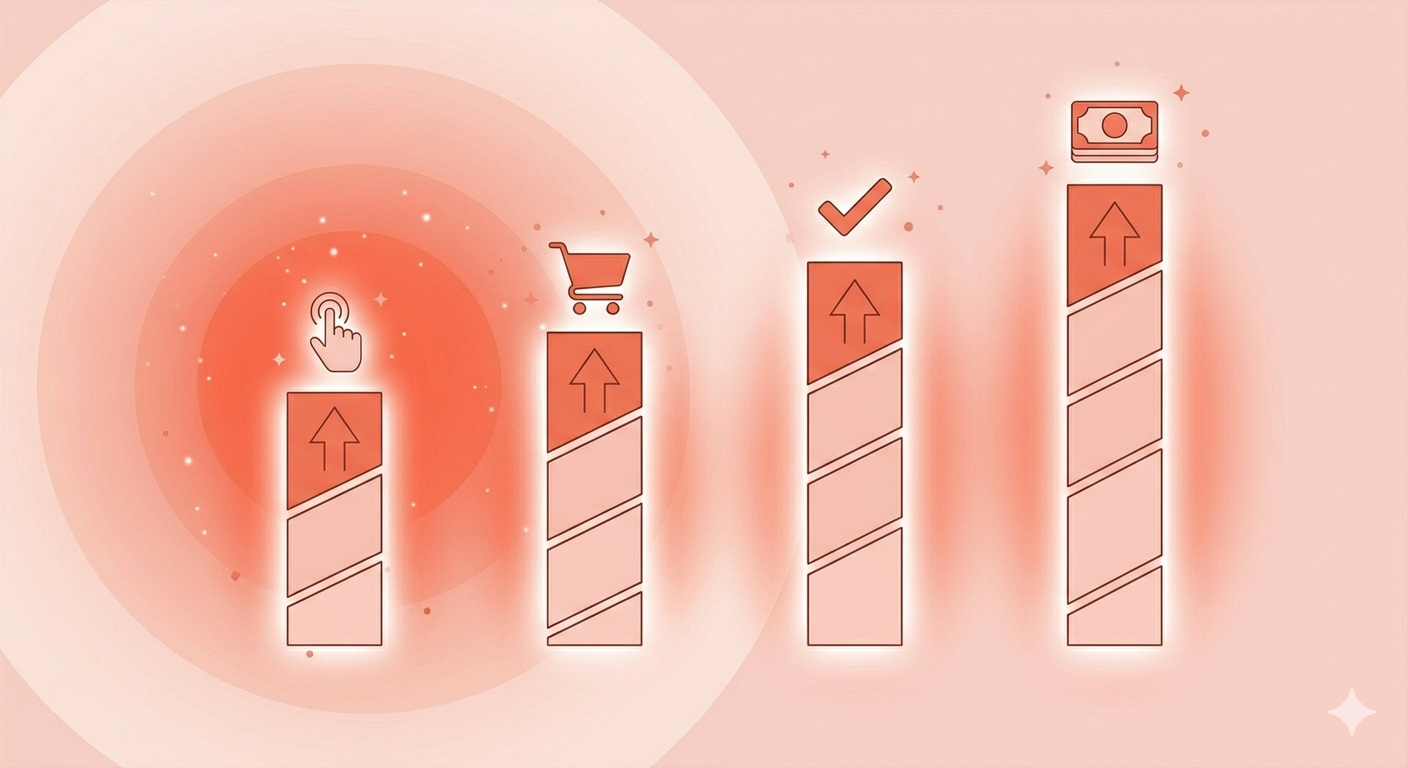
Product page visits from content. How many people are tapping your product tags and viewing the product detail page? This tells you whether your content is creating enough purchase intent to drive click-through. High reach with low product page visits suggests your content is entertaining but not triggering purchase consideration.
Add-to-cart rate. Of the people who visit your product page, what percentage add to cart? This tells you whether your product detail page — the images, descriptions, price, and reviews — is convincing once someone has been brought there by your content.
Conversion rate from social traffic. Of the people who add to cart, what percentage complete the purchase? This tells you whether the checkout experience is creating friction that is preventing sales you have effectively already earned.
Revenue per video. How much total revenue does each piece of tagged content generate over its lifetime? This is the metric that tells you which content formats, topics, and styles are actually driving sales — and therefore which to produce more of.
Tracking these metrics monthly and adjusting your content strategy based on what the data shows is what compounds social commerce performance over time.
The Window Is Now
Social commerce is not a future opportunity. It is a present reality that is already determining which brands grow and which brands stagnate in 2026.
The brands that established their TikTok Shop and Instagram Shopping presence 12 months ago are now sitting on creator affiliate networks, product review libraries, and algorithmic positioning that new entrants will take months to match. Every month that a brand delays building its social commerce presence is a month that competitors are pulling further ahead in the channels that are now driving the majority of product discovery.
But the window is not closed. Social commerce is still growing at 30% annually. New categories are entering the social commerce ecosystem every month. New creator partnerships are available for brands willing to engage with the affiliate model. New platform features are making the discovery-to-purchase journey even shorter and more frictionless.
The brands that move now — setting up their shops, building their shoppable content library, engaging with the creator affiliate ecosystem — are establishing the compounding advantages that will define their market position for the next several years.
Final Thoughts
Your customers are not waiting to discover your products through Google search or your website. They are on TikTok and Instagram right now — scrolling, discovering, and buying products from brands that have figured out social commerce.
The question is whether your brand is one of those brands or whether you are watching your customers buy from competitors who got there first.
Social commerce in 2026 does not require a massive budget, a production team, or a sophisticated technology stack. It requires a product worth buying, content that shows it authentically, and the platform setup that lets the purchase happen in the moment the customer is ready.
All three of those things are available to your brand today.
SnapReel AI generates shoppable video content for your brand automatically — product demonstrations, social proof videos, and platform-optimized content that drives social commerce sales across TikTok, Instagram, and every platform your customers shop on.