What Is Surprise and Delight Marketing — And How Small Brands Are Using It to Go Viral and Build Loyalty in 2026
SnapReel
May 13, 2026 · 20 min read

Table of Contents
There is a story from the online pet retailer Chewy that has been shared hundreds of thousands of times across social media, and it illustrates something fundamental about how brand loyalty is actually built in 2026.
A customer called Chewy to ask if they could return an unopened bag of dog food after their dog passed away. What happened next was not in any script, not part of any campaign, and cost almost nothing compared to what it generated. Chewy issued a full refund, told the customer to donate the food to a local shelter instead of returning it, and then had flowers delivered to the customer's home with a handwritten condolence note from the representative they had spoken with.
The customer posted about it on social media, the story went viral, and thousands of people who had never bought from Chewy before became customers specifically because of what they read — people who said they would never shop anywhere else for their pets after seeing how the brand treated someone in grief. Search Engine Journal
No ad created that. No influencer campaign generated that response. No content strategy produced that result. A single, unexpected, genuinely human moment of kindness did more for Chewy's brand than any marketing budget item on their annual plan.
This is surprise and delight marketing — and in 2026, it is the most underused and highest-ROI strategy available to small brands who want to build the kind of loyalty that actually compounds into business growth.
Sprout's Q4 2025 Pulse Survey found that surprise-and-delight moments are one of the top things Gen Z wants brands to prioritize on social in 2026 — tied with community management as the number one request from the most commercially influential generation of consumers. People are 10 times more likely to share a great experience than an ad — surprise and delight moments become social currency, and that unpaid amplification can beat any paid channel's return on ad spend. VetromarketinggroupDigitalbrandexpressions
This guide explains exactly what surprise and delight marketing is, why it works with such consistency, how small brands can build it systematically without large budgets, and the specific tactics generating the most powerful results in 2026.
What Surprise and Delight Marketing Actually Is — And What It Is Not
The term "surprise and delight" has been in marketing conversations for years, but it is frequently misunderstood — and the misunderstanding leads to strategies that miss the entire point of why it works.
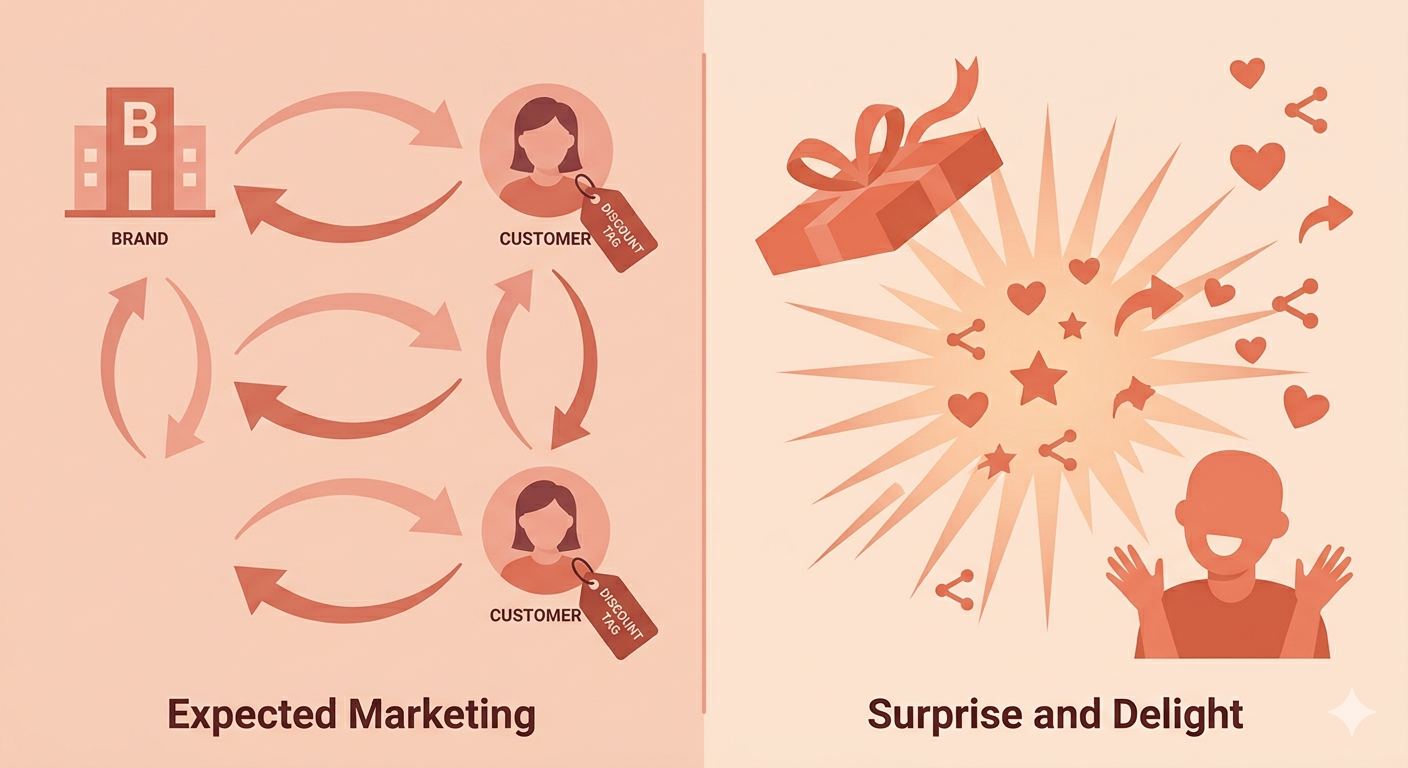
To surprise and delight customers is to exceed their expectations, improving their overall brand experience with spontaneous offers of kindness — it is not "Buy One Get One Free" style offers, or standard loyalty program rewards, or special promotions or exclusive deals. There is no catch. Customers are simply treated to something of value, completely out of the blue, with no strings attached. Digitalmagazine
This distinction is critical. A discount code your customer receives because they signed up for your email list is not surprise and delight — it is expected. A loyalty point they earn on their purchase is not surprise and delight — it is a transaction. These things have value and serve important functions, but they do not create the emotional response that surprise and delight creates, because they were anticipated.
Surprise and delight marketing is about creating unexpected moments that leave a lasting impression — think of it as going above and beyond in a way the customer did not anticipate. The surprise component is non-negotiable. The moment a customer expects the gesture — even slightly — the emotional impact diminishes. True surprise and delight happens when someone receives something they had absolutely no reason to expect, and that unexpectedness is precisely what triggers the powerful neurological and social response that makes the strategy work. Marketingblocks
The "delight" component is equally specific. Not just any unexpected thing generates delight — only unexpected things that are genuinely meaningful to the specific person receiving them. A generic branded tote bag sent to a customer who did not ask for it is a surprise. It is not delight. Delight happens when the gesture is personal enough, thoughtful enough, and well-timed enough that the recipient feels genuinely seen and valued as an individual — not as a transaction or a unit in a customer database.
At their core, surprise and delight plays are about making customers feel seen — a small, unexpected gesture sparks a chemical response that is neurologically sticky. The brain's reward pathways activate, and customers are literally wired to remember the brand that triggered that response. Digitalbrandexpressions
Why It Works — The Psychology and the Numbers
Understanding the psychology behind surprise and delight makes it possible to design moments that work consistently rather than randomly. There are three distinct psychological mechanisms at play, and each of them drives a specific commercial outcome.
The Dopamine Response — Why Surprise Creates Memory
When a surprise occurs — particularly a positive, unexpected one — the brain releases a surge of dopamine. This is the same neurochemical response associated with reward, discovery, and pleasure. Dopamine does not just make the moment feel good. It makes the moment memorable. Memories formed in the presence of dopamine are significantly more vivid and more durable than ordinary memories. This is why people remember exactly where they were when something wonderful and unexpected happened to them — and why they remember, often for years, the brand that created that moment.
In marketing terms, this means surprise and delight creates brand memory that no amount of repeated advertising can replicate. You can show someone your logo five hundred times and they will recognize it but not remember it with any particular feeling. You can surprise them with one genuinely thoughtful, unexpected gesture and they will remember your brand and tell other people about it — sometimes for the rest of their relationship with your category. The premise of surprise and delight is to build a strong emotional connection between the consumer and the brand or product — and as a result of this emotional connection, consumers grow into die-hard supporters of the brand, because multiple studies support the influence of emotion in purchasing decisions. Coalition Technologies
Reciprocity — Why Delight Generates Loyalty
The second psychological mechanism is reciprocity — one of the most powerful and well-documented principles in human psychology. When someone receives something from another person or entity without any expectation of return, they feel a natural impulse to give something back. This is not a calculated decision. It is an instinct so deeply wired into human behavior that it operates below the level of conscious thought.
In the context of brand marketing, reciprocity means that customers who receive an unexpected gesture from a brand feel a genuine impulse to return something to that brand — loyalty, a review, a referral, continued purchasing, a social share. They are not doing it because they feel obligated. They are doing it because the unexpected kindness created an emotional debt that they naturally want to balance. 67% of customers said surprise gifts are vital for loyalty programs, and 58% of consumers share positive experiences when they talk about brands on social media. These numbers are not about gratitude in the abstract — they are the documented behavioral outcome of reciprocity in action. Gloucestercitynews
Social Currency — Why Delight Spreads
The third mechanism is social currency — the human desire to share experiences that make us look interesting, knowledgeable, or special in the eyes of our social networks. Delivering surprise and delight inspires customers to do your marketing for them through word-of-mouth advertising — a factor that alone drives 20 to 50% of purchasing decisions. Code3
When something genuinely unexpected and wonderful happens to us, we share it — not because we are trying to help the brand, but because the experience is interesting enough to be worth telling. The Chewy story was shared hundreds of thousands of times not because people were trying to promote a pet food company, but because it was a genuinely remarkable story about human kindness that happened to involve a brand. The brand was the vehicle for a story worth telling. That is the highest form of word-of-mouth marketing — and it cannot be manufactured through any strategy other than genuinely delighting people.
Surprise your audience daily with branded content they actually want to see — generated automatically.
Stay ahead with SnapReel — your AI-powered social media manager.
The Small Brand Advantage — Why You Can Do This Better Than Big Companies
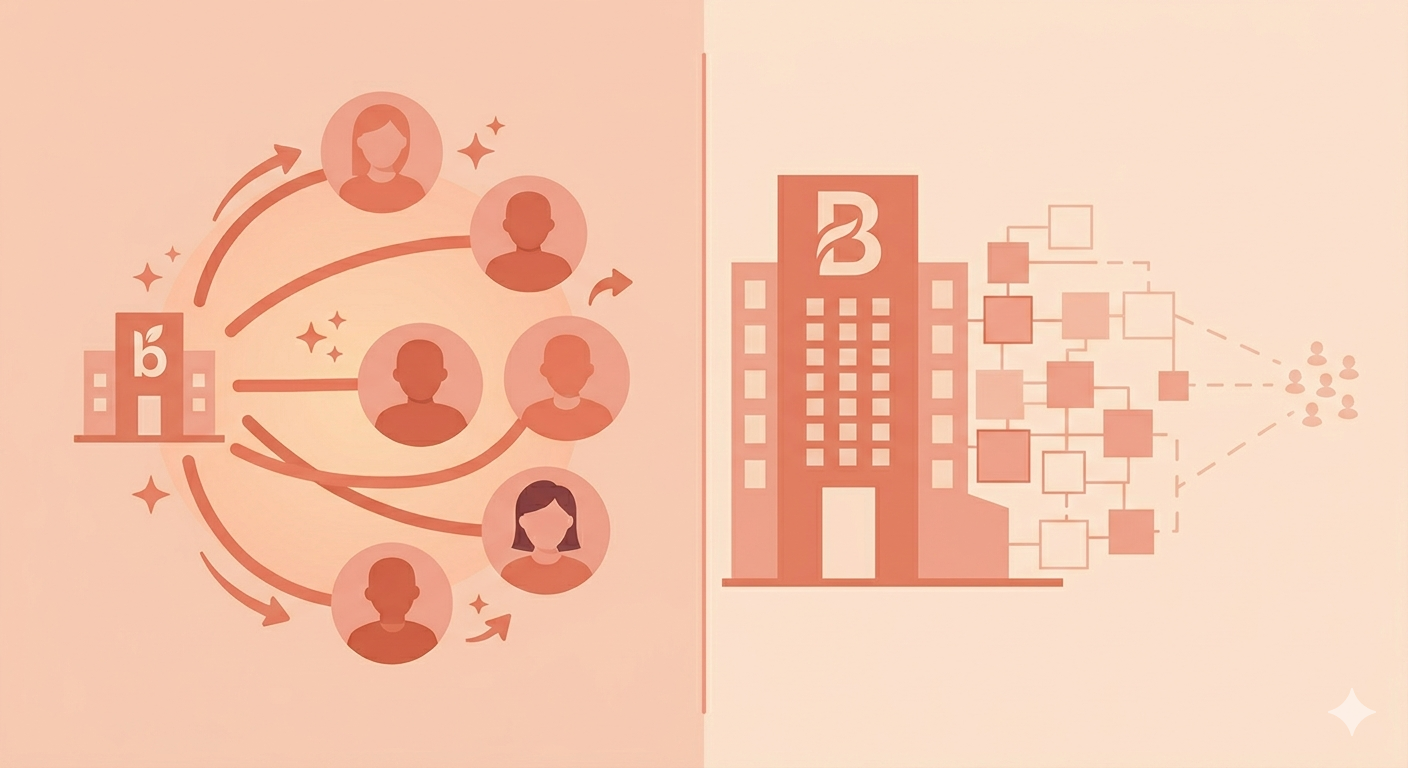
Here is the irony that most small brands miss: surprise and delight marketing is an area where small brands have a structural advantage over large companies, not a disadvantage. The reasons are both practical and psychological.
Large companies struggle with surprise and delight for the same reasons they struggle with community management, personal content, and authentic communication: they have too many customers, too many approval processes, and too much institutional distance between the people making decisions and the people receiving experiences. A large brand's surprise and delight program is, almost by definition, a systematized version of something that only works when it is not systematized. The moment surprise and delight becomes a tracked KPI with a budget allocation and quarterly targets, it stops being a surprise and starts being a program — and programs do not create the same emotional response that genuine, unscripted kindness does.
Small brands do not have this problem. A founder who notices that a customer mentioned something in an email, ships them something related to that thing with a handwritten note, and does it because they genuinely wanted to — that is pure surprise and delight. It costs almost nothing, it takes ten minutes, and it creates a story that customer will tell for years. Surprise and delight marketing is very open to going on low-budget — even a small act like a personalized acknowledgment or a Twitter shout-out can mean a lot to some customers. Brands do not need to spend a lot of money on surprise and delight moments. Gloucestercitynews
The small brand that builds a genuine culture of noticing and responding to individual customers creates something that no enterprise brand can easily replicate — and in 2026, where every category is crowded and differentiation on product alone is increasingly difficult, the brand that makes people feel genuinely seen and valued wins a loyalty that price, convenience, and marketing cannot compete with.
The Surprise and Delight Playbook — Specific Tactics That Work in 2026
Understanding the strategy is one thing. Knowing exactly what to do is another. Here are the specific surprise and delight tactics that are generating the strongest results for small brands in 2026, organized from the simplest and lowest-cost to the more involved.
Tactic 1 — The Unexpected Upgrade or Addition
This is the most accessible and most consistently impactful surprise and delight tactic available to any product-based small brand. When a customer places an order, include something they did not pay for and did not expect — a sample of a new product, an extra unit of something they ordered, a small complementary item that is thoughtfully chosen rather than random.
The psychology here is powerful. The customer has already completed their transaction and closed that mental account. When they open their package and find something extra, it reopens that account in the most positive possible way — with the feeling that the brand gave them more than they paid for. This feeling is extraordinarily sticky. It gets photographed, posted on social media, and mentioned in reviews with a frequency that no promotional content achieves organically.
The key to making this work is thoughtfulness over generosity. A small, clearly relevant addition — something that relates to what they ordered, or something you genuinely think they would like based on what you know about your customer — generates more delight than a larger, generic addition. The feeling that the brand thought specifically about them is what creates the emotional response. Generic filler items create the opposite feeling — they signal that the brand was fulfilling a checklist, not thinking about a person.
Tactic 2 — The Handwritten Note
In an era of automated order confirmations, AI-generated email sequences, and digital-everything packaging inserts, a handwritten note is genuinely surprising — and the surprise itself is part of what makes it effective. A handwritten note is a personal touch that can leave a lasting impression on customers — it signals that a real person cared enough about this specific order to spend time communicating personally rather than letting automation handle it. Influencerdb
For a small brand processing a manageable volume of orders, handwritten notes are entirely feasible and represent one of the highest ROI activities possible. A note that references something specific about the customer's order — "we saw you ordered our lavender scent, it's our personal favorite too" or "thank you for coming back again, your support genuinely means everything to us" — costs less than a dollar and creates a moment that gets talked about.
As order volume grows and handwritten notes become operationally challenging, even a printed note with a genuinely personal message — not the standard "thank you for your order" template — retains some of this power. The content matters as much as the medium. A note that reads like a real person wrote it, that feels specific to this customer and this order rather than generated for everyone, does the job even when it is printed.
Tactic 3 — The Social Media Surprise
Some of the most shareable surprise and delight moments happen on social media, and they cost nothing beyond attention and a few minutes of genuine engagement. When a customer tags your brand in a post, shares their experience, or creates content featuring your product, responding with more than a generic "thank you" creates an unexpected moment of genuine connection.
Chewy's social team is legendary for this — they respond to customer pet photos with illustrated portraits of the pet, done by their in-house artists, completely unexpected and completely free to the customer. The response generates immediate posting from the customer, sharing from their network, and coverage in marketing publications as an example of exceptional social media community management. Tabasco saw a customer go viral with a challenge involving their hot sauce, and rather than simply liking the video, they surprised her with several follow-up gifts and ultimately threw her a surprise party — turning a viral moment into a brand relationship story that generated far more exposure than the original video. Search Engine Journal
For small brands, this does not require the budget of a surprise party. It requires attention and creativity. When a customer tags you in a meaningful post, respond in a way they did not expect — DM them a thank-you with a personal touch, create something specific to their post, or send them something in the mail with a handwritten note referencing their content. The unexpectedness of any response beyond a generic acknowledgment creates delight.
Tactic 4 — The Anniversary or Milestone Surprise
One of the most underused surprise and delight opportunities for small brands is recognizing customer milestones — the anniversary of their first purchase, a round number of orders, a birthday if they have shared it, or any other milestone that signals they are a loyal, long-term customer.
A customer who placed their first order with your brand two years ago and has ordered twelve times since is one of your most valuable assets. Most brands do nothing to acknowledge that relationship explicitly. A surprise email on the anniversary of their first order, with a genuine personal note and an unexpected gift or discount with no purchase requirement, creates a moment of connection that most loyal customers have never experienced from any brand they regularly buy from. The rarity of being recognized as a valued individual — not as a loyalty tier or a data segment — is itself part of what makes it surprising.
Tactic 5 — The Random Act of Kindness
The purest and most powerful form of surprise and delight is the completely unexpected, completely unearned act of kindness — something given to a customer with no trigger, no criteria, and no reason beyond genuine appreciation.
This is the Chewy flowers story. This is the cafe owner who told the barista to give a regular customer a free coffee on New Year's Day. This is the brand that ships an existing customer a new product they did not order, with a note saying "we thought you'd love this, it's our gift." These moments are powerful precisely because they have no logical explanation beyond genuine human generosity — and in a commercial landscape where every brand interaction is transactional by design, a moment of pure generosity is jarring in the best possible way.
Surprise and delight strategies increase customer loyalty leading to repeat purchases, larger basket sizes, and increased brand engagement — and many companies use the approach to trial new products with loyal customers who are far more willing to give honest feedback and far more comfortable being guinea pigs for new marketing experiments. A random act of kindness that doubles as a product trial serves two purposes simultaneously — it delights the customer and generates genuine, unfiltered feedback from someone who already loves your brand. Digitalmagazine
How to Build Surprise and Delight Into Your Brand Systematically
The paradox of surprise and delight is that it needs to be systematic to happen consistently, but it needs to feel spontaneous to work. Resolving this paradox is the practical challenge of building the strategy into a small brand operation.
The solution is to create systems that enable surprise and delight rather than systems that execute it. The difference is critical. A system that executes surprise and delight — "send a handwritten note to every customer who places their third order" — produces gestures that are genuine but expected by the system, which risks becoming rote and losing the personal quality that makes them work. A system that enables surprise and delight creates the conditions, resources, and cultural permission for genuine, spontaneous moments to happen.
Use social listening to power connections with your customers and fuel your surprise and delight marketing ideas — reviewing customer conversations and trending topics can help you pinpoint opportunities. Delving deeper into your most engaged customers' social media will give you a glimpse of the best ways to employ this tactic. Search Engine Journal
In practice, this means maintaining a small fund — even $50-$100 per month — designated specifically for surprise and delight moments. It means giving everyone who interacts with customers the permission and the budget to do something unexpected when the right moment presents itself. It means reading your customer service emails and DMs not just for problems to solve but for opportunities to create unexpectedly positive moments. And it means tracking what generates the most genuine, spontaneous sharing from customers — not to replicate it exactly, but to understand what kind of gestures your specific audience finds most meaningful.
Think of surprise and delight marketing as a long-term relationship strategy, not a one-off tactic. Start small and create repeatable frameworks for similar campaigns. With those frameworks in place, you can amplify your emotional connection at scale. Code3
Measuring the Impact — How to Know If It Is Working
Surprise and delight is notoriously difficult to measure using conventional marketing metrics — and that difficulty has historically made it hard to justify to budget-conscious business owners. But the measurement framework has evolved in 2026, and there are now clear signals to track that connect the strategy to real commercial outcomes.
Unsolicited social shares and tags are the most direct signal that a surprise and delight moment worked. When a customer posts about a brand experience without being asked to, prompted by a discount code, or incentivized in any way, that is the purest possible signal that the experience was genuinely surprising and genuinely delightful. Track every instance of this — screenshot it, note what triggered it, and use that information to understand what kinds of gestures your specific audience finds most shareworthy.
Repeat purchase rate among surprised customers measures whether the loyalty impact is real and commercial. Compare the repeat purchase behavior of customers who received a surprise and delight moment against customers who did not, controlling for order value and category. If the strategy is working, surprised customers will show meaningfully higher repeat rates, shorter repurchase intervals, or larger subsequent order values than the control group.
Review sentiment and content tells you whether surprise and delight moments are generating the specific kind of positive review language that influences other buyers. Reviews that mention the packaging, the note, the unexpected addition, or the personal response from the brand are your highest-quality reviews — they describe the experience of buying from you rather than just the quality of the product, which is the kind of social proof that converts skeptical new customers more effectively than any product description.
Word-of-mouth referrals — tracked through referral codes, first-purchase surveys asking "how did you hear about us," or simply asking customers directly — show whether delighted customers are actually bringing new customers with them. Word-of-mouth advertising drives 20 to 50% of purchasing decisions — and surprise and delight is the most reliable mechanism for generating it, because people naturally share experiences that are remarkable enough to be worth telling. Code3
The Long-Term Compounding Effect — Why Surprise and Delight Is a Growth Strategy, Not Just a Nice Gesture
Most marketing activities have diminishing returns over time. Ads become expensive as audiences saturate. Content becomes harder to differentiate as competition increases. Influencer marketing becomes less authentic as the industry matures. Surprise and delight marketing has the opposite dynamic — it compounds in value over time as your brand accumulates a reputation for doing it.
When a brand becomes known for genuinely caring about its customers in unexpected ways, that reputation becomes part of its identity — something that prospective customers hear about before they ever buy, that influences their decision to try the brand, and that they look forward to experiencing themselves. The stories get told. The moments get shared. The reputation builds. And the loyalty that results from that reputation is extraordinarily durable — far more resistant to price competition, copycat products, and algorithm changes than any form of loyalty built through promotional activity alone.
In 2026, the brands that stand out are the ones that make customers feel something. Surprise and delight creates moments people remember. Relationship marketing builds trust that keeps them coming back. When used together, they create a customer experience that is both meaningful and sustainable. Marketingblocks
In 2026, with AI-generated content flooding every feed, with advertising costs rising on every platform, and with consumer trust in brand communications at historic lows, the brand that invests in genuine, unexpected human kindness is investing in the scarcest and most valuable asset in modern marketing: the feeling that someone actually cares.
That feeling is not manufactured by a campaign. It is not produced by a content strategy. It is created one unexpected, thoughtful, genuine moment at a time — and every single moment compounds into a brand reputation that no competitor can easily replicate and no algorithm can take away.
SnapReel AI handles your brand's content production on autopilot — so the time and mental energy you save goes directly into the human moments, the unexpected gestures, and the genuine connections that build the kind of loyalty no automated content could ever create.