How to Build an Ownable Brand Voice on Social Media — The Small Brand Guide for 2026
SnapReel
May 19, 2026 · 15 min read

Table of Contents
There is a reason some brands feel instantly familiar the moment you see their post — before you even read the name. You recognize the tone. The phrasing. The rhythm. The specific way they talk. That recognition is not an accident. It is the result of a deliberate, consistent, ownable brand voice built post by post, caption by caption, over time.
In 2026, this is no longer a nice-to-have for small brands. It is survival infrastructure.
The social media feed in 2026 is noisier than it has ever been. AI-generated content has flooded every platform — generic captions, generic hooks, generic calls to action. The content that gets scrolled past is content that sounds like everyone else. And in 2026, most content does. The brands cutting through are the ones that sound like nobody else. They have a voice so specific and recognizable that their audience knows it is them before seeing the name.
Industry experts are unanimous: the brands predicted to win social media in 2026 are the ones with ownable and distinctive voices rooted in who they actually are — not brands copying whatever worked for someone else last quarter. The era of the "unhinged social media manager" going viral with edgy posts is already fading. What replaces it is something harder to manufacture — genuine, consistent personality that sounds the same everywhere, every time.
This guide is the complete framework for building that voice from scratch — defining it, documenting it, deploying it consistently, and protecting it from the forces that erode it over time.
Why Brand Voice Is the Most Underbuilt Asset Most Small Brands Have
Most small brands invest in logos, color palettes, and product photography. Very few invest equivalent energy in defining how they actually sound. This is a mistake that compounds badly over time.
Brand voice is the unchanging personality of your brand — the consistent, distinct way you communicate through words, tone, and style. It is not the same as brand tone, which can shift depending on context. Your voice stays constant whether you are writing a product caption, a customer service reply, a TikTok description, or an email. Your tone might soften for a serious situation or sharpen for a playful moment — but the underlying personality never changes.
The reason voice is so valuable is that it is genuinely difficult to copy. A competitor can replicate your color palette overnight. They can duplicate your product line. They can run the same ad format. But they cannot copy the specific way your brand sounds after a year of developing and expressing it consistently. A strong brand voice becomes a real moat — one of the few authentic competitive advantages available to a small brand without a massive budget.
The compounding effect of consistent voice is measurable. Brands with consistent messaging across channels are dramatically more likely to be trusted by consumers — and trust directly drives purchase decisions. When someone encounters your brand five or six times and every touchpoint sounds like it came from the same personality, trust accumulates faster than any single piece of content could build it alone.
The brands with the clearest voices in 2026 invested in voice development years earlier. The brands struggling to stand out today are the ones that skipped voice and focused on volume instead. Volume without voice is just noise.
The Three Layers of Brand Voice Every Small Brand Needs
Before building your voice, you need a clear framework for what it actually consists of. Brand voice is not just a list of adjectives. It has three distinct layers that work together.
Layer One — Core Personality
This is the fundamental character of your brand — the 3 to 5 traits that describe who your brand is at its most essential level. These traits never change regardless of platform, situation, or campaign. A skincare brand might be warm, honest, and knowledgeable. A fitness brand might be direct, energetic, and no-nonsense. A sustainable fashion brand might be considered, purposeful, and quietly confident. These traits become the filter through which every piece of communication passes.
Layer Two — Communication Style
This is how the core personality expresses itself through actual language choices — sentence length, vocabulary level, use of humor, relationship to formality, word preferences and avoidances, and the rhythm of your writing. A warm brand uses contractions and informal punctuation. A direct brand uses short sentences and active verbs. A knowledgeable brand uses specific details rather than vague generalities. Communication style translates personality into real words on the page.
Layer Three — Platform Adaptation
This is how your consistent voice expresses itself differently across platforms while remaining recognizably the same. Your voice stays constant on TikTok and LinkedIn. Your tone adapts. On TikTok you are concise and immediate. On LinkedIn you are substantive and insight-driven. But in both places you sound like the same brand — just playing by the rules of the room you are in.
Most small brands only operate at Layer Three — adapting to each platform without ever defining Layers One and Two. The result is content that feels different everywhere because there is no consistent foundation underneath.

How to Define Your Brand Voice in Five Steps
Defining your brand voice is not a creative exercise. It is a strategic one. Here is the exact process that works for small brands without a dedicated marketing team.
Step One — Audit What Already Exists
Before defining anything new, look at what your brand has already been communicating. Pull your last 30 social media posts. Read your website copy. Read your email subject lines. Read your product descriptions. Ask yourself honestly — does all of this sound like it came from the same personality? Most small brands discover at this stage that their content sounds like three or four different people wrote it, because it did.
Note what feels most authentically yours. The posts where you wrote quickly and naturally, without overthinking — those often reveal your real voice more clearly than the ones you labored over. Common themes, recurring phrases, and natural word preferences are all data points.
Step Two — Define Your Core Personality Traits
Pick 3 to 5 adjectives that describe your brand's fundamental character. Be specific. "Friendly" is too vague. "Warmly direct — the kind of friend who tells you the truth without making it uncomfortable" is specific enough to guide real writing decisions.
A useful exercise: imagine your brand as a person at a dinner party. How do they talk? Do they tell stories or give advice? Are they the funny one or the wise one? Do they speak in short punchy sentences or rich detailed paragraphs? Do they swear occasionally or never? Do they laugh at themselves? Write down what you see.
Do not pick traits you wish you had. Pick the traits your brand can actually sustain authentically across every piece of content for the next three years.
Step Three — Write Your Voice Mission Statement
Compress your personality traits into one or two sentences that capture the full picture. This becomes the first line of your brand voice guide.
A strong voice mission statement sounds like: "We speak like the most knowledgeable friend in the room — someone who knows more than most but never makes you feel less than." Or: "We are the no-excuses coach who believes in you enough to tell you what you do not want to hear."
The test: could someone read your voice mission statement and immediately produce content that sounds like your brand? If yes, it is specific enough. If no, it needs more detail.
Step Four — Build Your Word List
Create a simple two-column reference: words and phrases you use, and words and phrases you never use. This is one of the most practical tools in your voice toolkit because it makes voice decisions concrete rather than subjective.
For example — a brand that values directness might say: we use "you will" not "you might want to consider." We use "here is what to do" not "one potential approach could be." We use "wrong" when something is wrong, not "suboptimal." These small distinctions accumulate into a voice that feels instantly recognizable across hundreds of pieces of content.
Step Five — Document and Share It
Write it all down in a single document — your voice mission statement, your core personality traits, your communication style notes, your word list, and platform-specific tone guidance. This document is your brand voice guide. It does not need to be long. One well-written page is more valuable than a fifty-page deck nobody reads.
Share it with everyone who writes anything for your brand — including yourself on the days when you are writing quickly and not thinking carefully. The guide exists precisely for those moments.
SnapReel learns your brand voice and generates content that sounds like you — every single day.
Put these tips into action — start creating with SnapReel for free.
What Ownable Brand Voice Looks Like in Practice
Understanding the theory is one thing. Seeing what a genuinely ownable voice looks like in practice is another. There are a few patterns that show up consistently across the small brands with the strongest voices in 2026.
They have a point of view on everything in their category. Not just on their products — on the entire world their customer inhabits. A coffee brand with a strong voice does not just talk about coffee. They have opinions about mornings, about productivity culture, about the ritual of brewing, about what people deserve before 9am. Their voice extends into the full life of their customer, not just the purchase moment.
They are consistent in their vocabulary. The same words appear again and again — not because they are lazy, but because those words are part of the brand's identity. When audiences encounter those words, they recognize the brand before seeing the name. Liquid Death uses "murder your thirst" across everything. Oatly uses long, self-aware, comma-heavy sentences that meander into philosophy. These vocabulary choices are not accidents. They are engineered consistency.
They have a relationship with their audience that shows. The voice is not broadcasting at followers — it is talking with them. Replies have the same voice as the original posts. Comments are answered in character. The brand sounds the same whether it is excited about a new product launch or apologizing for a shipping delay.
They know what they do not sound like. The strongest voices are defined as much by what they exclude as what they include. A brand that is warm and direct knows it does not use corporate jargon. A brand that is playful knows it does not use formal sign-offs. These exclusions are just as important as the positive traits — they are what keep the voice sharp and distinct over time.

The Most Common Brand Voice Mistakes Small Brands Make
Even brands that understand the importance of voice fall into predictable traps. These are the ones that show up most often.
Copying a competitor's voice instead of developing their own. When a brand in your category goes viral with a specific tone, the temptation is to imitate it. This is always a mistake. Your audience will recognize the imitation before you do. And even if they do not, you are building audience equity for a voice that is not yours — which means the moment you try to evolve, you have to start over. Study what works. Never replicate it directly.
Defining voice for one platform and ignoring the rest. A brand that has a clear voice on Instagram but sounds like a different company in their email marketing or their Google My Business replies has not built a brand voice — they have built a social media persona. Voice has to be consistent across every touchpoint where the audience might encounter the brand, including places the marketing team does not usually think of as marketing.
Letting the voice drift under pressure. When content is not performing, the natural instinct is to experiment — try a different tone, try a different style, try whatever seems to be working for other brands. Some experimentation is healthy. But changing the fundamental voice in response to short-term performance pressure is one of the fastest ways to erode the trust you have built. Voice consistency is a long game. The compounding value only accumulates if the voice is actually consistent.
Confusing having opinions with being controversial. A strong brand voice has a point of view — but a point of view is not the same as being deliberately provocative for attention. The brands with the most durable voices are the ones whose opinions feel genuinely held, not performed for engagement. Audiences can tell the difference between a brand that actually believes something and a brand that said something edgy to get shares.
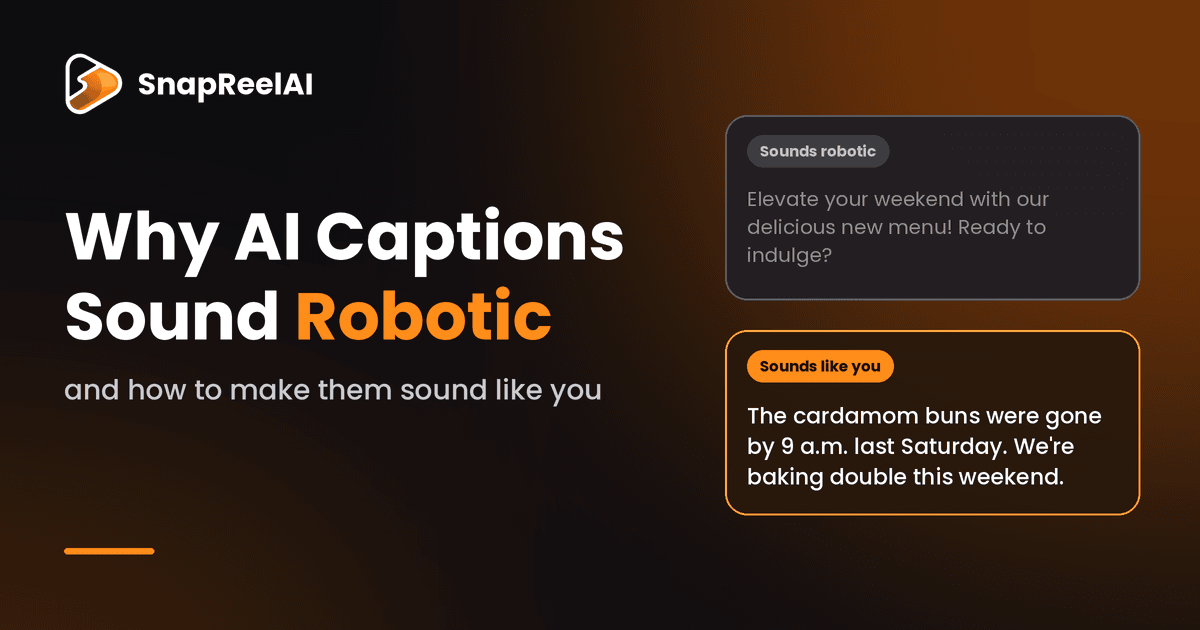
Letting AI erase the voice. This is the 2026-specific mistake. As AI tools become standard in content production, the risk is that the AI default voice — helpful, generic, slightly formal, careful — gradually replaces the brand's actual voice across more and more content. The solution is not to avoid AI. The solution is to treat AI output as a first draft that a human edits back into the brand's voice before publishing.
How to Maintain Brand Voice Across a Team
Brand voice consistency gets harder as the number of people creating content grows. A solo founder can maintain voice intuitively. A team of three needs a system. Here is what actually works.
The foundation is the voice guide document described earlier. But a document alone is not enough — it needs to be used actively, not filed away. The most effective approach is to build a voice review step into the content creation workflow, not as a policing mechanism but as a quality standard everyone understands and applies.
Practical tools that help: a swipe file of your best-performing content that exemplifies the voice at its strongest. New team members can read this before writing anything. Regular voice audits — once a quarter, review a sample of recent content and assess honestly whether it sounds like the brand. Voice workshops where the team writes the same post in the brand voice, then compares and discusses — these build shared understanding faster than any document.
The goal is not rigid rule-following. It is shared intuition. When every person creating content for your brand has a strong internal sense of what the brand sounds like, the voice stays consistent even when the guide is not open in front of them.

Building Brand Voice With AI — The Right Way
AI tools are now a standard part of content production for small brands. The question is not whether to use them — it is how to use them without letting them flatten your voice.
The most effective approach treats AI as a first-draft engine and a human as the voice editor. You prompt the AI with your content brief, generate a draft, and then edit that draft back into your brand voice. The edit is not minor cleanup — it is a genuine rewrite of the tone, word choices, sentence rhythms, and personality markers that the AI cannot replicate on its own.
A more advanced approach feeds the AI your brand voice guide and your best content examples as context before asking it to generate anything. This narrows the gap between the AI's default voice and your actual voice, reducing the editing time. It does not eliminate the gap — but it makes it manageable.
The brands that get this right use AI to produce at scale and humans to maintain quality. The brands that get it wrong let AI produce without human review — and publish content that technically covers the right topics but sounds like nobody in particular. In 2026, "nobody in particular" is the most crowded category on every platform.
Your brand voice is the one asset AI cannot generate for you from scratch. It can help you express it faster. But it cannot define it, cannot feel it, and cannot protect it from erosion if you stop paying attention. That part stays human.
The Long-Term Payoff of an Ownable Voice
Brand voice compounds. The first hundred posts might not feel dramatically different with a strong voice versus without one. The first year might feel like a lot of work for incremental results. But somewhere around the point where an audience member has encountered your brand a dozen times across different platforms and contexts, the accumulation becomes visible — as unprompted recognition, as the kind of trust that shortens the sales cycle, as followers who mention your brand to friends using the same language your brand uses.
That is the moment when voice becomes a genuine business asset. Not a marketing asset — a business asset. When customers trust you before the first interaction because they have absorbed your personality through content, your acquisition costs drop. When your brand is recognizable enough that people tag friends in your posts, your reach expands without paid amplification. When your community uses your language to describe themselves, you have built something no algorithm change can take away.
The investment in brand voice is not immediate. But of all the marketing investments available to a small brand in 2026, it is one of the few that genuinely compounds — and one of the very few that a competitor with ten times your budget cannot simply outspend.
Start with the five-step process. Write the voice mission statement. Build the word list. Document it. And then do the harder, longer work of expressing it consistently across every piece of content your brand touches — until your audience knows you before they see your name.
SnapReel AI helps small brands maintain consistent brand voice across all their social media content at scale — so the personality you work to define shows up in every video, every caption, and every post, automatically, without requiring you to manually review every piece of content before it goes live.