Social Media Moderation for Small Brands — How to Manage Comments, DMs, and Brand Reputation in 2026
SnapReel
May 21, 2026 · 13 min read
Table of Contents
One frustrated customer. One unanswered DM. One comment thread left unmoderated for 48 hours. Any of these can spiral into a brand reputation problem that takes months to recover from — and for a small brand, that is not a hypothetical risk. It is a weekly reality.
Social media moderation in 2026 is no longer a hygiene task. It is real-time reputation management. This guide gives you the exact system small brands use to manage comments, DMs, and brand perception across Instagram and TikTok — without a full community management team.
🎯 KEY TAKEAWAYS
90% of consumers say a brand's online reputation directly influences their buying decision — an unmoderated comment section is an active conversion killer.
Response time is the #1 moderation metric — brands responding to DMs within one hour see significantly higher customer satisfaction and purchase completion rates.
Four moderation types exist — pre-publish, post-publish, community-driven, and AI-powered — and small brands need at least two running simultaneously.
A documented moderation workflow protects your brand from one-off crises and scales as your audience grows without requiring a dedicated team.
Why Social Media Moderation Matters More Than Ever in 2026
Social media moderation has fundamentally changed in 2026. It is no longer about deleting spam or hiding offensive comments. It is reputation triage in real time — and the speed and quality of your response directly determines whether a difficult moment becomes a brand asset or a brand crisis.
The Drum's 2026 analysis puts it clearly: as feeds fill with AI-generated content and bot-driven noise, vanity metrics like reach are losing relevance. What matters now is genuine engagement — and the ability to listen, interpret, and respond at speed. Brands that connect insights to action can turn friction into loyalty. Brands that do not turn friction into public brand damage.
Why does social media moderation matter so much for small brands specifically?
Small brands are more vulnerable to reputation damage from unmoderated social media than large brands because they have fewer touchpoints to counterbalance a negative experience. A single viral complaint on Instagram can reduce brand favorability by 30% or more for a small brand — whereas a large brand with thousands of daily touchpoints absorbs the same complaint with minimal long-term impact. For small brands, every comment section is a reputation moment.
But here is what most small brands miss:
Moderation is not just about protecting your brand from negative content. It is also about capturing the positive signals that build trust faster than any ad campaign. A comment from a happy customer that goes unanswered is a missed opportunity. A comment that gets a fast, genuine response becomes social proof — visible to every future visitor who reads that thread.
💡 PRO TIP: Set a daily 15-minute moderation window — same time every day. Open your comment sections across all platforms, respond to every comment from the past 24 hours, and check your DM inbox. Consistency matters more than speed for small brands managing moderation solo. A reliable 24-hour response time beats an erratic 1-hour response time every time.
The Four Types of Social Media Moderation

What are the different types of social media moderation for small brands?
The four types of social media moderation are pre-publish moderation (reviewing content before it goes live), post-publish moderation (monitoring and managing content after posting), community-driven moderation (empowering your audience to self-regulate), and AI-powered moderation (using automated tools to filter, flag, and route content at scale). Small brands need at least pre-publish and post-publish running simultaneously from day one.
Type 1 — Pre-Publish Moderation
This happens before your content goes live. For small brands, it means reviewing every caption, image, and tag for anything that could be misread, misrepresented, or taken out of context before it reaches your audience.
What to check: Does the caption make a claim you cannot support? Does the image include anything that could be culturally insensitive? Does the post invite a specific type of comment you are not prepared to manage?
Why it matters: Prevention costs ten minutes. Reputation recovery costs weeks.
Best for: Any post making a product claim, showing before/after results, or engaging with a trending topic.
Type 2 — Post-Publish Moderation
This is the ongoing monitoring of your live content — comments, tags, mentions, and replies — after posting. For small brands, this is the highest-leverage moderation type because it is where reputation moments happen in real time.
What to monitor: Every comment on every post for the first 48 hours after publishing. Mentions of your brand name across platforms. DM inbox daily.
Response priority: Negative comments first, questions second, positive comments third.
Time investment: 15 to 30 minutes daily is sufficient for brands posting five to seven times per week.
Type 3 — Community-Driven Moderation
This involves your existing audience doing part of the moderation work for you — responding to questions from other followers, correcting misinformation, and reporting spam before you see it.
How to build it: Recognize and respond to engaged community members publicly. Reply to their comments with genuine engagement. Over time, these members naturally defend the brand and answer questions on your behalf.
Why it scales: Community-driven moderation grows with your audience — the larger your engaged community, the more moderation support it provides automatically.
Type 4 — AI-Powered Moderation
Automated tools that filter spam, hide offensive comments, flag keywords, and route DMs to appropriate response templates before a human ever sees them.
What it handles: Spam, offensive language, competitor mentions, crisis keywords, and repetitive questions.
What it cannot replace: Genuine human judgment on nuanced or sensitive comments that require brand voice and empathy.
Best tools for small brands: Instagram's built-in comment filters, TikTok's keyword blocking, and unified inbox tools like Hootsuite or Agorapulse.
Building Your Comment Moderation System
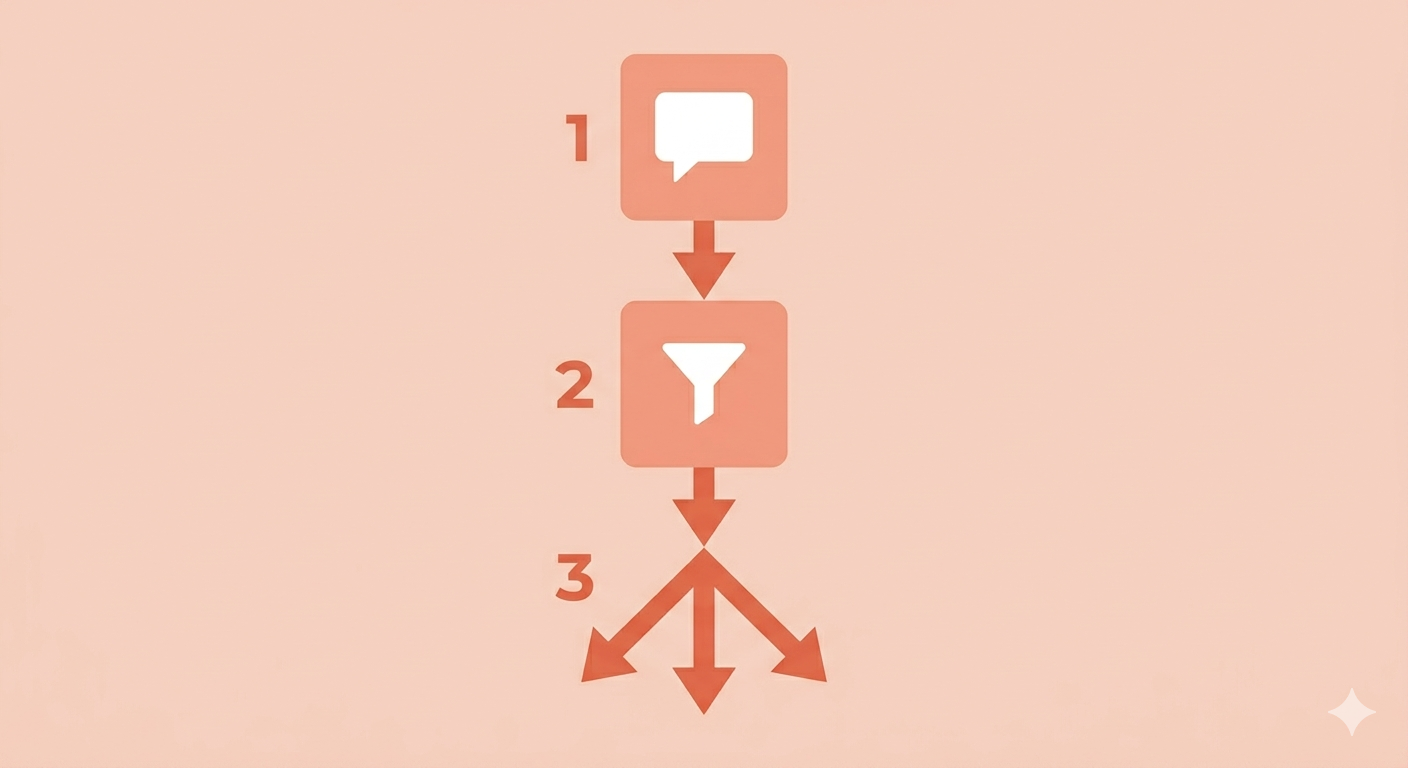
A comment moderation system does not need to be complex to be effective. For small brands, a three-tier classification system handles 95% of comment scenarios without requiring moment-to-moment judgment calls.
Tier 1 — Respond immediately
These comments require a response within one to four hours. They include direct questions about the product, shipping, or pricing; negative experiences shared publicly; comments from first-time followers who are clearly evaluating whether to buy; and any comment that has already received replies from other followers and is developing into a thread.
Tier 2 — Respond within 24 hours
These comments are positive but not urgent. They include general compliments, tag-a-friend comments, and engagement from existing loyal customers. A response within 24 hours is sufficient and still signals genuine brand engagement.
Tier 3 — Hide or delete
These comments add no value and create reputational risk. They include spam, irrelevant promotional comments from other accounts, offensive or hateful language, and deliberate misinformation about your product. Hide rather than delete where possible — hiding removes the comment from public view while preserving it for your review, whereas deleting it permanently removes the ability to reference it if a dispute escalates.
Here is the kicker:
The classification itself takes ten seconds per comment once you have internalized the three tiers. The slow part is not deciding what to do — it is building the habit of checking consistently. Set a phone reminder for your daily 15-minute moderation window and protect it the same way you protect time for fulfillment or customer service.
Consistent content keeps your community growing.
Create AI-powered videos and auto-post to all your platforms.
SnapReel AI posts your branded content automatically every day — keeping your audience engaged and your comment sections active without requiring daily manual effort.
No credit card required • 2-min setup • 2,000+ small brands already using it
DM Management — The Small Brand Playbook
Direct messages are where buying decisions get made. A potential customer who DMs your brand with a question is already 70% of the way to a purchase — they have found your product, they are interested, and they need one more piece of information or reassurance to convert. An unanswered DM is an abandoned sale.
The small brand DM management system has three components: a response time standard, a pre-approved response library, and an escalation path for complex situations.
Response Time Standard
Set a clear internal standard for DM response time and communicate it publicly in your bio or story highlights. "We reply within 24 hours" sets an expectation you can meet. "We reply within 1 hour" sets an expectation that will damage your reputation when you inevitably miss it on a busy day.
For small brands operating without a dedicated social media manager, a 4 to 8 hour response time during business hours is realistic and still strong enough to capture purchase intent before it cools.
Pre-Approved Response Library
Create a bank of 10 to 15 templated responses for the most common DM scenarios — shipping questions, product questions, returns, wholesale inquiries, collaboration requests, and complaint DMs. Each template should be written in your brand voice and designed to be personalized with one or two specific details before sending.
The goal is not to send copy-paste responses. The goal is to have a starting point ready so you are never composing a response to a common question from scratch under time pressure.
Escalation Path
Some DMs require more than a standard response — an angry customer, a press inquiry, a potential partnership, or a complaint involving a significant order. Define in advance which scenarios get escalated, to whom, and within what timeframe. For a solo founder, escalation might simply mean moving the conversation to email where you have more space to respond thoughtfully.
Now you might be wondering:
What do you do when a DM contains a complaint that is genuinely your fault — a shipping delay, a defective product, a miscommunication? The answer is the same every time: acknowledge it immediately, take full responsibility without qualifications, and offer a specific resolution in the same message. Do not ask for more information before offering to help. The speed and specificity of your resolution offer is what determines whether the customer stays or leaves.
Handling Negative Comments and Brand Reputation Threats

Negative comments are inevitable for any brand with an active social media presence. The question is never whether you will receive them — it is whether your response strategy turns them into trust signals or amplifies the damage.
The 2026 reality is that how a brand responds to a negative comment is now as visible and as consequential as the original complaint. Potential customers actively read negative comments and the brand's response before making a purchase decision. A well-handled negative comment is, paradoxically, one of the strongest trust signals a brand can produce.
The Response Framework for Negative Comments
Every negative comment response follows the same four-step structure regardless of how unfair or inaccurate the complaint is.
Acknowledge — Validate that the person had a bad experience. Do not argue with the facts of their complaint in a public comment. "I'm really sorry to hear this happened" is always the right opening.
Take ownership — Use first-person brand language. "We clearly missed the mark here" is stronger than "mistakes were made."
Move it offline — Invite the person to continue the conversation via DM or email. "Please DM us directly so we can make this right" removes the public thread from escalating further.
Follow up publicly — Once the issue is resolved via DM, return to the original comment with a brief public note: "Glad we could sort this out — thank you for giving us the chance to make it right."
What does that mean for your brand?
It means the negative comment thread becomes a public demonstration of your customer service quality — visible to every future visitor who reads it. Brands that handle negative comments well in public consistently report stronger conversion rates from social media than brands with perfectly clean comment sections, because the handled complaints prove the brand is real, accountable, and genuinely cares.
A consistent brand presence builds the trust that converts.
Create AI-powered videos and auto-post to all your platforms.
SnapReel AI keeps your brand posting consistently every day — so your audience stays engaged, your community stays active, and your reputation stays strong.
No credit card required • Free forever plan • 2-min setup
FAQ
Responding within 1 to 4 hours to questions and negative comments is the gold standard. For general engagement comments, within 24 hours is sufficient. The first 48 hours after posting are the highest-priority moderation window — algorithmic distribution is most active during this period and comment engagement directly influences reach.
Hide rather than delete in most cases. Hiding removes the comment from public view without permanently destroying the record. Delete only for spam, hate speech, or content that violates platform community guidelines. Deleting a legitimate negative comment and being called out for it publicly causes significantly more reputation damage than the original complaint.
Response rate and response time are the two most important DM metrics. Instagram and TikTok both display your average response time publicly on business profiles. A displayed response time above 24 hours reduces DM conversion rates because potential customers assume they will not get a timely answer to their pre-purchase question.
Acknowledge the situation publicly within two hours of identifying it. Do not go silent. Silence is consistently the worst crisis response — it allows the narrative to develop without your input. Issue a brief, honest statement in the comments of the original post and in your stories. Move detailed responses to DMs or a dedicated story highlight. Follow up once the situation is resolved with a transparent account of what changed.
Native platform tools — Instagram's comment filters and TikTok's keyword blocking — are sufficient for brands posting fewer than 20 times per week with comment volumes under 50 per day. Above that threshold, a unified inbox tool like Hootsuite or Agorapulse reduces daily moderation time by 40 to 60% by consolidating all platforms into one dashboard.
The Bottom Line
Social media moderation is not the glamorous part of running a brand's social media presence. It does not generate the same excitement as a viral Reel or a strong month of follower growth. But it is the part that determines whether your audience trusts you enough to buy from you — and keeps trusting you after they do.
The brands with the strongest social media reputations in 2026 are not the ones with the most followers or the most polished content. They are the ones whose audiences know they will get a real response, a fast answer, and a genuine resolution when something goes wrong. That reputation is built one comment and one DM at a time — and it compounds into the kind of brand loyalty that no ad budget can buy.
SnapReel AI handles the content creation side automatically — consistent daily posts that keep your community engaged and give your audience something to respond to. The moderation system in this guide handles the conversation side. Together, they give your brand the presence and the responsiveness that build real trust at scale.
Ready to build a brand your audience trusts and comes back to?
Create AI-powered videos and auto-post to all your platforms.
✓ Consistent daily content keeps your community active and engaged
✓ Branded Reels generated automatically from your product
✓ Auto-posts to Instagram, TikTok, and YouTube Shorts on your schedule
Free forever plan • No credit card • 2-min setup