What Is UGC — And How Small Brands Are Turning Their Customers Into Their Most Powerful Marketing Team in 2026
SnapReel
May 18, 2026 · 13 min read

Table of Contents
Your brand produces content every week.
You write captions. You design graphics. You film videos. You craft the message, choose the angle, and push it out across your platforms. And all of that content carries an invisible label that your audience reads in under a second — this is what the brand wants us to think about them.
Now consider what happens when a customer posts a photo of your product on their own account, unprompted. Or writes a detailed review explaining exactly how your product solved a specific problem they had been dealing with for months. Or films a thirty-second video showing themselves using what they bought, sharing their honest reaction with their followers.
That content carries a completely different label — this is what a real person actually thinks.
93% of marketers say UGC performs better than brand-generated content. 93% of customers believe user-generated content is very helpful when making a purchasing decision. UGC is seen as eight times more effective than influencer content in decision-making. COSMarketing Agency + 2
These numbers reflect something that every experienced marketer understands intuitively — the most persuasive thing a brand can show a potential customer is another customer who bought the product and is genuinely happy they did.
In 2026, the brands building systematic UGC strategies are not just collecting social proof. They are building a content engine powered by their own customer base — an engine that costs a fraction of traditional content production, converts at dramatically higher rates, and becomes more powerful with every customer who joins it.
This guide explains what UGC actually is in 2026, why it matters more now than it ever has, and exactly how small brands are building the systems to generate, capture, and deploy customer content across every stage of the buyer journey.
What UGC Actually Is — And What It Is Not
User-generated content is any content created and shared by real customers about your brand, product, or experience — rather than content created by the brand itself.
In practice, this includes a wide range of content types. Written reviews on your website, Google, or third-party platforms. Photos customers post on Instagram showing your product in use. TikTok videos where someone shares an unboxing, a before-and-after, or a daily routine featuring your product. YouTube videos reviewing or comparing your product. Comments and replies on social posts. Stories tagged with your brand. Reddit threads where your product is discussed. Direct messages customers send to friends recommending what they bought.
All of it is UGC. And all of it carries the fundamental characteristic that makes it so powerful — it comes from a real person with a real experience, not from a brand with a product to sell.
What UGC is not, in 2026, is content produced by paid influencers reading from a brief. Brands are shifting from big-name influencers to small, trusted creators under ten thousand followers — their content feels more relatable and authentic. But even micro-influencer content, when it is sponsored and scripted, is not the same as genuine UGC. The distinction consumers make is between content that comes from someone who bought the product and wanted to share their experience versus content that comes from someone who was paid to appear enthusiastic about it. Taboola
That distinction is becoming more important, not less, as AI-generated content floods social feeds in 2026. Eighty percent of consumers see peers — real customers, creators, and everyday users — as the most credible source of brand information. In a landscape increasingly saturated with artificial content, genuine human voices stand out with a clarity that no brand-produced content can replicate. LTX Studio

Why UGC Matters More in 2026 Than It Ever Has Before
The case for UGC has been building for years. But several specific developments in 2026 have made it more urgent and more strategically important than at any previous point.
The AI Content Flood Is Making Authenticity Scarce
AI tools have made it possible for any brand to produce an enormous volume of content at minimal cost. The result is a social media landscape increasingly flooded with content that is technically polished but humanly hollow — captions that follow the same patterns, videos that hit the same beats, and messaging that sounds like every other brand in the category.
52% of shoppers distrust unverified reviews, and brands prioritizing UGC see sustained engagement as platforms favor real user voices over polished ads. LTX Studio
In this environment, genuine customer content does not just perform better than AI-generated brand content. It stands out against a backdrop where almost everything else is AI-generated brand content. The scarcity of authentic human voices in 2026 makes each piece of real UGC more valuable, not less.
Platform Algorithms Are Rewarding Real Content
Every major platform in 2026 is explicitly prioritizing content that feels native and authentic over content that looks like advertising.
UGC is the best-performing content type on TikTok at 56%, followed by educational content at 16% and branded challenges at 13%. The algorithm reads signals that distinguish real customer content from produced brand content — the natural camera movement, the unscripted language, the authentic reaction — and distributes real content more broadly because it generates more genuine engagement. WordStream
For small brands with limited advertising budgets, this algorithmic preference for authenticity is a structural advantage. A piece of genuine customer content can outperform a produced brand video not because it is better made, but because the platform recognizes it as real and distributes it accordingly.
UGC Converts at Rates That No Brand Content Matches
The conversion data on UGC is striking regardless of which study you consult.
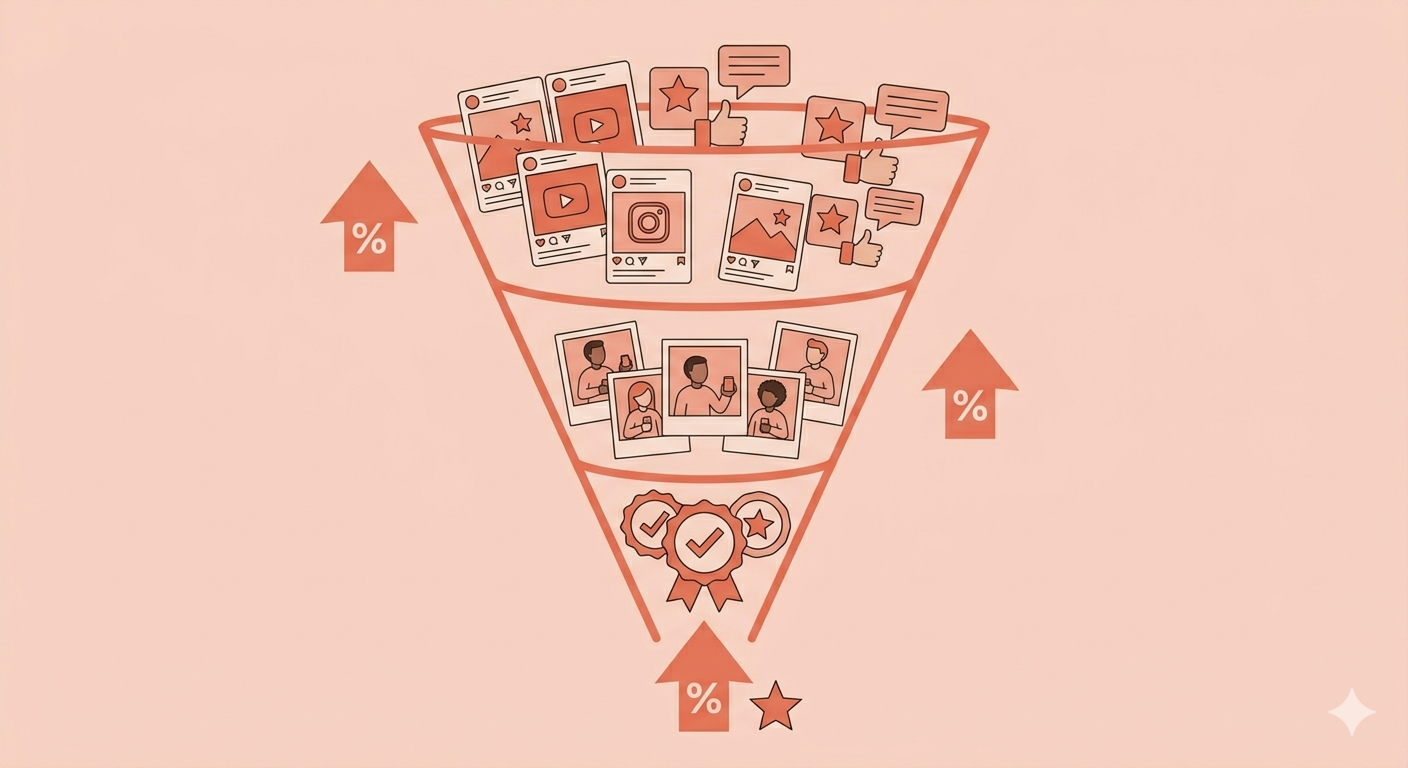
UGC increases conversions by 161% when included on e-commerce product pages. Product pages featuring customer content convert 74% higher than pages without it. Visitors who interact with UGC convert approximately 102% higher than the site average. Bsky Blog + 2
40% of shoppers say they will abandon a purchase entirely if there is no UGC or reviews available for the product. This is not a marginal preference — it is a significant portion of potential customers who will not complete a purchase without seeing real customer content first. LTX Studio
For small brands, this means that every piece of genuine customer content deployed on product pages, in advertising, and across social channels is not just good content marketing — it is a direct conversion optimization tool.
The Four Types of UGC Every Small Brand Should Be Collecting
Not all UGC serves the same purpose in a marketing strategy. Understanding which types of customer content drive which outcomes helps small brands prioritize their collection and deployment efforts.
Reviews and Written Testimonials
Written reviews are the foundation of any UGC strategy. Shoppers rank reviews at 78%, Q&As at 77%, and photos by real users at 69% as the most impactful types of UGC for their purchase decisions. Bsky Blog
Reviews work because they are specific. A customer who writes that your skincare product cleared their hormonal breakouts after two weeks of consistent use is providing information that no brand-produced content can credibly deliver. It is a real outcome from a real person — and that specificity is what makes it persuasive.
For small brands, the priority is getting reviews in the right places. Your own website product pages. Google Business Profile. Any third-party platform your category uses — Trustpilot, G2, Yelp, or category-specific review sites. The more places a potential customer can find genuine customer reviews before making a decision, the higher the conversion rate from every touchpoint in your marketing funnel.
Customer Photos and Videos on Social Media
Social UGC — the photos and videos customers post on Instagram, TikTok, and YouTube showing your product in their real life — is the highest-visibility form of customer content and the one with the greatest potential for organic reach.
Instagram posts with UGC garner 70% more engagement than brand-only content. UGC video ads show 35% higher watch-through rates compared to polished brand ads. RecurPostWordStream
When a customer posts about your brand on their own account, their followers see it — an audience that your brand has not paid to reach and may never have reached through your own content. Each piece of organic social UGC is effectively free brand exposure with a built-in credibility signal, delivered to an audience that already trusts the person sharing it.
Unboxing and Product Experience Videos
Unboxing videos and product experience content occupy a specific and highly effective position in the UGC ecosystem. They answer the question potential customers are most anxious about — what is the actual experience of receiving and using this product like, before you have bought it and cannot return it?
YouTube UGC generates twelve times more impressions and seventeen times more engagement than equivalent brand content on the platform. Product review and unboxing videos on YouTube receive three times longer watch time than traditional ads — because viewers are genuinely seeking information, not entertainment. WordStream
For small brands with physical products, encouraging customers to film their unboxing experience and share it on YouTube or TikTok creates content that serves as persistent social proof — searchable, discoverable, and available to every potential customer who searches for your brand or product category before making a purchase decision.
Community Content and Brand Mentions
The least visible but often most influential form of UGC is the conversational content that happens in communities — Reddit threads where your product is discussed, Facebook group recommendations, Discord conversations, and Twitter or Bluesky mentions where your brand comes up organically.
This content rarely drives direct traffic to your website. But it shapes how your brand is perceived by people who are actively researching a purchase decision in the communities they trust most. And as AI systems increasingly cite community platforms like Reddit in their generated answers, community UGC is also becoming an important AEO signal — genuine customer voices in trusted communities are exactly what AI systems look for when deciding which brands to cite.
How Small Brands Actually Get More UGC — The Practical System
Understanding why UGC matters is not the same as having a system to generate it consistently. Most small brands get occasional organic UGC from happy customers — but occasional is not a strategy.
The brands building significant UGC libraries in 2026 are doing so through deliberate systems, not by waiting and hoping customers will share spontaneously.
Make the Ask at the Right Moment
The most important variable in UGC generation is timing. Asking a customer to share their experience at the wrong moment — before they have received the product, or weeks after when the excitement has faded — produces far lower response rates than asking at the peak of their experience.
The right moment is immediately after the customer has had their first positive experience with your product. For physical products, that is one to three days after delivery. For services, it is immediately after the first result or completed session. For digital products, it is after the first successful use.
SMS review requests still command attention in 2026 — when a customer receives a review request via email, it often sits in a promotions tab. SMS creates an immediate impulse response. The channel through which you make the ask matters as much as the timing. Bsky Blog
Give Customers a Simple, Clear Action to Take
The biggest barrier to UGC generation is not customer unwillingness — it is friction. Customers who had a great experience often intend to share it but never do because the path from intention to action is unclear or effortful.
Reduce that friction to its absolute minimum. Give customers a direct link to the exact review platform where you want them to leave a review. Create a simple hashtag they can use when posting on social media. Send a one-tap option that opens the review form pre-filled with their purchase details. The easier the action, the higher the completion rate — regardless of how motivated the customer is.
77% of consumers are open to submitting UGC to receive a reward. A small incentive — a discount on their next purchase, entry into a monthly giveaway, being featured on your brand's social page — significantly increases response rates without compromising the authenticity of the content customers share. HubSpot
Create a Repeatable Repurposing Workflow
Collecting UGC is only half the system. The other half is deploying it consistently across the touchpoints where it drives the most impact.
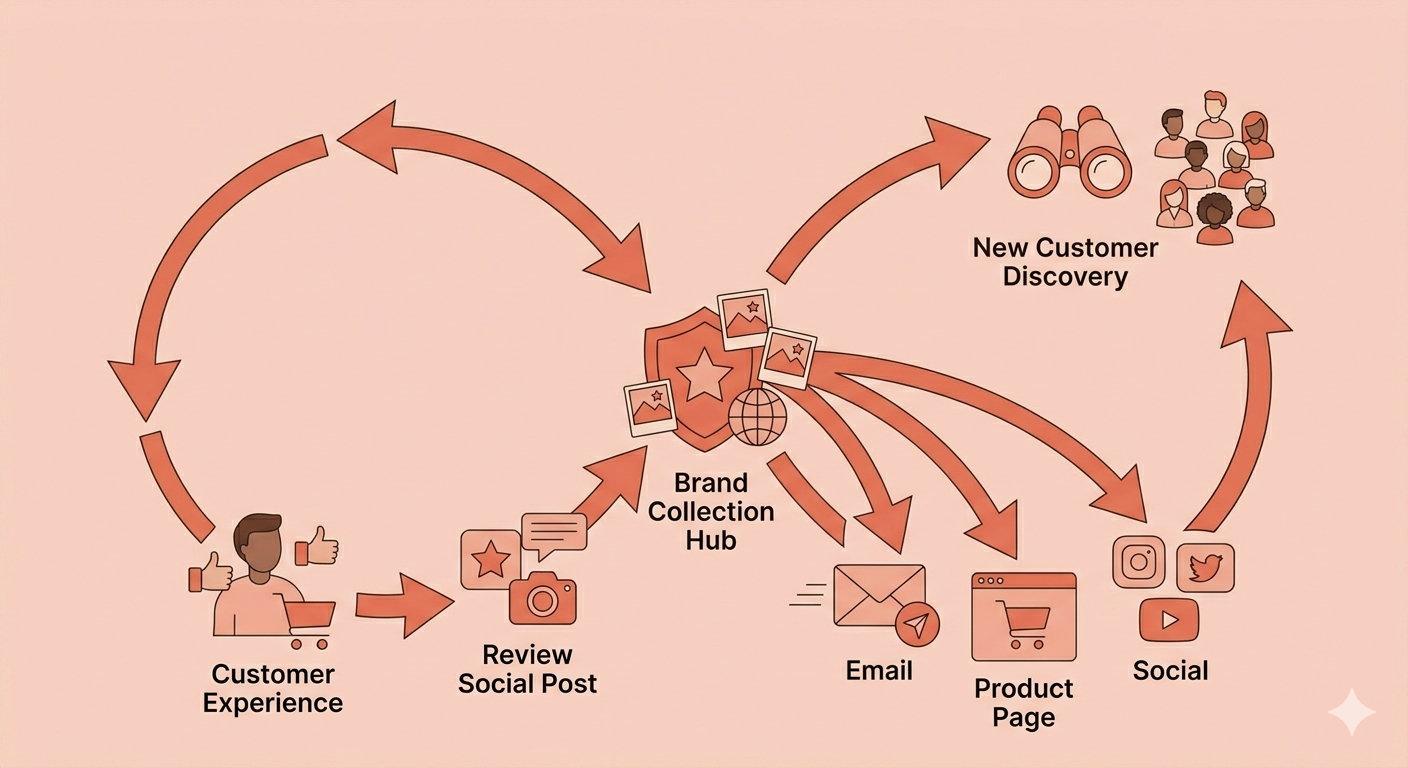
Every piece of genuine customer content should be assessed for where it fits in your marketing — product page social proof, social media reposts, email marketing testimonials, or advertising creative. The brands generating the most value from UGC are not just collecting it — they are running a systematic process of reviewing new customer content weekly and routing it to the correct deployment channel.
64% of customers say that when a brand reposts their content, they are more likely to share content about that brand again — creating a powerful loyalty loop. Repurposing UGC is not just a distribution strategy — it is a UGC generation strategy, because recognition is one of the strongest incentives for customers to create more content. LTX Studio
Pair your UGC strategy with daily branded content that keeps your feed active between customer posts.
Put these tips into action — start creating with SnapReel for free.
Where to Deploy UGC for Maximum Impact — The Full-Funnel Strategy
Collecting UGC and posting it occasionally on your Instagram account is the minimum viable version of a UGC strategy. The brands building significant competitive advantages from customer content are deploying it across every stage of the buyer journey.
On your website, UGC belongs on product pages above the fold — not buried at the bottom where most visitors never scroll. Customer photos alongside product images, review snippets next to pricing, and video testimonials on key landing pages all reduce purchase hesitation at the exact moment a potential customer is deciding whether to buy.
In your paid advertising, UGC creative consistently outperforms produced brand creative on every major platform. Ads with UGC get four times higher click-through rates and fifty percent lower cost per click compared to non-UGC ads. For small brands with limited advertising budgets, this efficiency advantage means the same spend goes significantly further when UGC is the creative. Bsky Blog
In your email marketing, customer testimonials and photos increase credibility and reduce unsubscribe rates. Campaigns featuring real customer content generate meaningfully higher click-through rates than product-only email campaigns — because the human element creates connection that product photography alone cannot.
On social media, repurposing customer content fills your content calendar with material that performs better than most brand-produced content, at a fraction of the production cost. Every piece of genuine UGC you repost is authentic content your audience trusts more than anything your team produced themselves.
SnapReel AI identifies your highest-performing content and helps you build the repurposing workflow that turns customer moments into consistent marketing output — so the UGC your customers create gets deployed across every platform where it can drive growth, automatically, without your team spending hours manually routing content from collection to publication.